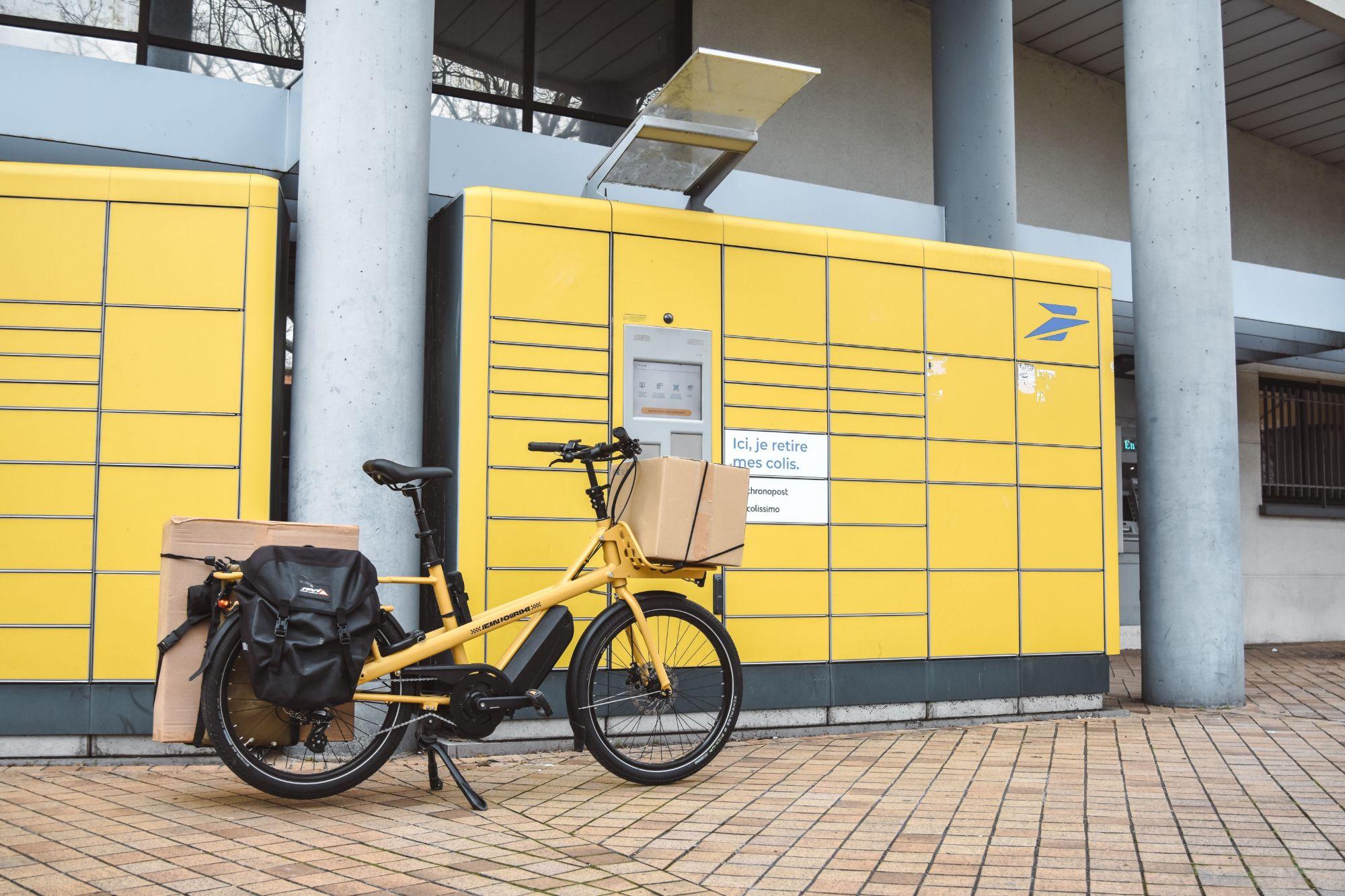
Cut last-mile emissions with parcel pick-up points
 Trendyol
 SKD Türkiye
Summary
Parcels are consolidated at neighbourhood pick-up points and lockers, cutting last-mile travel distance, repeat delivery attempts, fuel use and the associated emissions.
Context
Submitted through the COP31 Sustainable Transformation Awards · SKD Türkiye (WBCSD Global Network Partner)
Growth in order volume has a direct physical consequence in last-mile delivery. As order volumes increase, the number of delivery stops and total kilometres travelled also increase. A share of those parcels cannot be handed over on the first attempt because the recipient is not at the address. Each failed attempt generates a repeat visit, which lengthens the round, raises fuel consumption and increases the greenhouse gas emissions attached to the final delivery leg.
The conventional response is to add capacity: more couriers, more vehicles, more route hours. That scales the problem rather than solving it, because the number of individual door-to-door stops keeps rising with volume.
The adopting company's approach is to change the shape of the last leg instead. Deliveries are consolidated at pick-up and drop-off points, so a single courier stop serves two or more parcels rather than one address, and the recipient collects at a time that suits them.
The model was launched in 2021 and now runs as an established delivery option rather than a pilot, with a network of more than 10,000 pick-up points covering all 81 provinces of the country and combining neighbourhood shops acting as collection points with smart lockers. It handles an annual average of 13 million collected deliveries. Environmental and operational performance is monitored and reported through the company's sustainability disclosures (1).
Location of the initiative: 81 provinces across Türkiye
Solution
The model rebuilds the final delivery leg around consolidation points instead of individual doorsteps.
Two kinds of point make up the network. Neighbourhood shops act as staffed collection points, using counter space they already have, while smart lockers provide unstaffed collection where no suitable shop is available or where demand justifies dedicated equipment. Together they cover settlement types ranging from dense metropolitan districts to rural towns.
Orders are routed to a point when the customer selects that option at checkout, so consolidation is driven by customer choice rather than imposed on the delivery. The courier then makes one stop for all parcels destined for that point, and the recipient collects within the opening hours of the shop or at any time in the case of a locker.
The operating logic is that the number of stops, not the number of parcels, drives round length. Replacing many door-to-door stops with one consolidated stop shortens the round, and because the parcel waits at the point instead of returning to a depot, the repeat visit that a failed attempt would have generated disappears entirely.
The network is deliberately built on partners rather than on owned property. Local shops and contracted delivery partners supply the physical footprint, which keeps additional infrastructure requirements low and allows coverage to expand wherever delivery density justifies it.
Environmental and operational performance are managed on the same reporting cycle. Delivery distance, fuel consumption, first-attempt success and point utilisation are tracked together, and location planning uses that data to decide where points are opened, expanded or closed.
Figure 1: Conventional door-to-door delivery compared with delivery to a pick-up point or locker: fewer stops, no repeat attempts, shorter travel distance, and lower fuel consumption and emissions.

Impact
Sustainability Impact
Climate
The initiative targets the diesel burned in the final delivery leg. Where the round is operated by the group's own logistics fleet the reduction sits in Scope 1; where it is operated by contracted delivery partners it sits in Scope 3, Category 4: upstream transportation and distribution.
The effect is quantified with a purpose-built methodology based on 2026 operations, which is the baseline period for the calculation. Because delivery records are held at shipment level rather than customer level under the personal data protection law, the distance a collected parcel would have travelled to the door is not available in the operating systems. That gap was closed with a representative sample of 1,200 deliveries, drawn from different cities and different periods, in which the customer first selected a pick-up point and then changed the order to home delivery. Three coordinates were fixed for each of them: the last-mile operation site the courier departs from, the pick-up point first chosen, and the home address substituted afterwards. Using public mapping data and an analysis method supported by artificial intelligence, the actual road distance from the operation site to the pick-up point was compared with the distance from the operation site to the home address, so the same shipment was measured under both delivery scenarios.
On that comparison, pick-up points shorten the last-mile distance by an average of 550 metres per delivery, approximately 10 per cent, because they sit in central locations such as shopping centres, fuel stations and neighbourhood shops.
Scaled to the annual average of 13 million collected deliveries, the saving amounts to approximately 7 million kilometres of courier driving avoided each year. Applying the average urban fuel consumption of the light commercial vehicles used in last-mile operations, 6 litres per 100 km, gives approximately 420,000 litres of diesel not consumed. Converted in line with GHG Protocol principles using 2025 DEFRA emission factors, at 2.512 kgCO2e per litre of diesel, the avoided emissions are 1,055 tonnes CO2e a year.
The reduction comes from two effects that act together. Parcels destined for the same neighbourhood are served by a single stop instead of several, and parcels that would have failed on the first attempt are collected by the recipient rather than triggering a repeat visit and a second journey.
Because the network covers more than 10,000 points across 81 provinces, the effect applies across settlement types rather than only in dense urban districts where consolidation is easiest.
Impact is monitored through last-mile delivery distance in kilometres, fuel consumption in litres, transport greenhouse gas emissions in kgCO2e, average distance per delivery in kilometres, and the percentage environmental saving attributable to collection.
All deliveries within the PUDO network are carried out by third-party logistics partners, and the company does not operate its own delivery fleet. Accordingly, the avoided emissions resulting from this initiative are fully accounted for as Scope 3 (GHG Protocol Category 4: Upstream Transportation and Distribution). No Scope 1 emissions reduction is attributed to this project.
Nature
Fewer courier vehicle movements in residential streets reduce local air pollutants and noise along delivery routes, and lower the traffic load that rising delivery density adds to city centres.
Smart lockers and shop-based collection points occupy existing buildings and existing counter space, so the network expands without new logistics property being built and without the land take that would accompany it.
Removing repeat delivery attempts also removes the handling and vehicle wear associated with parcels that would otherwise circulate through the network more than once before reaching the customer.
Social
Neighbourhood shops serving as collection points are brought into the digital commerce ecosystem and receive additional footfall from customers collecting parcels, which supports small local businesses instead of displacing them.
Customers gain control over when and where they collect, which matters most for people who are not at home during standard delivery hours and who would otherwise face repeated failed attempts.
Couriers work shorter and more predictable rounds, because consolidated stops replace a long tail of individual addresses and the failed attempts attached to them.
Business Impact
Benefits
Consolidation raises the productivity of the delivery round. A courier serving one point instead of many addresses completes more parcels per hour, which increases the capacity of the existing fleet without adding vehicles or route hours.
Fuel consumption falls by approximately 10 per cent on the affected volume, which corresponds to approximately 420,000 litres of diesel a year that is not bought, and removing repeat delivery attempts eliminates the cost of handling parcels that would otherwise pass through the network more than once.
The network scales at low marginal cost because it uses counter space in existing shops and the operations of existing partners rather than new logistics property, so growth in coverage does not carry proportional capital expenditure.
Customer experience improves through choice of collection time and location, which supports order volume, while neighbourhood shops acting as collection points earn additional income and footfall, which makes the partner relationship commercially self-sustaining rather than dependent on subsidy.
The estimated fuel savings were derived from the calculated reduction in travel distance, using assumptions for average vehicle fuel consumption. As the project represents avoided fuel consumption and the associated avoided carbon emissions, rather than actual fuel purchased, there are no fuel invoices or financial records directly evidencing these savings. If required, an indicative financial value can be estimated by applying an appropriate reference fuel price; however, this should be considered an assumption-based estimate rather than an actual realised financial saving.
Costs
The investment is in smart locker equipment, the technology that integrates points into order routing and tracking, the commercial terms agreed with shops and contracted delivery partners, and the customer communication required to make collection a familiar choice.
Operating cost shifts rather than disappears. Fuel and route hours fall, while payments to collection partners, locker maintenance, parcel storage handling at the point and network management all rise.
The saving depends on density. A point serving few parcels does not consolidate enough volume to shorten the round, so the case holds only where location planning puts points where demand exists. Data-driven location planning is used to manage that risk.
The second dependency is customer behaviour. The reduction is realised only on the share of orders where the customer chooses collection, so adoption rate determines the size of the benefit and it changes slowly, which is managed through customer communication.
A third dependency is the partner network itself. Collection points are independent businesses, so service quality and continuity have to be secured through long-term agreements rather than assumed, and regional point density has to be managed actively.
Impact Beyond Sustainability And Business
Co-benefits
The network gives small neighbourhood businesses a paid role in digital commerce logistics and additional customer traffic, which is an economic benefit in districts where retail footfall has moved online.
City logistics improves as a side effect. Fewer vehicle movements per parcel delivered reduce congestion contribution in residential streets, which is a benefit to the municipality rather than to the operator.
The same infrastructure carries returns as well as outbound parcels, so a customer can hand back an item at the point that delivered it, which consolidates the reverse leg on the same principle.
The model also increases operational resilience. When a round is disrupted, parcels held at a point remain available to the customer instead of being returned to a depot and re-dispatched.
Potential side-effects
Consolidation transfers part of the final journey to the customer, and the calculation covers the courier leg only: the avoided distance is measured from the last-mile operation site to the pick-up point against the same site to the home address, without netting off any travel the customer makes to collect. If customers drive specifically to collect, part of the saving reappears as private vehicle distance. Siting points where people already go, in shopping centres, fuel stations and neighbourhood shops, together with location planning based on order density, is what keeps that trade-off favourable, and it has to be applied deliberately rather than assumed.
Collection points are small businesses with limited storage. Parcel volume at a point has to be capped to the space available, or service quality falls and the shop withdraws from the network.
Smart lockers carry their own manufacturing and electricity footprint, which offsets part of the saving in locations where the parcel throughput is low, so lockers are best placed where demand is already dense.
Adoption also changes slowly. Customer habits shift over years, not quarters, which means the model has to be run alongside door-to-door delivery for an extended period rather than replacing it.
Implementation
Typical Business Profile
The model suits e-commerce marketplaces, parcel carriers and retailers that run a last-mile delivery operation of their own or through contracted partners, and that face a measurable rate of failed first delivery attempts.
It is most relevant for operators with enough order density to consolidate several parcels at one point, and with an existing network of small businesses or franchise partners that can host collection without new property investment. Sectors beyond e-commerce and parcel delivery, including retail, fast-moving consumer goods, electronics and health products, can use the same structure wherever a final delivery leg exists.
Delivery engages last-mile operations, product and technology, network planning, commercial partnership management and the sustainability function, working to one shared performance cycle.
Approach
Map failed deliveries and round length by district: Record first-attempt failure rates, repeat visits and distance driven per district, so the areas where consolidation removes the most distance are identified before any point is opened.
Recruit collection points from existing local businesses: Sign neighbourhood shops that already have counter space and daily opening hours, so the network expands without new property investment and the host business gains footfall in return.
Add lockers where a staffed point does not fit: Install smart lockers in high-density locations and where no suitable shop is available, to provide collection outside shop hours and to absorb volume that a counter cannot hold.
Integrate the point into order routing: Offer collection as a checkout option, connect point capacity to the routing system, and give the customer tracking and a collection notification, so consolidation follows customer choice rather than being imposed.
Consolidate the round on the point rather than the address: Change route planning so all parcels for a point are delivered in a single stop, and remove the repeat visit that a failed door-to-door attempt would otherwise trigger.
Plan locations from delivery data: Use order density, failure rates and point utilisation to decide where to open, expand or close points, because a point below the density threshold does not shorten the round and adds handling cost.
Measure the counterfactual, not only the round: Track delivery distance, fuel consumption, collection adoption and point utilisation on one reporting cycle, and where records are held per shipment rather than per customer, build the comparison from a random sample of orders that switched from collection to home delivery, measuring the road distance from the operation site to the point against the operation site to the address, then scale the average saving to annual volume and convert it into fuel and emissions with published factors.
Manage the partner network for continuity: Agree long-term terms with collection partners and contracted delivery partners, collect feedback from customers, field operations and partners, and feed it back into network design and service standards.
Stakeholders Involved
Project leads: The model is sponsored by the senior management of the group's logistics business as part of its growth, operational excellence and sustainability strategies, and is run through the coordination of the relevant business units rather than by a standalone project team. Operational performance indicators and environmental impact data are reviewed on a regular cycle, and expansion decisions follow from those reviews rather than from a fixed rollout plan.
Company functions: Operations and last-mile teams run the delivery model, product and technology teams build the routing, capacity and tracking integration, and the sustainability team calculates and reports the environmental effect. Order creation, delivery planning, network management, technology development, performance tracking and impact analysis are managed as one governance cycle rather than as separate work streams, which is what keeps environmental and operational targets aligned.
Main providers: Contracted delivery partners and suppliers operate part of the last-mile infrastructure and carry out the rounds. Equipment suppliers provide the smart lockers. Relationships are managed through long-term agreements, because the continuity of the collection network depends on partners remaining in the system and maintaining service standards at the point of handover.
Other: Neighbourhood shops act as collection points, joining the digital commerce ecosystem and receiving additional footfall in return. Customers take part by choosing collection at checkout and by giving feedback on the experience, which is used to improve the network and the user journey. Local communities benefit from reduced delivery traffic in residential streets, and local administrations from lower vehicle movement per parcel delivered.
Key Parameters To Consider
The benefit is proportional to consolidation density. Distance is saved only where several parcels for the same point are carried in one stop, so a threshold of orders per point per day has to be met before the case holds.
Adoption rate is the second variable. The reduction applies to the share of orders routed through collection, so the headline percentage describes the affected volume rather than the whole delivery operation.
The measurement basis matters when the result is read. The per-delivery saving of 550 metres is measured on a sample of 1,200 real deliveries drawn from 2026 operations, and the annual figures of 7 million kilometres, 420,000 litres and 1,055 tonnes CO2e are that average scaled to the annual average of 13 million collected deliveries, using a single fuel consumption assumption of 6 litres per 100 km for light commercial vehicles.
The network mixes staffed shops and unstaffed lockers deliberately, because each covers a settlement type the other cannot serve economically. Metropolitan districts, small towns and rural areas therefore require different point mixes.
The main risks are the pace of change in customer habits, regional point density and the sustainable management of the partner network, and they are handled through data-driven location planning, customer communication and long-term partner agreements.
Implementation And Operations Tips
Site points where people already go. The environmental case depends on collection being a short walk or a stop on a journey the customer was making anyway, so proximity and everyday locations matter more than the number of points opened.
Build a counterfactual before claiming a saving. Where shipment-level records make a customer-level comparison impossible, orders that switched from collection to home delivery provide a matched pair for the same parcel, which is what makes the avoided distance measurable rather than assumed.
Measure first-attempt success, not only distance. Failed attempts are the hidden cost in last-mile delivery, and they are the component consolidation removes most completely.
Cap volume per point to the space the host business actually has. Overloading a small shop degrades service quality and costs the network a partner that is difficult to replace.
Make collection a visible choice at checkout rather than a default. Adoption built on customer preference holds, whereas a routed default generates complaints and uncollected parcels.
Use the same reporting cycle for operational and environmental indicators. Where fuel, distance, utilisation and adoption are reviewed together, network planning decisions automatically carry the environmental case with them.