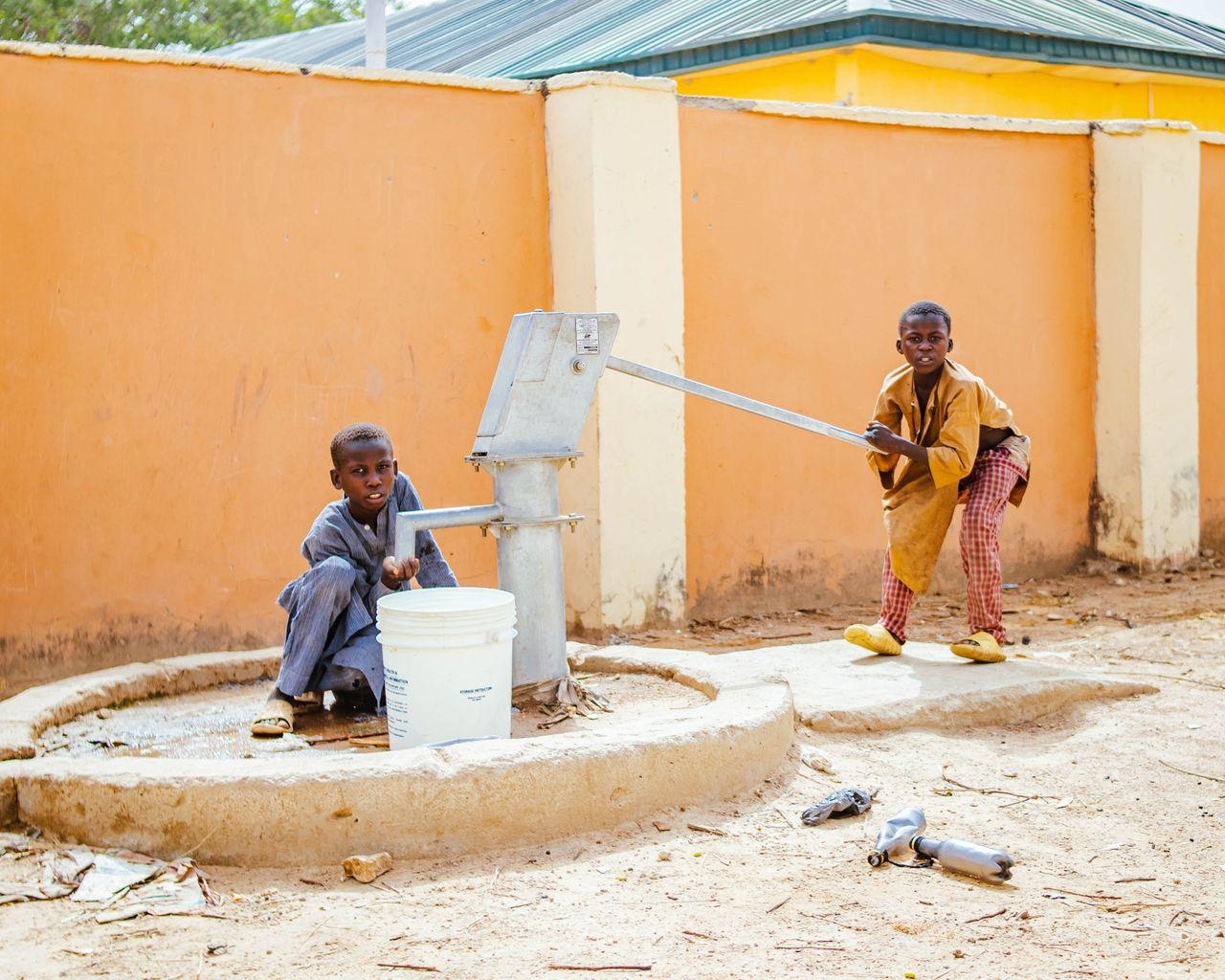
Drill a community well to secure rural water access
 Limak Çimento
 SKD Türkiye
Summary
A 70-metre borehole with a hand pump, a maintenance kit and community training replaced pond, river and open-well water for a rural settlement.
Context
Submitted through the COP31 Sustainable Transformation Awards · SKD Türkiye (WBCSD Global Network Partner)
The company is a cement and construction materials producer with more than 1,000 employees and operations in Africa.
The Bigoane community in the Moamba District of Mozambique had no safe, regularly accessible water point. Households met their water needs from rainwater, ponds, open wells and the Incomati River. These sources carry waterborne disease risk and make hygiene and sanitation conditions difficult to maintain.
The burden of collection falls mainly on women and children. Beyond the physical effort, this consumes time that would otherwise go to school attendance and other activities, and creates safety exposure on the journey to and from the water source.
The intervention was not driven by a legal obligation or a sector standard. It was undertaken to improve basic living conditions in a rural community with limited access to safe water, and it was deliberately designed as more than an infrastructure donation: the water point, the local maintenance capability and the monitoring arrangement were treated as a single package, so that the benefit would continue after the contractors left.
Delivery took place in 2025, with 2024 taken as the baseline year for the pre-project situation. The initiative is tied into the company's sustainability, social impact, community investment and water management priorities rather than being handled as a one-off donation (1).
Location of the initiative: Bigoane community, Moamba District, Mozambique
Solution
The solution is a single protected groundwater point, sized to community demand and handed over with the capability to keep it working.
Site selection followed a geophysical survey rather than local convenience, so that the drilling position was set by where the aquifer could actually be reached. The community's own expectations about where the well should sit and how it should be used were taken into account alongside the survey result.
The borehole was drilled to 70 metres and cased. A manual pump was installed with the pump element set at 63 metres, and the system was commissioned at a yield of 3.2 m3 per hour. A hand pump was chosen deliberately: it removes dependence on grid electricity or fuel supply, which is what usually determines whether a rural water point is still working several years later.
Maintenance capability was transferred with the asset. A maintenance kit and spare materials were supplied so that routine repairs can be carried out without waiting for external support, and the community received training in operating and maintaining the well.
Ownership was transferred rather than merely announced. First contact, site visits and a traditional community ceremony were used to establish that the community is the operator of the resource and not only its beneficiary, which is the point on which community-based rural water schemes usually succeed or fail.
Continuing arrangements complete the model: water quality is checked every three months, the area around the wellhead is protected from contamination, efficient water use is encouraged, and use conditions and needs are observed through direct contact with the community.
Social return on investment was used as an interpretive frame rather than as a calculation standard. It informs how outputs, outcomes and impact are read against each other; it was not used to generate a monetary ratio, and no such ratio is claimed.
Figure 1: Technical Specifications: 70-Meter Borehole Cross-Section

Figure 2: Access to Clean Water: Before and After

Impact
Sustainability Impact
Climate
The initiative is not an emissions reduction measure and no Scope 1, Scope 2 or Scope 3 figure is calculated for it. The five indicators defined for the project are technical and social, and measurement covers the 2025 delivery period against the 2024 baseline year.
Two enabling effects can be described. The pump was specified as a manual hand pump so that the water point does not depend on grid electricity or on a fuel supply, which means the community draws water for the life of the asset without the fuel combustion a powered rural pump would require. And the borehole is an adaptation asset: a protected groundwater source at 70 metres keeps supply available when rainfall is erratic and the ponds, open wells and river the community previously used become unreliable, which is the form climate-driven water stress takes at settlement scale.
The application aligns the work with the goal on climate action on that indirect basis rather than on a measured emissions basis.
Grid electricity required for pumping: 0 kWh
Fossil fuel required for pump operation: 0 L
Direct operational emissions from pumping: 0 kg CO2e
The manual hand pump operates without electricity or fossil fuel. As the surrounding community has no access to grid electricity and no powered pumping baseline was available, avoided GHG emissions were not quantified.
Nature
Replacing surface and shallow sources with a cased 70-metre borehole shifts abstraction away from ponds, open wells and the Incomati River, which reduces pressure on the surface water bodies the community previously relied on and removes the exposure route that open sources create.
The wellhead area is protected from contamination as a standing requirement rather than a construction detail, so that the quality of the abstracted groundwater is defended over time.
Water quality is verified every three months, which converts water safety from a one-off commissioning test into a monitored condition. Efficient water use is treated as part of the community-based management arrangement.
A reliable, protected groundwater point also reduces the community's vulnerability when rainfall is erratic and surface sources become unreliable, which is the practical form that climate-driven water stress takes at settlement scale.
Social
The Bigoane community numbers 517 people in approximately 300 families. Approximately 80 families living close to the well became direct beneficiaries of a safe and technically defined water source supported by local maintenance capability.
Before the project, the community had no safe, regularly accessible water point and drew water from rainwater, ponds, open wells and the river, with the associated waterborne disease risk. The new source removes that exposure for the households it serves.
Collection time and effort fall for the women and children who carried it, which reduces the daily burden and the safety risk of the journey and supports school attendance for children who previously spent that time fetching water.
Local capability was built rather than assumed: the community received training in well maintenance and a maintenance kit, so operation of the resource sits with the people who use it.
Five indicators were defined to assess technical and social benefit and to compare the situation before and after the project: the number of families directly benefiting, the number of safe water sources established, borehole yield, local maintenance capacity, and water quality monitoring frequency. Impact data covers the 2025 delivery period and the continuing monitoring process.
Business Impact
Benefits
The main business benefit is the quality of the relationship with communities around the company's African operations. A water point delivered with maintenance capability and a monitoring commitment is verifiable, which supports the trust on which local operating consent depends far more than a one-off donation does.
The intervention gave the Africa project team a tested delivery sequence — need identification, site selection, geophysical survey, drilling, pump installation, maintenance kit supply and community training — that can be repeated at other sites without redesigning the approach each time.
Because the work was tied into the company's sustainability, social impact, community investment and water management priorities rather than run as an isolated donation, the results feed corporate reporting and are auditable alongside other sustainability data.
Local capability transfer also lowers the company's future involvement. A community that can maintain its own well does not generate recurring call-outs, so the operating burden after handover is limited to periodic quality checks and observation.
Costs
The investment was approximately half a million Turkish lira, and the field campaign was completed in two weeks.
The cost base covers the geophysical survey, drilling and casing to 70 metres, the manual pump and its installation at 63 metres, well cleaning and development, water quality testing, the maintenance kit and spare materials, and the community training.
The recurring cost is the monitoring commitment: quarterly water quality checks, wellhead protection, site observation and community contact continue after handover and have to be budgeted for the life of the asset rather than as part of the construction cost.
The principal dependency is hydrogeological. The geophysical survey reduces but does not remove the risk that a borehole fails to find adequate yield, and a dry or low-yield hole is a cost with no output, so a contingency is needed in any replication.
Costs are contained by supplying spare equipment and materials at the outset, which allows quick response to maintenance needs and avoids the far larger cost of a failed and abandoned water point, and by transferring operation to the community rather than retaining it.
Impact Beyond Sustainability And Business
Co-benefits
Time released from water collection is the co-benefit with the longest reach. For children it supports school attendance, and for women it removes a daily task and the safety exposure attached to it.
Better hygiene and sanitation conditions follow from a reliable safe source, which reduces waterborne disease risk beyond the households that use the well directly.
The traditional community ceremony and the direct contact around delivery strengthened the relationship between the company's Africa team and community leadership, which has value for any subsequent engagement in the district.
Potential side-effects
A single water point concentrates demand. Approximately 80 of the approximately 300 families in the community are direct beneficiaries, which means the remaining households continue to rely on the previous sources, and expectations about extension have to be managed honestly rather than left open.
Hand pumps fail on spare parts, not on design. The maintenance kit and spares supplied at the outset address the first years, but a longer-term supply route for replacement components is the condition on which continued operation depends.
Concentrating collection at one point can create queueing and, over time, wear that outpaces the training given. The quarterly monitoring cycle exists to detect this early, and the value of the monitoring is precisely that it catches deterioration before the point is abandoned.
Protection of the wellhead area also has to be maintained by the community itself. Contamination risk returns quickly if the surrounding area is used for other purposes, which makes the training and the periodic checks part of the asset rather than an addition to it.
Implementation
Typical Business Profile
The model suits industrial companies — cement, mining, construction materials, agriculture and energy — that operate production or project sites in rural areas of countries where safe water access is limited, and that already carry a community investment budget and a local project team.
It is most relevant where the company has a continuing physical presence rather than a short project window, because the value of the model lies in the monitoring and community contact that follow handover.
Delivery engages the country or regional project team, which finances and coordinates the work, together with the sustainability, social impact, community investment and water management functions that connect it to corporate priorities and reporting.
Approach
Confirm the need and record the starting position: Establish what the community currently uses for water — rainwater, ponds, open wells, rivers — and document that pre-project situation as an explicit baseline year, so that the change is demonstrable rather than asserted.
Put the community at the centre of site selection: Use first contact, site visits and community leadership discussions to capture expectations about the location and use of the water point, and treat community acceptance of the site as a condition of proceeding.
Run a geophysical survey before committing to a position: Locate the aquifer technically rather than drilling where access is easiest, and carry a contingency for the possibility that the first position does not yield.
Drill and case the borehole to the surveyed depth: Complete the well to the depth the survey indicates — 70 metres in this case — and case it so the abstraction point is protected from surface contamination.
Install a pump matched to the yield and to local repair capability: Set a manual pump at the working depth, 63 metres here, and commission the system at its measured yield of 3.2 m3 per hour; a hand pump avoids dependence on grid electricity or fuel that rural sites cannot guarantee.
Develop and test the water before handover: Carry out cleaning and improvement of the well and run water quality testing, so that the community receives a source that has been verified rather than merely completed.
Transfer maintenance capability with the asset: Supply a maintenance kit and spare materials and train the community in well operation and maintenance, then mark the handover publicly — here through a traditional community ceremony — so that ownership of the resource is unambiguous.
Monitor on a fixed cycle against defined indicators: Check water quality every three months, protect the wellhead area from contamination, observe use conditions on site, collect community feedback, and report against the five indicators defined for the project — families directly benefiting, safe water sources established, borehole yield, local maintenance capacity and water quality monitoring frequency.
Stakeholders Involved
Project leads: The initiative was carried out with the ownership of senior management under the company's corporate sustainability approach. The company's Africa project team led it in practice, holding responsibility for financing, coordination, delivery tracking and for keeping the work aligned with its social benefit objectives. Need identification, site selection, the geophysical survey, drilling, pump installation, maintenance kit supply and community training were planned as one sequence rather than contracted as separate packages.
Company functions: The sustainability, social impact, community investment and water management functions connected the project to corporate priorities and reporting, so that technical installation records, field observations, community feedback, water quality checks and the maintenance plan are tracked as monitored corporate data rather than as project correspondence.
Main providers: Technical implementation contractors carried out the geophysical survey, borehole drilling, casing, pump installation, well cleaning and improvement, and water quality testing. Suppliers provided the maintenance kit and the spare materials handed over with the asset.
Other: The Bigoane community is the central stakeholder and the operator of the resource. It was engaged from need identification through site acceptance, first contact, site visits and a traditional community ceremony that established local ownership, and it continues to supply the feedback that the monitoring cycle depends on. Local authorities were engaged as part of the district-level arrangements around the site.
Key Parameters To Consider
The technical parameters are specific and transferable: a 70-metre cased borehole, a manual pump set at 63 metres, and a commissioned yield of 3.2 m3 per hour, serving approximately 80 families within a community of 517 people in approximately 300 families.
The delivery window was short — a two-week field campaign — but the monitoring window is open-ended, and this asymmetry is the defining characteristic of the model. Most of the risk to the benefit sits after construction, not during it.
The financing model is a company-supported community investment, and it is structured so that it can be widened through local partnerships, development institutions and civil society collaboration without changing the delivery sequence.
Evidence from community-based rural water management worldwide indicates that local ownership and maintenance capability are the determinants of long-term success, which is why the training, the maintenance kit and the quarterly checks are treated as core scope rather than as follow-up.
Implementation And Operations Tips
Budget the monitoring before the drilling. A borehole is a construction cost with a fixed end; safe water access is a service with a running cost, and projects fail at the second one.
Choose the pump technology for the repair environment, not for the specification sheet. A manual pump that a trained community member can fix outperforms a powered system that needs an external technician and a fuel or electricity supply.
Hand over spare parts at the same time as the asset. The interval between a component failing and a replacement arriving is when a community reverts to its old sources, and once it reverts the well is often not recovered.
Use a public handover moment. The traditional community ceremony was not ornamental: it established in front of the whole community that the resource belongs to it, which is what makes collective maintenance possible.
Be explicit about what social return on investment is being used for. Here it framed the relationship between outputs, outcomes and impact; presenting it as a monetary ratio without the underlying assumptions would have been a stronger claim than the data supports.