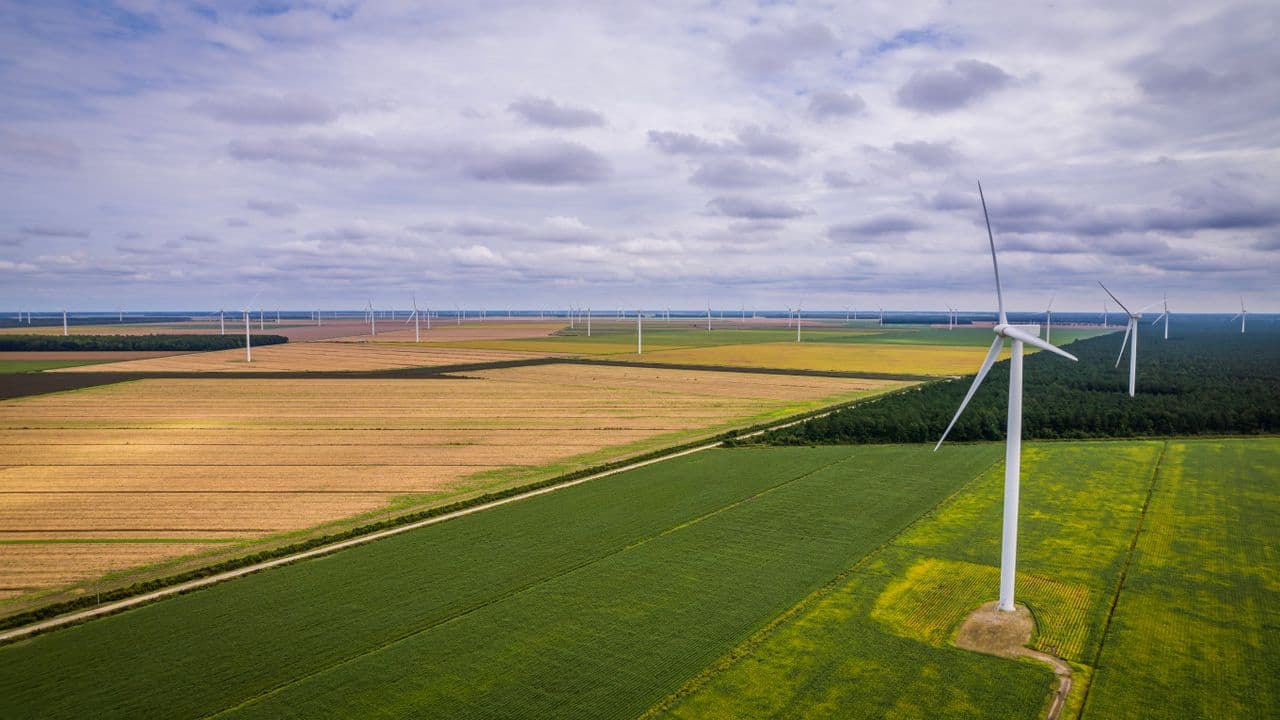
Extend renewable investment into regenerative farming
 Enerjisa Enerji
 SKD Türkiye
Summary
Farming households around wind farms receive regenerative agriculture training, mentoring and inputs, so that soil health, climate resilience and rural income improve together.
Context
Submitted through the COP31 Sustainable Transformation Awards · SKD Türkiye (WBCSD Global Network Partner)
The company generates renewable electricity in the energy sector and operates wind farms in western Türkiye, with more than 1,000 employees.
Wind farms are built in rural districts where the dominant economic activity is agriculture, and where the climate change those plants are built to address is already reducing water availability, disrupting growing seasons and putting pressure on household income. A renewable investment with no relationship to the farming economy around it creates value for the grid and leaves the local production system to absorb the climate risk on its own.
Soil is the connection between the two. The Intergovernmental Panel on Climate Change, under UNEP, has estimated that increasing soil carbon sequestration through regenerative agriculture practices could store up to 23 gigatonnes of carbon dioxide by 2050, a contribution it identifies as critical to limiting global warming to 1.5°C (1).
Working from that position, the company started a four-year social impact programme in March 2026 in the rural areas around its wind farms. The purpose is to spread climate-resilient production models, improve soil health, diversify rural household income, strengthen the participation of women and young producers in economic life, develop sustainable production capacity to international standards, and connect renewable energy investment to rural development.
The programme runs on a budget of approximately EUR 200,000 (TRY 11 million). Company climate performance data feeds CDP reporting and ISSB (IFRS S1 and S2) and TCFD aligned disclosure, with independent third-party assurance.
Location of the initiative: Villages around wind farms in Aydın, İzmir, Çanakkale and Balıkesir provinces, Türkiye
Solution
The programme turns the presence of a generation asset into a rural development instrument, built around three interventions delivered in the same villages: knowledge, practice support and market access.
Knowledge comes first. Producers receive regenerative agriculture training and applied workshops, and the design is set by prior need analysis — focus group discussions in the villages, household level need assessments, and pre-tests that measure knowledge, attitude and behaviour before a course is delivered rather than after it.
Practice support turns training into field application. Volunteer households enter one-to-one mentoring and receive a support package of green manure, medicinal and aromatic plant seedlings, heirloom seed and agricultural equipment, while the wider group receives natural plant nutrition solutions and organic fertiliser support in the form of vermicompost and compost.
Market access is the third element, because a change in practice that does not reach a buyer will not survive. A solar-powered cold store is being built for the use of producers in the programme; preparations for a fig festival to strengthen producer marketing networks are under way with the regional fig research institute; and discussions are being held with national coffee shop chains, bakeries and restaurants, alongside product quality and certification work.
Women and young producers are a defined target rather than an incidental beneficiary. A rural women's entrepreneurship and leadership course runs alongside the agricultural training, monthly focus groups are held with the women and young producers in the participating households, and a working group of lead women producers has been formed to build local leadership capacity.
Measurement is built into the design. A theory of change defines the results expected, pre-tests establish the starting point, and post-training surveys record whether producers actually applied what they learned, which is the indicator the programme treats as decisive.
Figure 1: The company's generation sites in western Türkiye, and the four provinces where the programme runs: Balıkesir, Çanakkale, İzmir and Aydın.


Figure 2: A regenerative agriculture training session in a pilot village, and producers at the fig harvest in the programme area.


Impact
Sustainability Impact
Climate
The activity sits outside the company's own Scope 1 and Scope 2 boundary. It works on emissions and removals in the farming systems around the plants, which are not part of the company's operational inventory, so it is reported as an enabling contribution rather than as a reduction in the company's own footprint.
The mechanism is soil carbon. Regenerative practice — green manure, organic fertilisation with vermicompost and compost, natural plant nutrition and reduced chemical input — increases soil organic carbon, and the Intergovernmental Panel on Climate Change puts the global potential of that route at up to 23 gigatonnes of carbon dioxide stored by 2050, which it treats as a critical contribution to limiting warming to 1.5°C (1).
Adaptation is the more immediate effect. Producers in four provinces are being equipped with production models that hold up under reduced water availability and less predictable seasons, which is the form of climate action rural households need first.
Site-level quantification is not yet available. Soil samples taken from producer fields in the first year are being analysed by the regional fig research institute, and the results will set the regenerative practices applied in the second year. In programmes of this type, changes in soil condition and carbon sequestration begin to produce meaningful data in the second and third years of implementation, and the company is in discussion with a nature technology company over the measurement work planned for the second year.
Nature
The programme works on soil as a living system rather than as a growing medium. Green manure, heirloom seed, vermicompost, compost and natural plant nutrition solutions replace part of the synthetic input load, which reduces chemical pressure on soil biology and on the water draining from these fields.
The measurable result so far is in pest management. In the first year the practices are being applied on 10 dönüm pilot plots identified within approximately 500 dönüm of fig orchards — dönüm is a local land unit — belonging to 8 producer households. Where the practices were adopted, an 85 per cent success rate in pest control was achieved compared with the previous year, which is a direct substitution of biological management for chemical treatment.
Medicinal and aromatic plant seedlings and heirloom seed distributed through the support packages diversify what is grown, which supports crop genetic diversity and pollinator habitat alongside household income.
Social
Training reached producers who had not been reached before. In three villages in Aydın, 100 producers took regenerative agriculture training and applied workshops between March and June 2026, and 66 per cent of participants stated that they had never previously attended training given by an agricultural specialist.
Application, not attendance, is the test. Of those trained, 61.5 per cent applied part of what they learned in the field and 30.8 per cent applied all of it, while 7.7 per cent did not put it into practice.
The programme is scaling on the same model. Need analyses through focus group discussions were completed in 17 villages in İzmir, Çanakkale and Balıkesir, and training for a further 200 producers began there in the July to October 2026 period.
Household support is concentrated. In three villages around one Aydın wind farm, need analyses were carried out with 30 volunteer households; one-to-one mentoring began with 8 households and the remaining 22 households were brought into the training, workshops and field applications. By the sixth month of the programme the first results of the practices had become visible during the first harvest period, and households across all three villages have since asked to take part more fully.
Women and young producers are tracked separately. A 9-question pre-test before the rural women's entrepreneurship course found that 79 per cent of the women had never received entrepreneurship training. After the entrepreneurship, leadership and regenerative agriculture workshops in three villages, two-thirds of the women who had attended said they were able to apply what they had learned. A 25-person working group of lead women producers has been formed to strengthen local leadership capacity, and monthly focus group meetings are held with the women and young producers in the 30 participating households.
In the first phase the programme is designed to reach approximately 300 households in 20 villages; that figure is a target for the current phase rather than a completed result.
Business Impact
Benefits
The programme protects the social licence that renewable development depends on. Wind farms are built in communities that experience the construction traffic, the land take and the visual change, and a programme that puts practical value into the same households changes the terms of that relationship from compensation to partnership.
It supports the social sustainability and inclusive development commitments the company has taken on through its work with international financial institutions, which makes it a condition of that financing rather than a discretionary activity.
It has produced institutional reach at low cost. Within months of starting, the programme drew an invitation to collaborate from a foundation's capacity development programme, and it was the only project representing the energy sector at a workshop on water efficiency and finance in agriculture organised by the national business council for sustainable development with a national bank.
There is an operational benefit as well. The relationships, the village level need analyses and the local partners built for this programme are the same channels through which a generation business manages land access, local recruitment and community issues at existing and future sites.
Costs
The programme runs on a budget of approximately EUR 200,000 (TRY 11 million), covering training, workshops, mentoring, support packages, need analyses, impact measurement and the partner organisations delivering the work in the field.
Capital items sit on top of that operating budget. The solar-powered cold store to be made available to producers from September 2026, and the agricultural infrastructure investments alongside it, are asset purchases with their own maintenance and governance requirements once handed over.
The heavier cost is time and continuity. Need analyses, monthly focus groups, one-to-one mentoring of individual households and repeated measurement are labour-intensive and slow, and the four-year commitment is what makes the results credible; a shorter programme would produce attendance figures rather than application rates.
Costs are contained by working through a strategic field partner and local technical institutions rather than building delivery capacity in-house; by concentrating intensive mentoring on a small number of lead households — 8 of the 30 in the pilot — while the wider group receives group training and input support; and by using the same measurement instruments across villages, so that the design does not have to be rebuilt for each new area.
Impact Beyond Sustainability And Business
Co-benefits
Diversifying household income sources reduces the exposure of rural families to a single crop and a single price, which is a resilience benefit independent of the environmental one.
The working group of lead women producers and the monthly focus groups build organisational capacity that outlasts the training itself, and the entrepreneurship course connects that capacity to income generation.
The technical partnership with the regional fig research institute and the academic input from two universities give a corporate programme a scientific base and give the research institutions a field site, which is a benefit running in both directions.
Bringing producers into direct discussion with national coffee shop chains, bakeries and restaurants creates a market route that continues to operate whether or not the programme does.
Potential side-effects
The programme began in March 2026 and most of its scope is still ahead of it. Coverage of approximately 300 households in 20 villages, the extension to the Muğla and Edirne areas after the first year, the integration of sustainable energy technologies into agricultural production and the vocational training models for young people are stated targets, not delivered results, and should be read as such.
Adoption is partial by nature. 7.7 per cent of trained producers did not apply what they learned and 61.5 per cent applied only part of it, so training alone does not change practice. The mentoring and input support exist because of that gap, and they are expensive to deliver at scale.
Intensive support to 8 households out of 30 creates a difference in treatment inside a small village, which has to be managed openly through the group training, the input distribution and the lead producer role given to those households, or it becomes a source of local friction. The first results at the sixth month raised demand across all three villages, so the balance between intensive and broader support has to be reset in the second year's field planning.
Dependence on the funder is a risk in any corporate-financed rural programme. The strategic field partner, the producer working group, the cooperative structure and the direct market relationships are the mechanisms through which the activity is meant to become independent, and a four-year horizon is short for that transition.
Implementation
Typical Business Profile
The model suits renewable energy developers and other capital infrastructure operators with long-lived assets in rural districts, where the surrounding economy is agricultural and the operator has a multi-decade presence to protect.
It is most relevant where a company already has a community investment budget and is looking for a use for it that produces measurable change rather than visibility, and where commitments to international financial institutions require demonstrable social outcomes.
Delivery engages corporate communication, new technologies and renewable energy investment teams inside the company, under a sustainability directorate, working with a strategic implementation partner and local technical institutions rather than through direct company delivery.
Approach
Define the theme from the risk facing the community: Analyse what producers around the sites are contending with — climate-driven production difficulty, declining water resources, food security and livelihoods — and set the programme theme from that analysis rather than from a corporate menu of causes.
Run village level need analyses before designing anything: Hold focus group discussions in each village and household level need assessments with volunteer families, so that the content of the training and the composition of the support package are set by the producers who will receive them.
Measure the starting point with a pre-test: Apply a short structured pre-test, such as the 9-question instrument used before the women's entrepreneurship course, to record knowledge, attitude and behaviour before delivery, so that change can be attributed afterwards.
Appoint a strategic field partner and a technical partner: Contract an organisation with standing in the villages to plan and deliver on the ground, and a research institution with authority in the local crop to provide technical content, instead of attempting delivery with corporate staff.
Deliver training and applied workshops in the pilot villages: Start with a defined pilot — three villages and 100 producers in the first period — and use the results to set the design before extending to further villages.
Concentrate mentoring and inputs on lead households: Select volunteer households for one-to-one mentoring and provide a support package of green manure, medicinal and aromatic plant seedlings, heirloom seed and equipment, while the remaining households receive group training, natural plant nutrition solutions and organic fertiliser support.
Build the market route in parallel with the practice change: Invest in the post-harvest infrastructure producers need, such as a solar-powered cold store, work with the technical partner on quality and certification, and open direct discussions with buyers so that improved product has somewhere to go.
Measure application rather than attendance, and scale on the evidence: Survey trained producers on whether they applied what they learned, hold monthly focus groups with the target groups, track field results such as the pest control outcome in the fig orchards, and use the findings to design the next phase and the extension to new areas.
Stakeholders Involved
Project leads: The programme is led by the asset management and sustainability directorate, which aligns it with the corporate sustainability strategy and monitors strategic objectives, performance indicators and impact measurement on a regular cycle. Delivery is coordinated across the corporate communication, new technologies and renewable energy investment units: corporate communication supports stakeholder engagement and visibility, new technologies brings applications from the technology portfolio into the programme, and the renewable energy investment teams identify field needs and make delivery work at each site.
Company functions: Sustainability sets the framework and holds the measurement discipline; corporate communication manages the relationship with villages, partners and external audiences; new technologies contributes the energy and agricultural technology elements such as the solar-powered cold store; and the renewable energy investment teams provide the site level presence and the connection between the plants and the surrounding villages.
Main providers: A youth cooperative acts as the strategic implementation partner in the field, positioned inside planning as well as delivery, and contributed to the programme design alongside village headmen and lead producers. A regional public research institute specialising in the local crop provides technical content and works with the company on the solar-powered cold store and the producer marketing event. Academics from two universities strengthened the scientific basis of the design.
Other: Public authorities, local administrations, civil society organisations, cooperatives, academic institutions and local producers carry out the field work together. Village headmen and lead producers were part of the design process. National food and hospitality buyers are in discussion as market outlets for participating producers. A foundation running a capacity development programme has invited collaboration, and the programme was presented as the only energy sector project at a workshop on water efficiency and finance in agriculture organised by the national business council for sustainable development with a national bank.
Key Parameters To Consider
The programme is designed as a four-year transformation programme, which is the timescale on which changes in agricultural practice and in producer organisation can be observed.
It began in March 2026 with field application around wind farms in four provinces, and the first phase covers approximately 20 villages and approximately 300 households, with the Muğla and Edirne areas planned for addition after the first year.
The budget is approximately EUR 200,000 (TRY 11 million), and the delivery model depends on a strategic field partner and local technical institutions rather than on company staff.
The pilot crop matters to the design. Fig production in Aydın gave the programme a crop with an established research institute, an existing producer base and a defined market, which is what made the market access element workable in the first year.
Implementation And Operations Tips
Start from the producer's problem, not the company's theme. Need analyses and focus groups in the villages before the curriculum was designed are what produced attendance from producers, 66 per cent of whom had never attended training given by an agricultural specialist.
Measure application, not participation. The decisive figures are the 61.5 per cent applying part of what they learned and the 30.8 per cent applying all of it; a programme that reports only the number of people trained cannot tell whether anything changed.
Pair training with inputs and mentoring. The 85 per cent pest control result came from households that received both instruction and material support, which suggests that training alone would not have produced a field result in the first season.
Work through a partner with standing in the village. A cooperative already trusted locally, positioned as a strategic partner rather than as a subcontractor, opens doors a generation company cannot open on its own.
Build the market before the surplus arrives. Cold storage, certification and buyer relationships have to be under way while practices are changing, otherwise producers carry the cost of the transition without the return.