Protect coastal biodiversity beyond the site boundary
 Tüprag Metal Madencilik Sanayi ve Ticaret A.Ş.
 SKD Türkiye
Summary
A mining company worked with a conservation NGO and the national parks authority to monitor a 16 km nesting beach, supporting 110,019 loggerhead hatchlings reaching the sea.
Context
Submitted through the COP31 Sustainable Transformation Awards · SKD Türkiye (WBCSD Global Network Partner)
Tüprag Metal Madencilik Sanayi ve Ticaret A.Ş. is a mining company with more than 1,000 employees, operating in Türkiye as part of an international mining group.
Loggerhead (Caretta caretta) and green (Chelonia mydas) turtles in the Mediterranean basin form genetically distinct subpopulations, so a decline would represent an irreversible loss of genetic biodiversity rather than a local species loss alone. Sea turtles also act as an umbrella species, and their protection supports coastal dunes, nesting grounds and the habitats associated with them.
Kızılot, on the Mediterranean coast, is one of Türkiye's primary nesting beaches for the loggerhead turtle, although regular scientific monitoring there remained limited for approximately 20 years. Conventional practice in the mining sector concentrates on mitigating impacts within operational boundaries.
The group's environmental policy, its integrated sustainability management system and the Mining Association of Canada Towards Sustainable Mining—TSM—biodiversity conservation protocol require biodiversity performance that is measured and independently verified, which made action outside the operational footprint a governance consideration as well as an ecological one.
Location of the initiative: Kızılot beach, Mediterranean coast, Türkiye
Solution
In 2024 the company established a long-term biodiversity monitoring and conservation programme on a stretch of coast outside its operational footprint, together with Ekolojik Araştırmalar Derneği—EKAD, the Ecological Research Society—and the General Directorate of Nature Conservation and National Parks—DKMP. The programme covers the coastal and marine habitats associated with the two sea turtle species along 16 km of nesting beach.
The central asset is a permanent research camp financed by the company. It allows expert teams and volunteers to work continuously through the nesting season rather than in short campaigns, and serves as a fixed base for training, volunteering and awareness activities.
The programme combines nesting and non-nesting emergence detection and protection of nests against predation, relocation of nests identified as at risk of inundation, rescue of hatchlings trapped in nests via daily field studies, satellite tagging of adult females, volunteer placements for national and international participants including employees, and education and awareness work with stakeholders (schools, tourism workers, visitors and local communities).
Roles are separated. The NGO is responsible for the scientific design, the monitoring methodology and field implementation. The company provides financing, the research camp, equipment, logistics and volunteers. The public authority issues study permits and reviews the annual reports, giving it a regulatory role in the decision cycle.
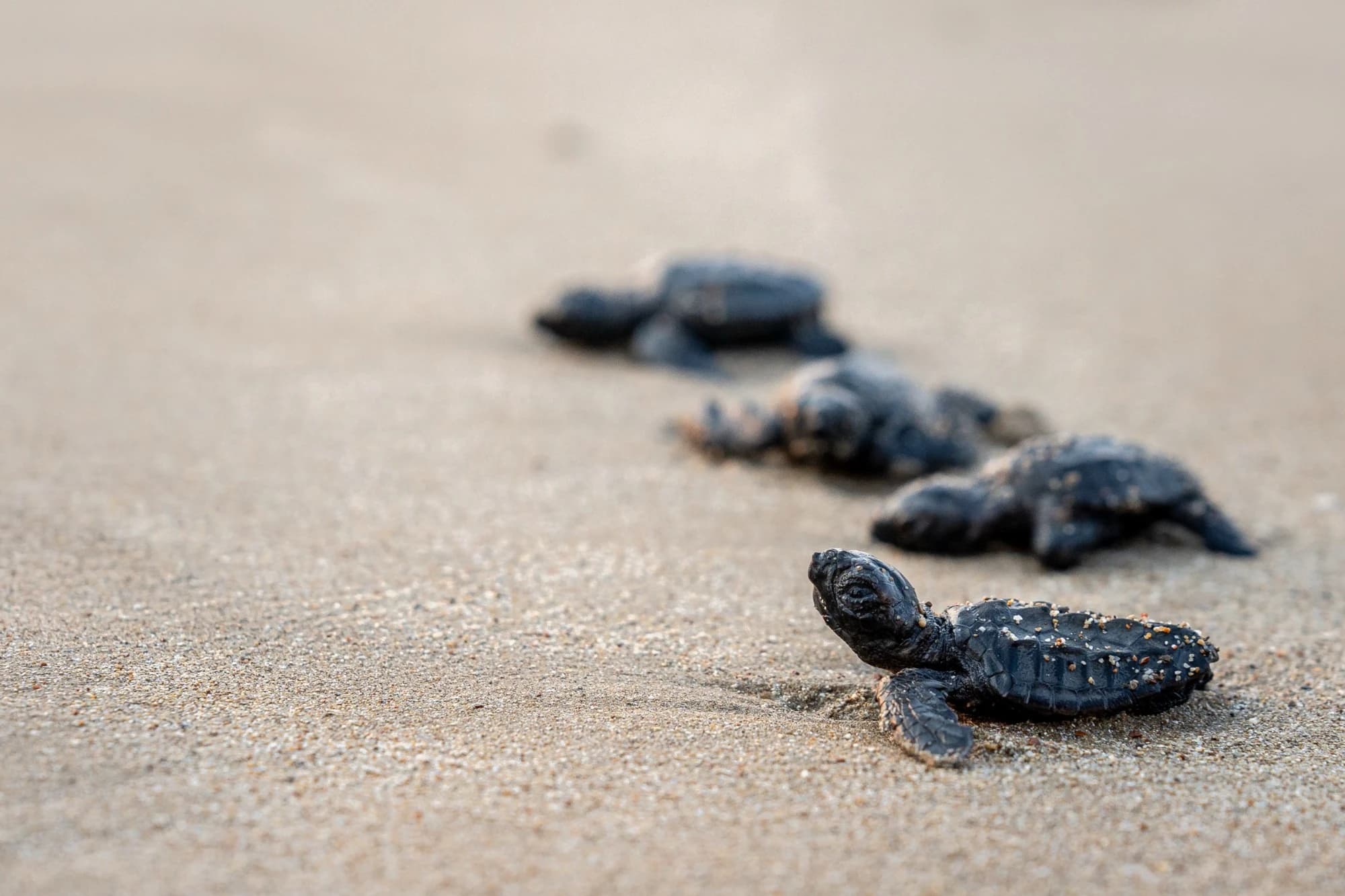
Figure 1: Loggerhead hatchlings making their way to the sea on the Kızılot nesting beach

Figure 2: Key results of the 2024 and 2025 nesting seasons at Kızılot beach

Impact
Sustainability Impact
Climate
This initiative is an enabler. It is a biodiversity programme rather than an emissions reduction measure, and no greenhouse gas reduction is claimed or quantified for it against the 2024 baseline year or across the 2024 and 2025 nesting seasons.
The activity falls under Scope 3, Category 1: Purchased goods and services, because the scientific design, the monitoring methodology and the field work are delivered under contract by the partner organisation. The research camp, equipment and logistics financed directly by the company sit within its own Scope 1 and Scope 2 footprint.
The enabling contribution is ecological rather than measured in emissions. Sea turtles act as an umbrella species, so continuous protection of the 16 km nesting beach also maintains the coastal dunes and vegetation, nesting grounds and associated habitats that depend on it. Emissions performance is managed separately under the group environmental policy and the integrated sustainability management system.
Nature
Monitoring covers a 16 km stretch of nesting beach. According to monitoring data, 4,497 loggerhead nests and 314,867 eggs were recorded across the 2024 and 2025 seasons.
In 2024, 52,488 hatchlings reached the sea from 2,381 nests and 161,419 eggs, an emergence success of 32.5%. In 2025, 57,531 hatchlings reached the sea from 2,116 nests and 153,448 eggs, an emergence success of 37.5%. Over the two seasons 110,019 hatchlings reached the sea and emergence success increased by approximately 5%.
A further 10,569 hatchlings trapped within nests were rescued alive during daily field work and released, 4,474 in 2024 and 6,095 in 2025. In addition, 450 nests were caged against predation for in situ protection, and four adult females were fitted with satellite transmitters across the two nesting seasons.
Monitoring also established the relative importance of the site. Published monitoring results of the 1988–2000 period reported an annual average of 179.3 loggerhead nests at this beach (Canbolat, 2004), compared with an annual average of 2,248 nests during the programme. The Mediterranean subpopulation of loggerhead is estimated at more than 8,000 nests a year in total according to the most recent publication (Casale et al., 2018).
Published survival rates for hatchlings reaching adulthood range between 1 in 400 and 1 in 2,000, and are commonly taken as 1 in 1,000. On that basis, the programme estimates that the hatchlings released over the two seasons represent a potential long-term contribution in the order of 110 adult loggerheads to the Mediterranean subpopulation of loggerhead.
Social
Over the two seasons 212 volunteers worked in the field: 48 national and 18 international in 2024, and 89 national and 57 international in 2025. Employees of the company take part as volunteers alongside them.
Education and awareness activities reached approximately 3,100 students, 1,450 tourism sector workers and 1,900 tourists, together with representatives of public institutions and local communities. Activities include World Sea Turtle Day events, hatchling releases and structured training programmes. Volunteers apply the field skills they acquire in other geographies.
Business Impact
Benefits
The programme supports the operating relationship with the national nature conservation authority, which issues study permits and reviews the annual technical reports. That process provides an audited, regulator-reviewed record of biodiversity performance outside the operational boundary.
It also supplies verified data for corporate disclosure. Performance is managed under the group environmental policy, the integrated sustainability management system and the Towards Sustainable Mining biodiversity conservation protocol, and is supported by independent third-party assurance and reporting aligned with ISSB (IFRS S1–S2) and the Task Force on Climate-related Financial Disclosures—TCFD, with a disclosure aligned with the Taskforce on Nature-related Financial Disclosures—TNFD—published separately (1).
The company also reports non-financial benefits, including employee engagement through volunteering and closer working relationships with local authorities, the tourism sector, schools and local communities, which support social acceptance of its presence in the region.
Costs
The recurring cost drivers are the maintenance and operation of the permanent research camp, salaries for the NGO's field staff, scientific equipment, volunteer programmes, logistics support and satellite telemetry devices.
These items are planned annually and budgeted with senior management approval, so that the programme operates as a recurring commitment rather than a one-off sponsorship. That structure increases the cumulative cost but secures continuity of the dataset.
Costs are partially offset by the division of responsibilities: the NGO provides scientific capacity that would otherwise have to be built in-house, and 212 national and international volunteers, including employees, carry out much of the field effort. The principal dependency is continuity of funding, expert staff and volunteers from season to season.
Impact Beyond Sustainability And Business
Co-benefits
Satellite tracking generates data on migration routes, foraging and wintering areas that was not previously available for this site, and is shared with the regulator. The permanent camp also functions as a training base, and volunteers, students and tourism workers acquire field conservation skills that transfer to other sites and habitats.
Potential side-effects
The main trade-off is the dependency on continuous financing and on the retention of expert staff and volunteers. These risks are managed through annual resource planning, the public authority's permit and reporting cycle, and the NGO's scientific direction of the field programme.
Implementation
Typical Business Profile
The model is most relevant to extractive and heavy industry companies whose sites are located near coastal, marine or protected areas, and to large employers considering investment in nature outside their own operational footprint. It suits companies with an environment and sustainability function, a multi-year budget cycle and nature-related disclosure obligations. It applies to Mediterranean nesting beaches and, in principle, to other sites where a species of recognised importance lacks continuous scientific monitoring.
Approach
Identify a nature priority outside the operational footprint: Select a species or habitat of recognised importance that is at risk and where scientific monitoring is limited.
Partner with a specialist NGO: Assign the scientific design, the monitoring and conservation methodology and field execution to an organisation with established expertise rather than building that capacity internally.
Secure regulatory permissions: Obtain study permits from the national nature conservation authority and agree the annual reporting obligations before field work begins.
Fund permanent field infrastructure: Finance a research camp or equivalent base so that monitoring runs continuously through the season rather than in short campaigns.
Standardise data collection: Use field study forms (including nesting and non-nesting emergence numbers, locations, predation and nest inventory, emergence counts and satellite tagging of adults).
Build volunteer and awareness capacity: Recruit and train national and international volunteers, including employees, and run awareness programmes for schools, tourism workers and visitors.
Report and review annually: Submit results to the regulator and to senior management, and use the findings to plan the following season's field priorities.
Budget for continuity: Approve the programme annually at senior management level so that it operates as a long-term programme rather than a one-off sponsorship.
Stakeholders Involved
Project leads: Project leadership sits with the Board of Directors, which holds corporate ownership of the programme and approves its annual budget. Day-to-day coordination is handled by the Environment and Sustainability Directorate, which agrees each season's field priorities with the partner NGO, while the NGO retains scientific direction of the work.
Company functions: Environment and sustainability, finance and budgeting, and logistics teams work to a single annual cycle: the field plan is costed and approved before the season opens, and logistics support camp operation through it. Employees also take part directly as field volunteers alongside the NGO's teams.
Main providers: Ekolojik Araştırmalar Derneği—EKAD—an ecological research NGO, designs and runs the scientific monitoring, the field methodology and the survey work, and reports the results back to the company and the regulator each year. Equipment and logistics suppliers support camp/on-site operations and satellite telemetry under contract to the company.
Other: The General Directorate of Nature Conservation and National Parks—DKMP—issues study permits and reviews annual reports, which sets the terms under which each season's field work is carried out. Local authorities, the tourism sector, education institutions, local communities and volunteers take part in the field and awareness activities, with volunteers trained and deployed through the research camp.
Key Parameters To Consider
The field methods are established conservation practice rather than new technology, so the limiting factors are continuity and capacity rather than technical maturity. The baseline year is 2024 and reported data cover the 2024 and 2025 nesting seasons.
Key prerequisites include:
study permits from the national nature conservation authority;
an annual reporting cycle;
access to trained specialists and volunteers;
satellite telemetry equipment; and
a permanent field base.
Performance is managed within the group environmental policy, the integrated sustainability management system and the Towards Sustainable Mining biodiversity conservation protocol, with reporting aligned with ISSB (IFRS S1–S2) and TCFD and independent third-party external assurance.
Implementation And Operations Tips
The main constraint at the site was that regular scientific monitoring had been limited for approximately two decades, leaving little historical data to build on.
The determining factor for continuous, science-based conservation proved to be permanent camp infrastructure rather than the conservation techniques themselves.
The residual risks are sustainable financing, continuity of expert teams and volunteers, and local stakeholder ownership. These are managed through annual resource planning, the regulator's permit and reporting process, and the NGO's scientific direction. Wider adoption depends on combining long-term private financing, specialist NGO capacity, a defined public regulatory role and volunteer participation.