Switch packaging material to decarbonise a product range
 Abdi İbrahim
 SKD Türkiye
Summary
A standing cross-functional mechanism reviews every pack in a medicine portfolio, then removes, thins or substitutes material wherever quality and regulatory limits allow.
Context
Submitted through the COP31 Sustainable Transformation Awards · SKD Türkiye (WBCSD Global Network Partner)
The company is a pharmaceutical manufacturer with nearly 5,800 employees in Türkiye, and its portfolio covers nearly 250 brands and more than 500 products, developed in house as well as under agreements with 30 licensors.
Packaging is a material-intensive part of pharmaceutical production and a substantial share of the emissions embedded in a finished pack. It is also unusually static. A pack specification is fixed when a product is registered, and any later change has to clear stability testing, quality requirements, marketing authorisation processes and supply chain constraints, so material that could be removed often stays in the pack simply.
The company's packaging strategy, Green Harmonization, sits inside its HEAL2050 sustainability strategy and is organised into three phases: reduce, replace and collect back. Ecovantage was created in 2023 to serve the reduce and replace phases, and it addresses the ownership problem directly.
Rather than commissioning individual packaging projects, the company built a standing mechanism. The sustainability team leads it, and every function able to contribute is brought into a shared working model; for the packaging estate as a whole, that scale of joint working was new to the organisation.
The programme is aligned with the emission reduction and 2050 net-zero targets validated by the Science Based Targets initiative.
Location of the initiative: Türkiye
Solution
Ecovantage is a screening and delivery mechanism for packaging and material efficiency, not a single redesign project.
It starts with coverage. At the outset all packaging used across the product range was reviewed in one pass by the assembled teams, which produced a large number of ideas and project proposals rather than a shortlist selected in advance.
Proposals are then screened in periodic meetings against a fixed set of criteria: environmental impact, cost advantage, technical feasibility, product safety, marketing authorisation requirements, supply chain effects and commercial suitability. Proposals that fail on stability results, regulatory requirements, return on investment or commercial priority are not taken forward. Those that pass are developed end to end, through technical suitability, quality requirements, licence and stability processes, production line trials and market launch.
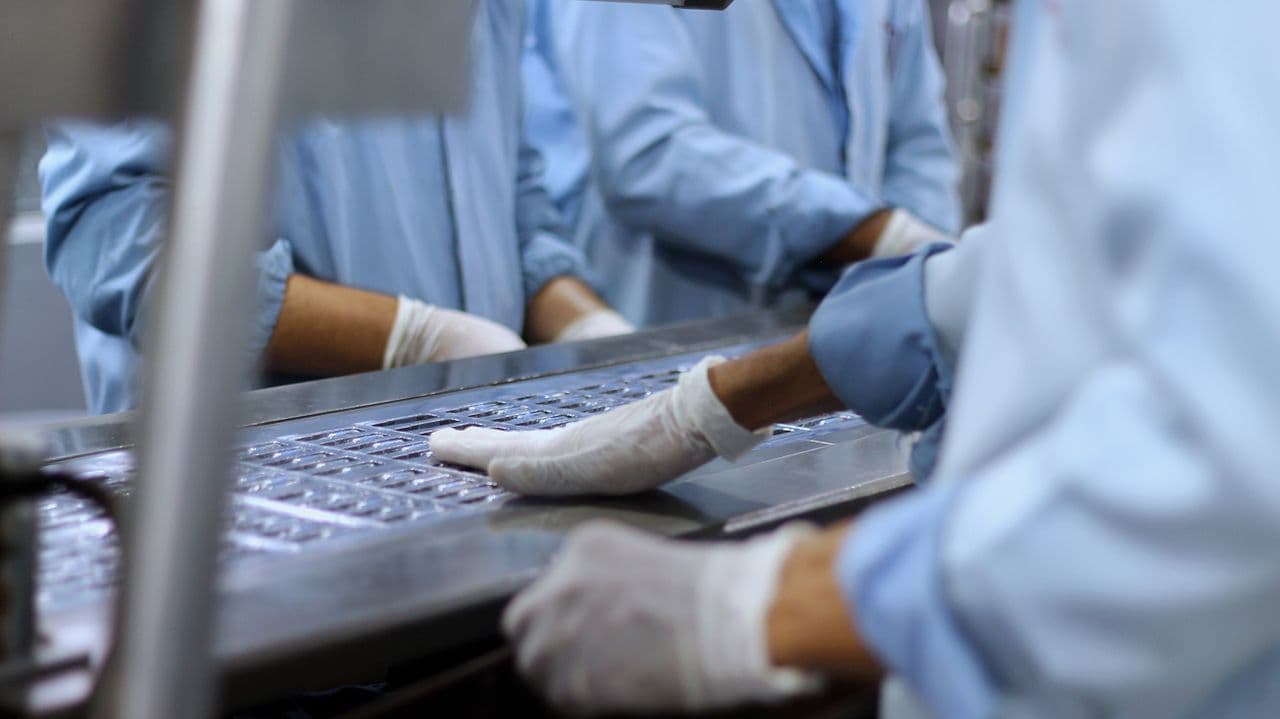
Four work streams have come through that route. Patient information leaflets were reduced in size, with optimum dimensions set product by product within the limits the regulations allow. Syrup bottles were standardised: several bottles of the same volume were in use across different products, and the range was consolidated on the option with the lowest carbon footprint. Dosing spoons were moved from polystyrene to polypropylene, lowering the carbon footprint of the component. Blister layer thinning was assessed across all blistered products by risk level, with production trials and physical and chemical stability studies; it has been completed for 4 products and continues for the remainder as a long-running project governed by stability requirements.
Between 2023 and 2026 the completed projects delivered 953 tonnes CO2e of emission reduction and TRY 28.2 million of realised savings. The mechanism remains active and continues to generate new projects.
Figure 1: The screening funnel: every packaging idea passes initial screening, cross-functional evaluation and a go/no-go decision before development and compliance work begins

Figure 2: Emission reductions by completed workstream, 2023-2026: leaflet downsizing, syrup bottle standardisation, dosing spoon material change and blister layer thinning, totalling 953 tonnes of CO2e

Impact
Sustainability impact
Climate
The reduction sits mainly in Scope 3, Category 1: Purchased goods and services, because the emissions removed are those embedded in the packaging materials the company buys. A smaller share falls in Scope 3, Category 5: Waste generated in operations, since several of the projects reduce packaging waste as well as packaging material.
The reference point for measurement is the packaging designs and material use in place before the projects, and the calculation is a before-and-after comparison at product level. Emission reductions are derived from the material and waste reductions achieved per product, using DEFRA emission factors in line with the GHG Protocol, and reported in tonnes CO2e. The base year is 2023.
On that basis, the projects completed between 2023 and 2026 delivered a reduction of 953 tonnes CO2e.
The portfolio effect is not yet complete. Blister layer thinning, the work stream with the largest primary packaging content, has been completed for 4 products only; the rest is a long-running project because each product has to pass physical and chemical stability testing before its blister specification can change. Further reduction from that stream is therefore a target rather than a result.
Progress is tracked through two indicators, emission reduction in tonnes CO2e and realised savings.
Nature
Every completed project reduces the quantity of virgin material entering the pack: paper in the leaflets, glass or polymer in the syrup bottles, polystyrene in the dosing spoons and aluminium and film in the blisters.
Material substitution accompanies material reduction. Moving dosing spoons from polystyrene to polypropylene lowers the carbon footprint of that component, and the bottle work consolidated several containers of the same volume onto the lower carbon-footprint option rather than adding a new one.
Work with packaging suppliers also produced domestic supply alternatives and new material solutions, which shortens the material supply chain for some components.
No land, water or biodiversity indicator has been quantified. The reported outcomes are material reduction, waste reduction and the GHG emissions equivalent calculated from them.
Social
The main social outcome is internal and organisational. The programme brought sustainability, production, packaging, quality, procurement, regulatory affairs, marketing, technical operations, pharmaceutical technology, strategy and business development, international markets, material planning, regulatory compliance, medical, quality assurance and artwork teams into one working model at a scale the organisation had not previously used for packaging.
The consequence is that environmental impact became one of the criteria against which operational and commercial packaging decisions are assessed, rather than a separate reporting exercise, and awareness of that criterion rose among the decision makers involved.
Suppliers were drawn into the same process. Joint work on alternative materials, domestic sourcing options and pack optimisation extended the effect beyond the company's own operations.
Product safety and quality requirements were treated as fixed constraints throughout, so no reduction was pursued at the expense of the protection a patient receives.
Business impact
Benefits
The programme delivered TRY 28.2 million of realised savings between 2023 and 2026 alongside 953 tonnes CO2e of emission reduction, which is the central argument for running material reduction as a permanent mechanism rather than as an environmental project.
The benefits are structural rather than one-off in character. A smaller leaflet, a standardised bottle or a lighter blister continues to reduce material use and its associated environmental impact, while also delivering cost savings on every unit produced over the life of the product.
Standardisation carries its own operational benefit. Consolidating several same-volume syrup bottles onto one option reduces the number of components to buy, qualify, plan and hold.
Supplier collaboration has generated domestic sourcing alternatives and new material solutions, helping to reduce exposure to imported material supply and price volatility, while shorter supply distances also offer the potential to reduce logistics-related emissions.
The model also has the potential to extend beyond the company's own products: it can be applied to products manufactured on behalf of other organisations and to products destined for international markets, enabling the same screening approach to cover a wider volume base.
Finally, embedding environmental criteria in packaging decisions means new packs are assessed on that basis from the start, which avoids the cost of revisiting them later.
Costs
One cost associated with the programme is the development effort spent on proposals that do not reach implementation. The screening process generates a range of ideas and project proposals, some of which may not progress due to stability results, regulatory requirements, return on investment or commercial priorities, including cases where technical assessment has already been carried out.
Each approved project carries a full delivery cost: technical assessment, feasibility work, supplier discussions, production line trials, physical and chemical stability studies, marketing authorisation assessment and market launch. In a regulated sector these steps cannot be shortened, which is why blister layer thinning has reached only 4 products and continues as a long-running project.
Running the mechanism itself has a cost. Periodic screening meetings draw on a large number of functions, and investment requirements and strategic decisions are escalated to senior management and board level, so management time is a real input.
Supply chain constraints limit what can be implemented: an alternative material has to be available reliably and at the required quality before a change can be committed.
Running the programme as a continuous improvement mechanism enables each new proposal to be assessed systematically against an established set of criteria. Experience and knowledge gained from previous projects can inform subsequent assessments, while each project is evaluated individually against its own technical, quality, regulatory, supply chain and commercial requirements.
The investment and running cost of the programme are treated as confidential company information and are not published.
Impact beyond sustainability and business
Co-benefits
Sustainability awareness rose among internal decision makers because the criteria were applied to real commercial choices rather than presented as guidance, and packaging decisions now carry an environmental test as a matter of process.
Collaboration with packaging suppliers has supported the development and evaluation of domestic sourcing alternatives, new material solutions and packaging optimisation opportunities, extending the programme's impact across the value chain.
The model is designed as a systematic approach that can be applied across a broad packaging portfolio. Its screening framework can also provide a useful reference for other organisations seeking to integrate environmental criteria into packaging decisions, subject to their own product, quality and regulatory requirements.
Potential side-effects
Reduction has a hard floor set by product protection. A thinner blister film, a smaller leaflet or a different polymer must not compromise stability, legibility or patient safety, which is why stability and regulatory gates sit inside the process and why they slow it down. That is a deliberate trade-off between pace and safety, not an inefficiency.
Not every proposal identified through the screening process progresses to implementation. Some may be discontinued following technical assessment, stability studies, regulatory review, commercial evaluation or other feasibility considerations. As a result, development time and resources may also be invested in ideas that are ultimately not implemented.
Substitution is incremental rather than structural. Moving a dosing spoon from polystyrene to polypropylene lowers embedded carbon but leaves a plastic component in the pack, so this work reduces impact within the existing packaging model rather than changing the model.
Blister layer thinning is implemented on a product-by-product basis and only where risk assessment, technical evaluation and stability testing confirm its suitability. As only four products have completed this process to date, further emission reduction remains possible as additional products are evaluated. However, the scale and timing of any future reduction will depend on the outcome of the required assessments and should therefore not be treated as a confirmed result.
Implementation
Typical business profile
The model suits pharmaceutical and consumer health manufacturers with a large estate of registered pack specifications, in-house packaging development, quality and regulatory affairs functions, and production sites where line trials can be run without disrupting supply.
It is most valuable where packs were specified years apart under different priorities, so that material reduction opportunities are dispersed across the portfolio and no single function can see them all.
Delivery engages sustainability, production, packaging, quality, procurement, regulatory affairs, marketing, technical operations, pharmaceutical technology, strategy and business development, international markets, material planning, regulatory compliance, medical, quality assurance and artwork functions, together with packaging suppliers.
Approach
Give one function ownership of the mechanism rather than of the packs: Put the sustainability team in charge of running the screening process while the packaging, quality and regulatory functions retain ownership of the specifications, so the process has a driver without cutting across technical accountability.
Review the entire packaging estate in a single pass: Bring every contributing function together and assess all packaging used across the product range at once, so the opportunity set is complete before any project is chosen and the obvious candidates do not crowd out the rest.
Set the screening criteria before the ideas arrive: Define in advance that proposals will be judged on environmental impact, cost advantage, technical feasibility, product safety, marketing authorisation requirements, supply chain effects and commercial suitability, so that rejection is a process outcome rather than a negotiation.
Screen in periodic meetings rather than in an annual review: Run the assessment as a standing cycle so that new proposals enter continuously and stalled ones can be reopened when a constraint changes.
Take approved projects through an end-to-end route: Manage each project from idea to market across technical suitability, quality requirements, marketing authorisation and stability processes, production line trials and launch, and hold a single owner accountable for the whole chain rather than for one stage.
Start with the changes that do not touch the medicine: Leaflet dimensions and accessory materials such as dosing spoons can be changed without altering the primary contact surface, so they deliver reduction while the harder work is still in testing.
Treat primary packaging as a long-running stream: Assess all blistered products by risk level, run production trials and physical and chemical stability studies, and convert only where the evidence allows, accepting that this stream will complete over years rather than in a single cycle.
Measure in both currencies of the business: Report emission reduction in tonnes CO2e and realised savings together, calculated per product from material and waste reductions using published emission factors, so the programme is defensible to both the sustainability and the finance side of the organisation.
Stakeholders involved
Project leads: The sustainability team leads the programme and convenes the working model. Senior management owns it, and project priorities, investment decisions and implementation progress are tracked at that level, with investment requirements and strategic decisions taken by executive management and the board. That governance is what allows a proposal to be rejected on commercial or regulatory grounds without the mechanism itself being weakened, and what keeps the programme running as a standing structure rather than a campaign. Continuity is anchored in the HEAL2050 strategy, the net-zero target validated by the Science Based Targets initiative and the company's operational excellence approach.
Company functions: Sustainability, production, packaging, quality, procurement, regulatory affairs, marketing, technical operations, pharmaceutical technology, strategy and business development, international markets, material planning, regulatory compliance, medical, quality assurance and artwork teams work inside a single model. Their involvement is not limited to idea generation. The same functions carry the technical assessment, feasibility studies, production line trials, stability processes, supplier discussions, marketing authorisation assessments and implementation stages, which is why sustainability, product safety, quality requirements, regulatory compliance, supply chain needs and commercial priorities are weighed against each other rather than in sequence. The effect on the organisation is that responsibility for the sustainability objective is shared across business units instead of resting with one department.
Main providers: Packaging suppliers work closely with the programme. Joint work covered the assessment of alternative materials, the development of domestic sourcing options and pack optimisation, and produced solutions that were then tested in production trials. Because suppliers were engaged during the assessment rather than after a specification was fixed, several of the material options considered came from the supply base itself.
Other: Relevant regulatory authorities and external stakeholders may be involved depending on the scope and requirements of each packaging change.
Key parameters to consider
The programme started in 2023 and is continuing; it is a permanent mechanism rather than a project with an end date, and new proposals enter it as constraints change.
The base year is 2023 and results are reported for the period to 2026: 953 tonnes CO2e and TRY 28.2 million of realised savings from completed projects.
Measurement is a before-and-after comparison against pre-project packaging designs and material use, calculated per product from material and waste reductions using DEFRA emission factors in line with the GHG Protocol.
Delivery pace is set by regulatory and stability requirements, not by the technical change. Leaflet, bottle and dosing spoon projects completed within the period; blister layer thinning has completed for 4 products and continues for the rest.
The main constraints on wider application are marketing authorisation requirements, product safety criteria, stability processes and supply chain limits, all of which the model assesses at the screening stage rather than after development.
Implementation and operations tips
Define clear screening criteria for project ideas. Establish a consistent set of criteria covering environmental impact, cost considerations, technical feasibility, product safety, regulatory requirements, supply chain effects and commercial suitability. Applying these criteria consistently helps determine which proposals should progress to further evaluation.
Allow for proposals that may not progress to implementation. Some ideas may not move forward following technical assessment, stability studies, regulatory review, commercial evaluation or other feasibility considerations. Development time and resources required for these evaluations should therefore be considered as part of the process.
Track both environmental and financial outcomes where relevant. Measuring emission reduction alongside realised savings provides a broader view of the programme's impact and helps demonstrate both its environmental and business contribution.
Reflect the different requirements of each packaging change in project planning. The complexity and timeline of implementation may vary depending on the type of packaging and its interaction with the product. Primary packaging changes, in particular, may require additional risk assessment, production trials and stability studies. Each project should therefore be planned according to its own technical, quality and regulatory requirements.
Engage suppliers during the assessment process. Packaging suppliers can contribute technical expertise, material alternatives and sourcing options during project evaluation. Early collaboration can broaden the range of solutions considered and support the assessment of their technical feasibility.