Digitise greenhouses to cut water and fertiliser use
 Alarko Agriculture
 SKD Türkiye
Summary
Greenhouse sensors, artificial intelligence and water recovery systems cut water, fertiliser and energy use while keeping production stable under climate stress.
Context
Submitted through the COP31 Sustainable Transformation Awards · SKD Türkiye (WBCSD Global Network Partner)
The company is a diversified industrial holding whose agriculture business operates geothermally heated modern greenhouses, a micro-granular fertiliser plant, a climate-resilient seed breeding operation and dried food production, with approximately 6,000 people employed across the group. The greenhouse operation covers 1,062 decares (about 106 hectares) of active modern greenhouse in Türkiye, with a 400-decare (about 40-hectare) first phase in Kazakhstan, and the micro-granular fertiliser plant has a capacity of 12,000 tonnes a year.
Agriculture in Türkiye is under direct climate pressure from drought, agricultural frost, extreme heat and climate-related disasters, and water availability and soil quality are growing constraints on production. Approximately 79 per cent of the country's fresh water is used in agriculture, and in 2025 the sector contracted by 8.8 per cent as a result of drought, agricultural frost, extreme heat and climate-related disasters. Soil condition compounds the problem: organic matter is below 2 per cent in approximately 88 per cent of agricultural soils.
The social consequence falls unevenly. Because 91.9 per cent of women working in the sector are informally employed, production losses translate directly into economic vulnerability for women rather than into a shared reduction in income.
The company decided to invest in agriculture in 2023 and within three years became the largest corporate agricultural investor in Türkiye across modern greenhouse production, niche fertiliser, climate-resilient seed and dried food. Rather than treating resilience as a set of separate measures, it applies a 360-degree model in which energy, water and resource management are prioritised together across the operation.
The initiative described here is the artificial intelligence supported smart greenhouse management system, implemented in 2024 and reported within the company's sustainability reporting, which is subject to independent third-party external assurance (1).
Location of the initiative: Türkiye; the wider farming model has also been transferred to Kazakhstan
Solution
The system brings sensor instrumentation, artificial intelligence based decision making, recovery technologies, automation infrastructure and circular resource management under a single structure. That integration is what separates it from the individual efficiency measures more commonly applied in greenhouse production.
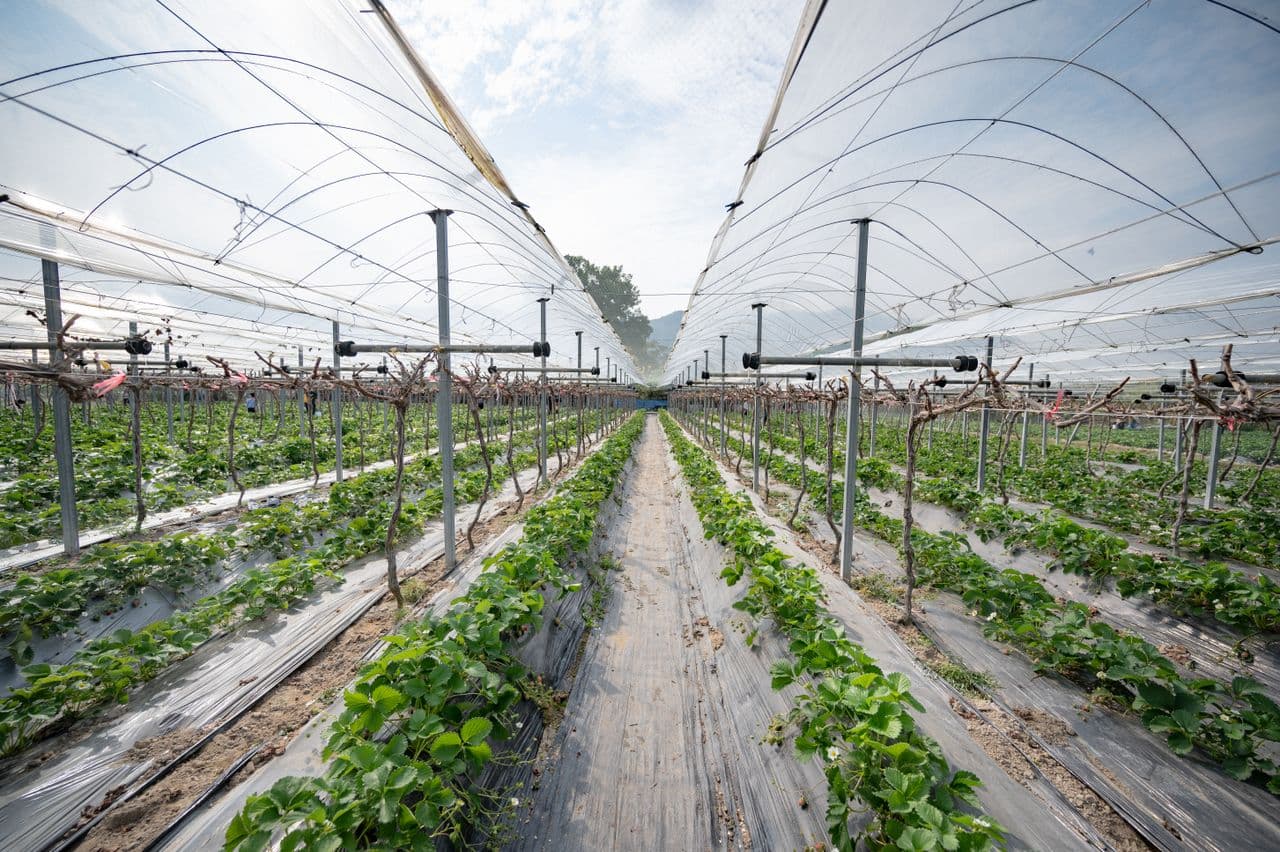
Greenhouse infrastructure has been digitised so that soil moisture, weather conditions, energy consumption and the water and nutrient requirements of the plants can be monitored in real time and optimised. Decisions previously made from experience and periodic inspection are made from continuous measurement, which reduces the risk of human error and makes labour planning more efficient.
Water is managed as a closed loop rather than as an input. Drainage water is recovered through filtration technologies and returned to the growing system, and a rainwater recovery system with a capacity of 4,000 tonnes, sufficient to meet the daily water requirement of one greenhouse, has been commissioned.
Heating comes from geothermal water, which is reinjected into its source after use so that the resource is sustained rather than depleted.
Production is soilless and takes place in a controlled environment, which removes the dependence on soil organic matter that constrains open field production. Pests are managed through biological control, which is what allows the produce to be grown without chemical residues.
Taken together the system addresses water stress, rising energy costs, resource inefficiency and the need for standardisation in the sector at the same time. It lowers production costs while going beyond legal requirements in water, fertiliser, energy and operational terms, and it supports reliable and sustainable food production rather than trading yield against efficiency.
Figure 1: Central monitoring of greenhouse conditions and resource use, which feeds the artificial intelligence supported irrigation, nutrition and climate decisions

Figure 2: Water treatment and filtration unit used to recover water for reuse in the greenhouses

Impact
Sustainability Impact
Climate
The initiative targets Scope 1 emissions from greenhouse heating and Scope 2 emissions from the purchased electricity used in climate control, irrigation and pumping.
On the Scope 1 side, heating is supplied by geothermal water rather than by fossil fuel combustion, and the water is reinjected into its source after use. On the Scope 2 side, energy consumption is monitored continuously alongside water and nutrient demand, and the artificial intelligence layer optimises consumption instead of running fixed schedules.
A greenhouse-specific greenhouse gas reduction against the 2024 base year has not been separately quantified for this reporting period. The company's agriculture group has been in a continuous investment phase since 2023, with more than USD 450 million invested, so the operational footprint of the greenhouse business has been expanding year on year and a stable 2024 emissions baseline could not yet be established.
Nature
Water is the principal environmental result. Compared with conventional soil-based (open-field) farming, the system uses up to 72 per cent less water in total. This is a theoretical calculation against conventional practice rather than a measurement against a prior-year baseline. Within that total, the drainage recovery loop contributes a further saving of about 30 per cent in water and fertiliser.
The 4,000-tonne rainwater recovery system covers the daily water requirement of one greenhouse, substituting harvested rainfall for abstracted water in a country where approximately 79 per cent of fresh water already goes to agriculture.
Drainage water filtration technology is now in use across all of the company's greenhouses. The rainwater recovery system has been installed in 33 per cent of the greenhouses, with installation in the remainder planned by the end of the year.
Soilless production removes the cultivation pressure on soil in a country where approximately 88 per cent of agricultural soils have organic matter below 2 per cent, and biological control of pests replaces chemical intervention, which protects organisms in and around the growing environment and produces crops free of chemical residues.
Good Agricultural Practices certification under Global G.A.P. confirms production without chemical, physical or microbiological residues harmful to human health, without polluting the environment or damaging the natural balance, and in line with international regulation.
Social
Employment structure is the principal social result. Women make up 75 per cent of the workforce in the greenhouses and 70 per cent across the agriculture group, and this employment is registered, which is a direct contribution in a sector where 91.9 per cent of women work informally.
Automation changes the nature of the work rather than removing it. As automation systems have spread, staff have been directed towards more qualified roles, and operational processes are improved continuously using feedback from the field teams.
Training is delivered through the group's agriculture academy, with investment in sustainable agriculture skills focused particularly on women and young people, and protocols signed with secondary schools to develop a qualified workforce for the sector.
The GRASP certificate, a voluntary standard developed to assess social practice in agriculture, covers worker health, safety and welfare and has been awarded alongside Global G.A.P.
Production without chemical residues also serves food safety for consumers, and the wider investment in dried food and climate-resilient seed supports access to healthy food and security of food supply.
Business Impact
Benefits
Production costs fall. Water, fertiliser, energy and labour use are optimised by the same system, so the savings appear across several cost lines at once rather than in one.
Operational reliability improves. Continuous measurement reduces the risk of human error, standardises decisions that previously depended on individual experience, and makes workforce planning more efficient.
Market access is the commercial return. Produce grown without chemical residues in the geothermally heated greenhouses is exported to 33 countries, principally in Europe, and the business receives an agricultural export award every year.
Certification underpins that access. Global G.A.P. and GRASP are conditions of entry for the European retail customers the business supplies, and the monitoring data generated by the management system provides the evidence those audits require.
The agriculture business also demonstrated that corporate scale farming is financeable in Türkiye by securing the sector's first project financing from an international development bank, which lowered the cost of capital for the wider investment programme.
Elsewhere in the agriculture portfolio, the micro-granular fertiliser produced at the company's plant allows up to 10 times less chemical fertiliser to be applied per unit area for equivalent plant nutrition, and is produced with about 65 per cent less energy and 70 per cent less water than conventional methods, which reduces both input use and transport cost per hectare treated.
Costs
The investment base is the sensor instrumentation, automation infrastructure, data analysis platforms, filtration technology for drainage water recovery and the rainwater recovery systems, together with the geothermal heating and reinjection infrastructure that supports the model.
Costs continue after commissioning. Technology investment, employee training, data monitoring and dissemination work are continuing activities rather than one-off items, and the digital infrastructure requires maintenance and skills that greenhouse operations have not traditionally carried.
Coverage is still being completed. Drainage water filtration is in place across all greenhouses, but the rainwater recovery system reaches 33 per cent, with the remainder planned by the end of the year, so part of the water benefit is still to come.
The model also depends on conditions that not every operator has: access to a geothermal or other low-carbon heat source, controlled environment structures capable of carrying the instrumentation, and a soilless growing system.
Costs are contained by standardising drainage and rainwater recovery in new greenhouse investments so that the systems are specified at build rather than retrofitted, by reusing the same monitoring data for operational, certification and sustainability reporting purposes, and by developing skills through the group's agriculture academy rather than buying them in.
Impact Beyond Sustainability And Business
Co-benefits
The wider agriculture model carries benefits beyond the greenhouses. Dried food production is a direct response to food waste, and climate-resilient seed breeding addresses resilience upstream of the growing operation.
The model has been transferred to Kazakhstan, which shows that the design is not dependent on one national context, and it led the institutionalisation of corporate agriculture in Türkiye.
Skills investment through the agriculture academy, the protocols signed with secondary schools and the joint projects and field research conducted with non-governmental organisations spread capability into the wider sector rather than retaining it inside the company.
The greenhouse operations are reported as contributing to at least 9 of the 17 United Nations Sustainable Development Goals, which reflects the breadth of a design connecting water, energy, employment, food safety and biodiversity in one operation.
Potential Side-Effects
Automation shifts the skills required rather than reducing headcount, and the transition has to be managed with training if experienced growing staff are to move into the more qualified roles the system creates.
Dependence on data and connectivity increases. Decisions previously made by inspection now rely on sensor accuracy, calibration and the availability of the analysis platform, which introduces a failure mode that manual operation did not have.
Geothermal heating is only as sustainable as the reinjection regime that supports it, so the abstraction and reinjection balance has to be monitored over the long term rather than assumed.
Soilless production removes soil degradation pressure but introduces substrate and nutrient solution management, and the closed loop only delivers its full benefit where drainage recovery and filtration are maintained to specification.
Recovery percentages of the kind reported here depend on the starting point. An operator moving from an already efficient irrigation regime should expect smaller proportional savings than one moving from conventional practice.
Implementation
Typical Business Profile
The model suits controlled environment and soilless growing operations — modern greenhouses and protected horticulture — where water, energy and nutrient inputs are already delivered through an engineered system that can be instrumented and automated.
It is most relevant in water-stressed regions and in operations with access to a low-carbon heat source, and it adapts to agricultural businesses of different sizes because the sensor, analytics, recovery and automation layers can be added incrementally.
Delivery engages agricultural operations, technical infrastructure, technology, sustainability and human resources teams working together, with local business partners and international technology providers supplying the sensor, automation and water recovery components.
Approach
Measure the resource baseline per greenhouse: Record water, fertiliser and energy use per growing area, and express savings relative to conventional soil-based (open-field) farming.
Instrument the growing environment before automating it: Install sensors for substrate moisture, weather conditions, energy consumption and plant water and nutrient demand, and confirm data quality first, because automated decisions inherit the accuracy of the measurement layer.
Move decisions from schedules to measured demand: Use the analytics layer to set irrigation, nutrition and climate control against measured plant demand rather than fixed timetables, and record where the automated decision differs from previous practice so that the change can be evaluated.
Close the drainage loop: Install filtration to recover drainage water and return it to the growing system, and roll the technology out across the whole estate rather than to selected houses, so that the recovery percentage is an estate-wide figure.
Add rainwater harvesting sized to daily demand: Build storage capable of covering the daily water requirement of a greenhouse, in this case 4,000 tonnes, and set a dated completion plan for the remaining sites rather than leaving coverage partial.
Decarbonise the heat source and protect it: Use geothermal or another low-carbon heat source where available, and reinject the water into its source after use so that the resource is maintained over the long term.
Replace chemical pest control with biological control: Introduce beneficial organisms as the primary pest management method, and certify the outcome under Good Agricultural Practices and social practice standards so that the residue-free claim is independently verified.
Standardise the design in new investments and build the skills: Specify drainage and rainwater recovery as standard in every new greenhouse, run operational training through an internal academy, sign protocols with secondary schools to develop qualified staff, and feed field team observations back into process improvement.
Stakeholders Involved
Project leads: The system is managed as a strategic project with the direct support of the holding company's central management and the senior management of the agriculture group, and it is integrated into the holding company's long-term investment plans against objectives for resource efficiency, environmental sustainability, operational excellence and social inclusion. The agriculture group is represented within the holding company's central sustainability governance structure, and its company-level annual sustainability targets feed the group's shared impact and net zero initiatives.
Company functions: Agricultural operations, technical infrastructure, technology, sustainability and human resources teams work together under a multi-stakeholder governance model. Sensor systems, automation infrastructure, data analysis platforms and recovery technologies were integrated into greenhouse operations as a single corporate integration exercise rather than as separate departmental projects, and technology investment, employee training, data monitoring and dissemination continue on a regular cycle.
Main providers: Local business partners and international technology providers supplied the internet of things sensors, automation systems and water recovery technologies and worked with the company on their specification, with the technology options evaluated jointly during the design phase against their contribution to resource efficiency. Independent certification bodies audit the Good Agricultural Practices and social practice standards.
Other: Public institutions, academic institutions, local communities, employees and sector stakeholders take part. Employees and local communities are among the principal stakeholders of the application, and feedback is collected through regular field assessments, operational meetings, performance analyses and technical monitoring processes, so that effects in the field are tracked and the system is developed against need. Joint projects and field research are conducted with non-governmental organisations, good practice examples are shared through sector platforms, and awareness work is carried out through digital channels.
Key Parameters To Consider
Water and fertiliser savings are calculated relative to conventional soil-based (open-field) farming. Drainage water filtration is in use across all greenhouses; the rainwater recovery system is installed in 33 per cent, with the remainder planned by the end of the year.
Savings depend on the starting efficiency of the operation, on the crop and on the climate, so the reported figures of up to 72 per cent in total water consumption and a further 30 per cent from the recovery systems should be read as the result of the full package rather than of any single component.
The operations hold Global G.A.P. and GRASP certification, export to 33 countries and are reported as contributing to at least 9 of the 17 United Nations Sustainable Development Goals.
The wider investment context is a stated ambition to be among the 10 largest agricultural investors globally by 2030, which is a target rather than a current position.
Implementation And Operations Tips
Integration is what produces the result. Sensors, analytics, recovery technology, automation and circular resource management were brought together under one structure, and the savings reported here would not follow from installing any one of them alone.
Roll recovery technology across the whole estate before optimising further. Drainage filtration in every greenhouse produced an estate-wide result, whereas the rainwater system at 33 per cent coverage still has most of its benefit ahead of it.
Design the social side into the operation rather than alongside it. Registered employment, a 75 per cent share of women in the greenhouse workforce and skills investment through an internal academy and school protocols are what allow the operation to meet a social practice standard as well as an agricultural one.
Expect the workforce conversation early. Field teams read automation as a threat unless the route to more qualified roles is visible, and their feedback is also the fastest source of process improvement.