Take refrigeration off-grid with device-level solar
 SKD Türkiye
Summary
A refrigerator with an integrated solar panel, battery and control unit runs without a grid connection, cutting use-phase emissions and food spoilage for unserved households.
Context
Submitted through the COP31 Sustainable Transformation Awards · SKD Türkiye (WBCSD Global Network Partner)
Arçelik A.Ş. manufactures household appliances in Türkiye's manufacturing sector and employs more than 1,000 people. The initiative is delivered by Defy Appliances, the company's South African brand, and developed jointly by the Defy and Beko research and development teams.
More than 600 million people in Sub-Saharan Africa and Southeast Asia have no access to electricity, and where a grid exists it is not always dependable. In South Africa more than 93 per cent of households experience food spoilage because of load shedding and load reduction. The fallback options for those households are a diesel generator or a fossil-intensive grid, both of which raise emissions and cost while leaving the underlying reliability problem in place.
Whole-home solar systems solve the reliability problem for households that can afford them, which excludes most of the population that needs them. The company's response was to change the boundary of the system: instead of powering a house so that the appliance works, power the appliance directly.
Research and development began in 2021 and the product was brought to market in March 2024. The initiative is at pilot and early commercialisation stage, with more than 1,500 units in the field in South Africa and neighbouring countries. The base year for impact measurement is 2024, the year of early commercialisation, and customer feedback has been collected continuously since July 2023.
Sustainability governance runs through a Sustainability Board chaired by the Deputy General Manager responsible for Finance and Financial Affairs, meeting quarterly, with the Deputy General Manager responsible for Sustainability, Quality and Customer Services acting as secretary. The company's disclosures cover targets aligned with SBTi validation, CDP reporting on climate, water and forests, and ISSB and TCFD aligned reporting.
Location of the initiative: South Africa and neighbouring countries, with early deployment concentrated in South Africa
Solution
The product is a refrigerator that carries its own generation and storage, so that it does not depend on a grid connection to keep food cold.
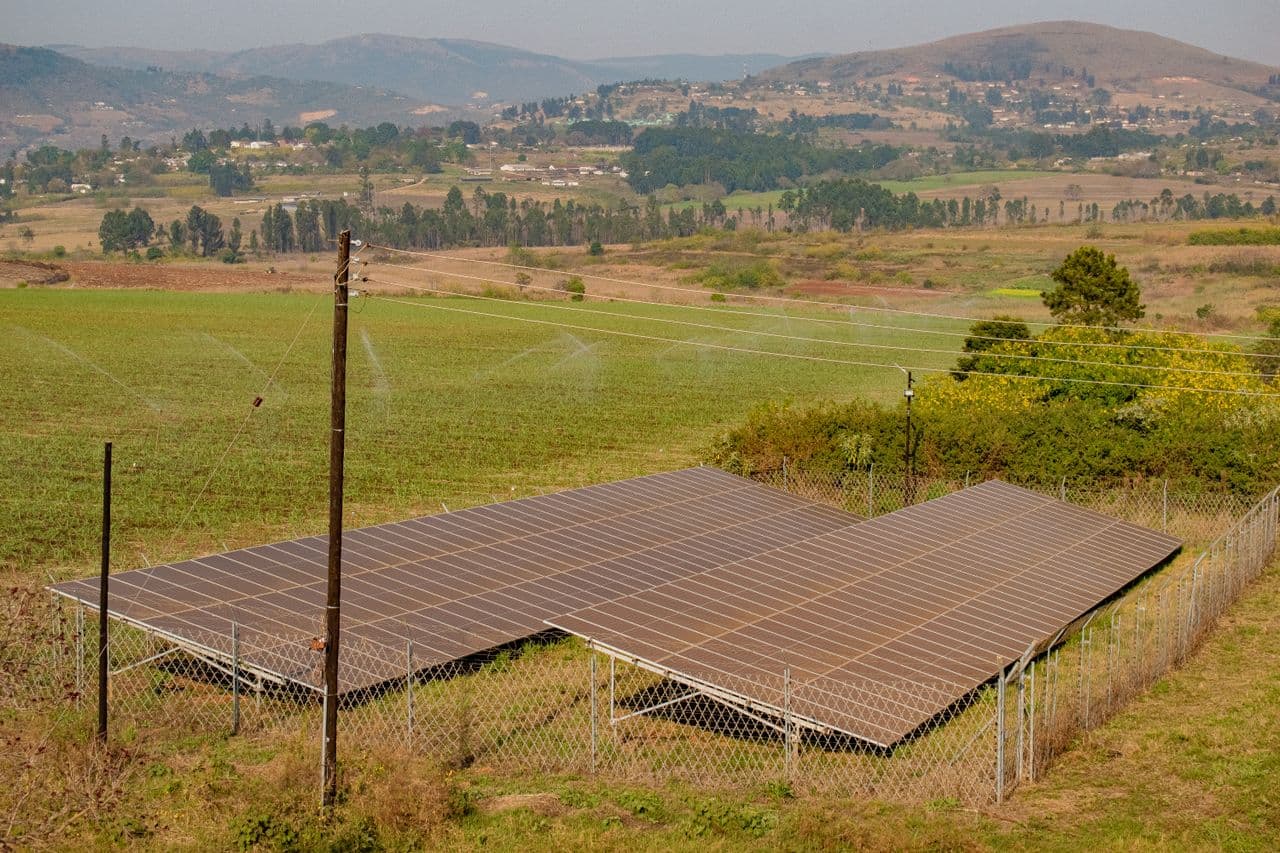
The system has four elements: the solar panel, the lithium-ion battery, the smart control box that manages them and the refrigerator itself. During the day the panel runs the refrigerator and charges the battery through the control box. At night the system runs from the battery. Where a grid connection exists the appliance can also operate in hybrid mode, drawing from the grid when that is the better option and from stored solar energy when it is not.
The control unit is the element that makes the economics work. By managing energy and battery behaviour autonomously it removes the need for an expensive inverter that is also a common point of failure in household solar installations, which takes both cost and a maintenance dependency out of the system.
The solar refrigerator's operating algorithm and compressor are optimised to function with a limited energy supply through the smart control system. The system is also designed to perform under low irradiance conditions and can maintain continuous cooling for up to three days without sunlight.
Demand is reduced before generation is added. A high-performance insulation system and an A plus rated inverter compressor minimise consumption, which in turn allows a smaller panel and battery and extends the working life of both.
The design inverts the usual paradigm by placing the appliance, rather than the house, at the centre of the energy system. This device-level microgrid approach brings the cost down to one fifth of a full home solar system, which is what turns clean refrigeration from an option for affluent households into an accessible product.
Regional adaptation is built into the specification. Modular design and region-specific panel sizing between 550 and 700 W accommodate different levels of solar irradiance, and the range covers more than one format: a 60 cm model and the larger CF300 model. A USB charging point on the appliance provides a route to digital access in homes with no other reliable power.
Figure 1: How the system works: the solar panel runs the refrigerator and charges the battery through the smart control box during the day, and the battery runs it at night.

Figure 2: Verified annual energy consumption of the 60 cm combi refrigerator and the CF300 chest freezer: grid electricity use falls to zero when the appliance runs on solar power.

Impact
Sustainability impact
Climate
The initiative does not reduce the company's own Scope 1 or Scope 2 emissions. It acts as an enabler in the use phase of a sold product, and the effect is accounted under Scope 3, Category 11: use of sold products, which is where the emissions of a refrigerator over its operating life sit. No change to national grid infrastructure is required to obtain the reduction.
The calculation follows the GHG Protocol Scope 3 approach. Avoided emissions are calculated as the downstream electricity emissions avoided by replacing grid-powered refrigerators with off-grid or hybrid solar models. The grid emission factor used is the International Energy Agency value for South Africa of 1.013 kg CO2 per kWh, and the annual consumption reduction per unit is based on verified energy use: 285 kWh per year saved on the 60 cm model and between 310 and 319 kWh per year on the CF300 model. The base year is 2024.
With more than 1,500 units in the field, more than 400 tonnes of CO2 have been avoided per year to date. A rollout scenario of 30,000 units by 2030 carries a reduction potential of 7,445 tCO2 per year; this is a target, not a realised result.
For off-grid users the reduction in downstream operational emissions is 100 per cent, because the appliance no longer draws grid electricity at all. Even in grid-connected hybrid use a reduction is obtained: approximately 11 kg CO2 per year, or 8 per cent, for class C refrigerators, and approximately 15 kg CO2 per year, or 10 per cent, for class E.
Impact data have been monitored since 2024, supported by customer feedback and field verification running since July 2023, and the results are addressed in the group's corporate sustainability reporting and in its published work on access to refrigeration.
Nature
The clearest resource result is avoided food waste. Field surveys show that spoilage incidents in a typical household fall from weekly to less than monthly, so food that would have been produced, transported and discarded is instead eaten.
Beyond the household, reliable cold storage reduces post-harvest losses where the technology is applied to agricultural value chains, which addresses waste at the point in the chain where most of the embedded resource has already been spent.
The control approach also extends battery and panel life, which delays replacement of the components that carry the highest material footprint in the system.
Social
The initiative delivers climate equity for populations that cannot otherwise obtain reliable refrigeration: households that would remain dependent on a diesel generator or a fossil-intensive grid, and those with no connection at all.
More than 1,500 units are installed in South Africa. Field surveys record that spoilage incidents in a typical household fall from weekly to less than monthly, which is a direct food security and nutrition result rather than a proxy indicator.
More than 50 Defy technicians have been trained and contracted for installation and service, bringing local enterprises into the value chain and creating skilled work in the regions where the units are sold.
The USB charging point provides digital access in homes without dependable power, and the technology strengthens women-led micro-enterprises in rural areas by making refrigerated stock viable for very small retailers.
A pilot designed and delivered with the civil society organisation Taking Care of Business placed the solution with communities in need in South Africa, and that partnership shaped the selection of target regions and use cases. The product was listed in TIME magazine's Best Inventions of 2025, which the company reports as external recognition of its affordability, modular solar installation and suitability for developing markets (1).
Business impact
Benefits
The product opens a market segment that conventional appliances cannot serve, in regions where unreliable or absent grid supply had previously ruled out refrigeration rather than merely made it inconvenient. More than 1,500 units have been placed during pilot and early commercialisation.
Cost is the commercial lever. At one fifth the cost of a full home solar system, the device-level approach lowers the barrier to clean energy adoption to a level that retail consumer finance can bridge, which converts a development need into a purchasable product.
The control unit is a platform rather than a component. The same energy management approach can be scaled to other appliance categories such as washing machines and air coolers, which makes the research and development investment the basis of an energy-independent product class rather than of a single model.
The installation and service network of more than 50 trained Defy technicians creates an after-sales capability in markets where the company would otherwise have limited local presence, and correct installation is what protects warranty performance.
External recognition, including the TIME Best Inventions listing for 2025, supports market entry in developing markets where the proposition is unfamiliar.
Costs
The cost base is research and development from 2021 to market launch in March 2024, the laboratory and test infrastructure behind it, production lines, and the human resources, talent development and training investment required for installation and service.
At unit level, the solar panel and lithium-ion battery add materially to the bill of materials compared with a conventional refrigerator, which is the reason affordability for low-income households remains the central constraint even at one fifth the cost of a home system.
Initial rollout is self-funded from the company's own resources, supported by consumer financing through retail partners, and the company is seeking a strategic government partnership that could provide grant opportunities for rural and low-income distribution. That mix determines how fast the installed base can grow.
The principal risks on the cost side are correct panel sizing, component supply, affordability for low-income households, installation and maintenance support in remote regions, panel theft or damage, and battery degradation over the operating life.
Costs are contained by removing the inverter through integrated control electronics, by reducing the load with insulation and an efficient compressor so that panel and battery can be smaller, by modular region-specific sizing that avoids over-specification, and by training local installers instead of operating a company service fleet.
Impact beyond sustainability and business
Co-benefits
The same technology is adaptable beyond the home: off-grid small retailers, clinics, agricultural value chains including milk cooling and the storage of medicines and crops, and humanitarian contexts.
Reliable cold storage reduces post-harvest losses and improves nutrition, and it strengthens women-led micro-enterprises in rural areas by making refrigerated stock possible where it previously was not.
Training more than 50 Defy technicians builds a local technical workforce whose skills transfer to other solar equipment in the same regions.
The energy management platform provides the basis for extending the approach to washing machines, air coolers and other categories, which would compound the access benefit across the household.
Potential side-effects
The system introduces a lithium-ion battery into households that previously had none, which creates a degradation and end-of-life management issue in regions where collection infrastructure for batteries is limited.
Panels are exposed assets. Theft and physical damage in remote areas are identified risks, and they fall on the household rather than on the manufacturer once the warranty period is over.
Performance depends on correct panel sizing for local irradiance and on correct installation, which is why installer training is tied to warranty coverage; an incorrectly sized or installed system will underperform and will be read by the user as a product failure.
Affordability remains the limiting factor for the households with the greatest need. Consumer finance through retail partners and grant funding are the mechanisms used to address it, and without them the product reaches the upper part of the target population rather than the whole of it.
Implementation
Typical business profile
The model suits appliance and equipment manufacturers selling into markets where grid supply is absent or unreliable, and that hold their own research and development and test capability for power electronics as well as for the appliance itself.
It is most relevant for companies with a local brand, manufacturing presence or distribution partner in the target market, because installation, service and warranty performance determine whether the proposition holds after the sale.
Delivery engages research and development, manufacturing, sales and marketing, after-sales service, quality and customer services, and sustainability functions, working with component suppliers, retail partners, trained local installers and civil society organisations that can reach the intended users.
Approach
Diagnose the energy failure at household level: Establish how the users actually lose their food - no connection at all, or scheduled load shedding - and what they currently do about it, because a generator-owning household and an unconnected household need different specifications.
Invert the system boundary: Place the appliance rather than the house at the centre of the energy system, so that generation and storage are sized for one load; this is what brings the installed cost down to one fifth of a full home solar system.
Cut the load before adding generation: Apply high-performance insulation and an efficient inverter compressor first, since every watt removed from the load reduces the panel, the battery and the price the target household has to meet.
Replace the inverter with integrated control electronics: Design a control unit that manages energy and battery autonomously, which removes the most expensive and failure-prone component of a conventional household solar installation and reduces service demand in remote areas.
Size the array for the region rather than for the product: Use modular design and region-specific panel sizing, in this case between 550 and 700 W, so that the same appliance performs across different irradiance levels without over-specification.
Build the installer network before pushing volume: Train and contract Defy technicians, in this case more than 50, and link warranty coverage to correct installation so that quality control is enforced through the commercial terms.
Open a financing route for the intended users: Arrange consumer financing through retail partners and pursue grant opportunities for rural and low-income distribution, because the households with the highest need cannot fund the purchase from savings.
Quantify the avoided emissions with a documented method: Calculate under the GHG Protocol Scope 3 approach using a published grid emission factor - here the International Energy Agency value of 1.013 kg CO2 per kWh for South Africa - and verified per-unit consumption, fix the base year, and validate the user-level result with field surveys of spoilage incidents.
Stakeholders involved
Project leads: The initiative is publicly owned at chief executive level, and the group published a corporate report on access to refrigeration in May 2024 that frames the problem the product addresses. Sustainability governance runs through a quarterly Sustainability Board chaired by the Deputy General Manager responsible for Finance and Financial Affairs, with the Deputy General Manager responsible for Sustainability, Quality and Customer Services as secretary; sustainability-related matters are assessed by that board while daily implementation and ownership sit with the relevant product teams and the sustainability department.
Company functions: The Defy and Beko research and development teams developed the product jointly, with the South African brand running market delivery. Manufacturing, sales and marketing, after-sales service, quality and customer services and sustainability functions are engaged through market launch, warranty and support, awareness campaigns and continuous customer feedback processes.
Main providers: Component suppliers provide the solar panels, lithium-ion batteries and control electronics. Retail partners provide the sales channel and the consumer financing that makes the purchase affordable. More than 50 Defy technicians have been trained and contracted as authorised installers and service partners, and correct installation is critical to warranty coverage.
Other: Taking Care of Business, a civil society organisation, designed and delivered a pilot with communities in need in South Africa and took a role in identifying target regions and use cases. Local communities are engaged directly: households living with load shedding and off-grid conditions, women-led micro-enterprises and end users shaped the specification around their own needs, including food security and USB charging for digital access. A feedback mechanism has run since July 2023, with field tests and surveys of spoilage incidents used to improve both the design and the service.
Key parameters to consider
The initiative is at pilot and early commercialisation stage. Research and development began in 2021, the market launch was in March 2024, the base year is 2024 and feedback has been collected since July 2023.
Five indicators are used: avoided CO2 per unit and in total, the number of units installed, average daily energy consumption per unit, food spoilage incidents caused by load shedding measured before and after, and the number of trained and contracted authorised installers and service partners.
Technical parameters: region-specific panel sizing between 550 and 700 W; verified consumption savings of 285 kWh per year on the 60 cm model and 310 to 319 kWh per year on the CF300 model; a grid emission factor of 1.013 kg CO2 per kWh for South Africa; installed cost at one fifth of a full home solar system.
The starting market is South Africa, where more than 93 per cent of households experience load shedding-related spoilage, and the solution also applies in countries such as Nigeria, Zambia, the Democratic Republic of the Congo, Myanmar and Haiti. The stated target is 30,000 units by 2030.
Implementation and operations tips
Reduce the load first. Every improvement in insulation and compressor efficiency is repaid twice, once in the size of the panel and once in the size of the battery, and it is the cheapest route to an affordable off-grid appliance.
Design out the inverter. It is the component that fails most often in household solar systems and the one hardest to service in a remote area, so integrating its function into a control unit removes a cost and a support liability at the same time.
Tie warranty to installer training. The performance a user experiences is determined largely by installation and panel sizing, so treat the installer network as part of the product rather than as a distribution detail.
Measure what the user notices alongside the tonnes avoided. Spoilage incidents falling from weekly to less than monthly is the evidence that persuades the next household, while the emissions calculation is what satisfies the reporting requirement; both are needed.