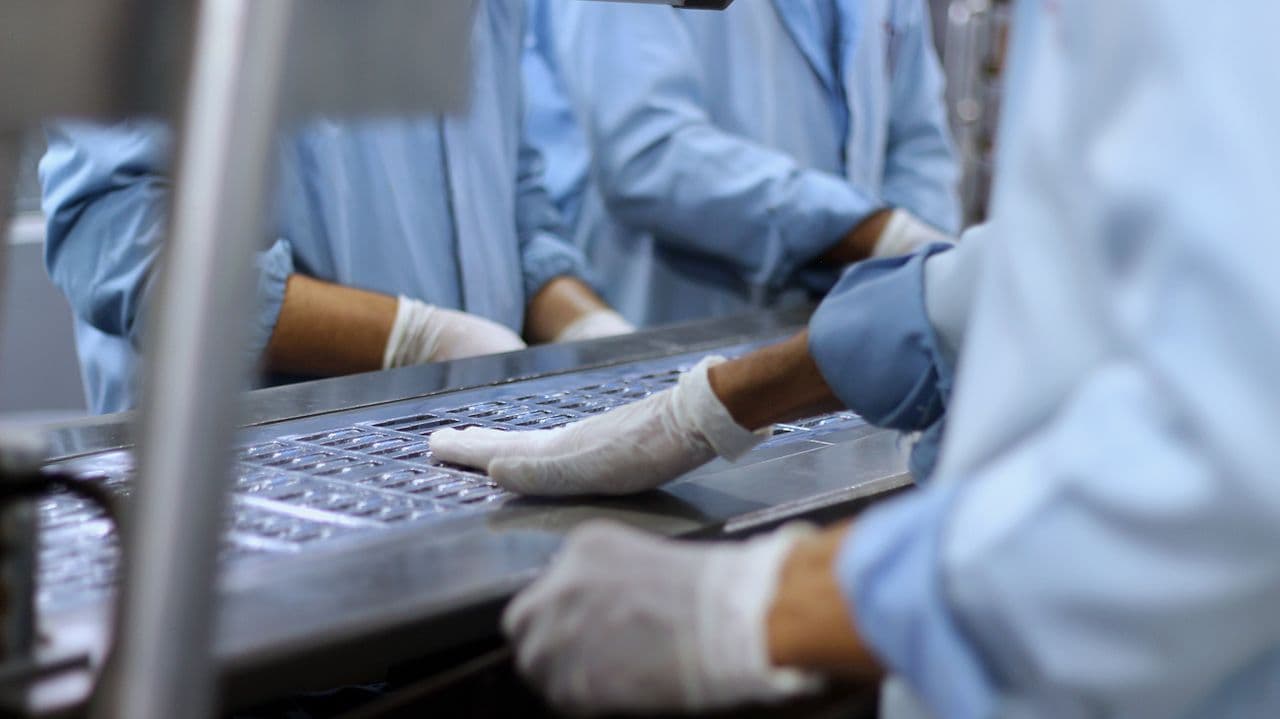
Optimise blister layouts to cut packaging carbon
 Abdi İbrahim
 SKD Türkiye
Summary
An artificial intelligence algorithm redesigns blister and carton layouts so the same medicine is packed in less aluminium, PVC and carton, and ships on fewer pallets.
Context
Submitted through the COP31 Sustainable Transformation Awards · SKD Türkiye (WBCSD Global Network Partner)
The company is a pharmaceutical manufacturer with nearly 5,800 employees in Türkiye, and its portfolio covers nearly 250 brands and more than 500 products, developed in house as well as under agreements with 30 licensors.
Blister medicines are packed in aluminium, PVC and carton, all of them carbon-intensive inputs bought in large volumes. The quantity used is set by the blister layout and the carton dimensions chosen when a product is first designed, and in pharmaceutical manufacturing those dimensions are rarely revisited: a packaging change normally triggers stability testing, marketing authorisation updates and operational disruption, so the material specified at launch tends to stay for the life of the product.
The company's packaging strategy, Green Harmonization, sits inside its HEAL2050 sustainability strategy and is organised into three phases: reduce, switch and collect. The question the reduce phase put was narrower and more tractable than a redesign: could the same number of tablets be packed in less material without altering the tablet cavities themselves, and therefore without triggering re-registration?
Work began in 2021 with an academic partner, and the resulting optimisation system has since been registered as a patent by the Turkish Patent and Trademark Office in 2026. It is now part of the company's routine blister packaging design process rather than a project, and its results have been disclosed through the company's sustainability reports and CDP reports.
Location of the initiative: Türkiye
Solution
The solution is an artificial intelligence-based optimisation algorithm, developed through university-industry collaboration, that proposes the most efficient blister arrangement for a given product, reducing the number of blisters required and consequently enabling the carton size and overall packaging material use to be reduced.
Its defining constraint is what it does not touch. The tablet cavities themselves are left unchanged, so the surface in contact with the medicine is identical and the change does not create a re-registration requirement. What the algorithm alters is the arrangement of the blister and the carton dimensions that follow, which is where the aluminium, PVC and carton are consumed.
Because the assessment runs at the design stage, cost, sustainability and regulatory criteria are weighed together rather than sequentially, and the environmental reduction is achieved in the first step of the production process rather than downstream of it.
Optimum blisters and cartons then propagate through the operation. The same quantity of medicine occupies less volume, which reduces the number of pallets moved and frees production and storage capacity.
The system was applied to 26 licensed products covering approximately 91 million boxes. Across that volume the results were a 28 per cent reduction in packaging-related greenhouse gas emissions per box, 179 tonnes of packaging material avoided, an energy saving equivalent to the annual electricity consumption of 150 households, 90 kg of production waste prevented, 6 weeks of freed capacity, a reduction of 2,500 pallets in annual pallet circulation, and an annual material saving of EUR 1 million.
The algorithm is now integrated into operational processes and used both for new products and for optimisation work on the existing range. Collaboration and service arrangements are run through the group's technology company, which makes the system available to organisations for which the company manufactures and, in principle, to other pharmaceutical producers. A follow-on project extending the same logic to cardboard and pallet optimisation, called GreenPack, started in 2025.
Figure 1: Before and after for the same tablet count: five blisters of six tablets, each 54 by 93 mm, replaced by two blisters of fifteen tablets, each 64 by 112 mm, with the tablet cavities unchanged.

Figure 2: Results across the 26 licensed products: 179 tonnes of packaging material avoided and 28 per cent lower packaging emissions per product, production waste prevented equivalent to 8,600 PET bottles, energy saved equivalent to 150 households, lower pallet circulation, EUR 1 million saved a year and 6 weeks of spare capacity.

Impact
Sustainability impact
Climate
The initiative addresses Scope 3, Category 1: Purchased goods and services, because the reduction comes from buying less aluminium, PVC and carton for the same output. A second effect falls in Scope 3, Category 12: End-of-life treatment of sold products, as less material use means less packaging waste.
The reference point is the packaging design in use before optimisation, product by product, and the calculation is a before-and-after comparison. Greenhouse gas reductions are derived from the quantity of packaging material and packaging waste avoided, using DEFRA emission factors. The base year is 2021, the year the project started, and the impact data covers 26 products optimised between 2022 and 2025.
Across the 26 licensed products and approximately 91 million boxes assessed, the optimisation of aluminium, PVC and carton use produced a 28 per cent reduction in packaging-related greenhouse gas emissions per box, 179 tonnes of packaging material avoided, an energy saving equivalent to the annual electricity consumption of 150 households, and 90 kg of production waste prevented.
Results are monitored by the sustainability, production and technical operations teams, published through the sustainability reports, and sit inside a 2050 net-zero pathway whose targets are validated by the Science Based Targets initiative.
Nature
The direct effect is less virgin material entering the system. Aluminium, PVC and carton are the three inputs the optimisation targets, and 179 tonnes of packaging material were avoided across the volume assessed.
Production waste is affected as well, with 90 kg prevented, and the reduction of 2,500 pallets in annual circulation lowers the handling and transport load associated with moving the same quantity of medicine.
Energy demand falls with material demand: the saving is equivalent to the annual electricity consumption of 150 households.
No land, water or biodiversity indicator has been quantified. The reported outcomes are material avoided, waste prevented, energy saved and the emissions equivalent derived from them.
Social
The system was developed through university-industry collaboration, with academic partners contributing to the construction of the optimisation algorithm and the company's technical functions defining the operational, product safety and regulatory constraints it had to respect. The result is capability held jointly rather than bought in.
Registering the system as a patent in 2026 gives it an institutional basis, and the results have been published through the company's sustainability reports so that the method is visible outside the organisation.
That visibility reaches health professionals, pharmacists, hospitals, organisations for which the company manufactures and other participants in the sector, which turns an internal efficiency measure into a demonstration that packaging material can be reduced inside pharmaceutical constraints.
Nothing changes for the patient: the tablet cavities, and therefore the product's contact packaging, are untouched.
Business impact
Benefits
The material saving is EUR 1 million a year across the volume assessed, achieved without a change to the medicine, to the tablet cavities or to the marketing authorisation.
Avoiding re-registration is itself the central commercial benefit. Packaging changes in this sector normally carry stability testing, licence variation and operational disruption; by holding the tablet cavity geometry constant the system removes that cost from the change, which is what makes optimisation viable across a portfolio rather than for one product at a time.
Operational capacity improves alongside material use. The work released 6 weeks of free capacity and removed 2,500 pallet movements a year, which reduces warehouse occupancy and handling.
The results were achieved across 26 licensed products and approximately 91 million boxes, so the assessment cost per product falls as the system is reused, and payback periods on the investment are described by the company as reasonable.
The capability has also become an asset in its own right. It is registered as a patent, integrated into the design process for new products, and offered through the group's technology company to organisations for which the company manufactures and to other pharmaceutical producers.
Costs
The main cost is the development of the algorithm itself, carried out from 2021 through a university-industry collaboration, with investment decisions taken at senior management level. That is a capability build rather than a per-product cost, and it has to be recovered across a portfolio.
Each product then requires analysis: the existing pack design has to be compared with the proposed layout, and the proposal validated by production, technical operations, research and development, quality, regulatory affairs and supply chain functions before it is adopted.
Operational change carries its own cost. New blister and carton dimensions mean tooling settings, line trials and logistics changes, and change management is one of the risks the company identifies for wider deployment.
Extending the system beyond its home market raises further costs: different national regulations and product safety requirements have to be accommodated, and an adopting manufacturer needs the investment capacity to integrate the system into its own design process.
Costs are contained by the design that avoids re-registration, by reusing the same system across 26 products and approximately 91 million boxes rather than treating each as a separate project, and by running collaboration and service arrangements through the group's technology company so the capability can be shared rather than rebuilt.
Impact beyond sustainability and business
Co-benefits
Freed capacity and reduced pallet circulation are operational gains that arrive with the environmental result rather than being traded against it: 6 weeks of capacity and 2,500 fewer pallet movements a year came from the same change that removed the material.
The approach is transferable beyond the products it was built for. The company identifies tablet-form medicines as the primary application but also food supplements and other products with a similar packaging structure, and the system is designed to adapt to different production volumes and operating conditions.
A follow-on project, GreenPack, started in 2025 and extends the same optimisation logic from the carton to the cardboard and pallet, addressing the layer of packaging this project did not reach.
Because the results have been published and the system is offered through the group's technology company, the method is available to the sector rather than held as an internal advantage.
Potential side-effects
The gain is one-off per product. Once a pack has been optimised the same saving cannot be taken again, so the pipeline depends on new products entering the portfolio and on extending the method to packaging layers it has not yet covered, which is what the follow-on case and pallet project addresses.
The optimisation is bounded by the constraint that makes it viable. Leaving the tablet cavities untouched is what avoids re-registration, but it also fixes part of the geometry, so the material reduction available is limited to the arrangement and the carton around it.
Transfer across borders is not automatic. Different national regulations and product safety requirements govern pack content and dimensions, so the system has to be reconfigured for each regulatory environment, and adopting organisations face investment and change management requirements.
Smaller packs also change how a product presents on the shelf and how it is handled in the supply chain, which is why line trials and logistics assessment sit inside the process rather than after it.
Implementation
Typical business profile
The model suits pharmaceutical manufacturers packing solid dose products in blisters and cartons, with in-house packaging design, regulatory affairs, quality and production functions and enough registered products for a design-stage tool to be worth building.
It applies equally to producers of food supplements and other goods with a comparable blister and carton structure, and it adapts to different production volumes and operating conditions.
The practical requirements are reliable data on pack dimensions and production and logistics parameters, a technology partner able to build and maintain the optimisation algorithm, and a change management route into the design process so that the tool is used on new products by default rather than on request.
Approach
Identify which packaging materials dominate the footprint: Establish that aluminium, PVC and carton account for the carbon-intensive share of a solid dose pack, so the optimisation is aimed at the materials that carry the emissions rather than at pack count or weight in general.
Define the constraint that must not move: Fix the tablet cavities as untouchable, because leaving the contact surface unchanged is what avoids a re-registration requirement and therefore what makes portfolio-wide optimisation affordable.
Build the optimisation with an academic partner: Develop the algorithm through university-industry collaboration, with the academic side constructing the optimisation method and the company's technical functions supplying the operational, product safety and regulatory constraints it must respect.
Feed the algorithm cost, sustainability and regulatory criteria together: Assess the three at the design stage in one calculation rather than optimising for one and checking the others afterwards, so the proposed layout is already compliant and commercially sensible when it reaches review.
Validate proposals product by product with the technical functions: Route each proposed layout through production, technical operations, research and development, quality, regulatory affairs and supply chain review, and shape the analysis according to the feedback those functions give.
Prove the change on the line and in the warehouse before committing: Run production trials on the new blister and carton dimensions and check the logistics effect, since capacity and pallet gains only appear if the pack runs cleanly at production speed.
Institutionalise the tool instead of running it as a project: Embed the algorithm in the design process for new products and in optimisation work on the existing range, protect it through patent registration, and place collaboration and service arrangements with a dedicated technology unit so it survives beyond the original team.
Measure across every dimension the change affects: Track emissions per box, packaging material avoided in tonnes, energy saved, pallet circulation removed and money saved together, because a single indicator understates a change that moves material, energy, capacity and logistics at the same time.
Stakeholders involved
Project leads: The initiative was started under the leadership of the group president responsible for human resources, corporate communications and sustainability, and investment decisions were taken by senior management, which also tracked the objectives, performance and results on a regular basis. Long-term continuity is anchored in the HEAL2050 strategy, the climate targets validated by the Science Based Targets initiative, the company's sustainability roadmap and its operational excellence approach. The patent registration obtained in 2026 provides a further institutional basis for developing and extending the system.
Company functions: Sustainability, production, technical operations, research and development, quality, regulatory affairs, supply chain and the group's technology unit delivered the work together. The division of work was clear: the technology and academic side built the optimisation, while the operational functions defined the constraints it had to satisfy and then tested its output. Feedback from those functions was assessed through the decision process and the product-level analyses were reshaped accordingly, so the algorithm's proposals were treated as candidates for review rather than as instructions. Results were monitored regularly, performance indicators shared with the functions involved, and improvements made on the basis of what the monitoring showed. That loop is what turned a research output into an operating process.
Main providers: Academic partners contributed to the construction of the artificial intelligence based optimisation algorithm under a university-industry collaboration. The group's own technology company runs the collaboration and service arrangements through which the system is offered outside the company, including to organisations for which the company manufactures. Packaging material suppliers are affected by the change, since reduced aluminium, PVC and carton consumption alters order volumes and specifications along the supply chain.
Other: The Turkish Patent and Trademark Office registered the system as a patent in 2026, which underpins its further development and wider use. Health professionals, pharmacists, hospitals, organisations for which the company manufactures and other sector participants form the audience for the published results, and the visibility of the approach among them is one of the stated outcomes. The results of the initiative have been shared through the company's sustainability reports and CDP reports. The initiative is also presented in relevant training programmes, helping to share the approach and lessons learned with wider stakeholder groups.
Key parameters to consider
The base year is 2021, the year the project started, and impact data covers the four years from 2022 to 2025. The system is now institutionalised rather than running as a project.
Scope of application to date: 26 licensed products and approximately 91 million boxes. Results are reported for that segment, so they scale with volume and with the number of products assessed rather than being a fixed portfolio figure.
The governing technical parameter is that tablet cavities are not modified. This is what keeps the change outside the re-registration route and defines the limit of the material reduction available.
Delivery requires production line trials and logistics assessment for each new pack dimension, and the risks to wider deployment are different national regulations, product safety requirements, investment need and change management.
A follow-on project extending the same optimisation to cardboard and pallet level, GreenPack, started in 2025 and is in progress.
Implementation and operations tips
Choose the constraint that keeps the change out of the regulatory route. Optimising the arrangement of tablet cavities rather than the cavities themselves is the decision that makes this affordable; a design change that triggers re-registration will not survive a portfolio-wide rollout.
Run the assessment at design stage. Cost, sustainability and regulatory criteria evaluated in the same calculation produce a proposal that can be adopted; evaluated in sequence they produce a proposal that has to be reworked.
Build the tool with an academic partner but validate with the line. The optimisation method came from the university side, while production, quality and regulatory teams determined whether each proposal was usable, and both inputs were necessary.
Count the logistics and capacity effects. Material savings alone understate the result: 6 weeks of freed capacity and 2,500 fewer pallet movements a year came from the same change and are what make the business case persuasive to operations.
Plan for the pipeline, not the project. Each pack can only be optimised once, so extending the method to further packaging layers, as the follow-on cardboard and pallet project does, is what keeps the reduction going.