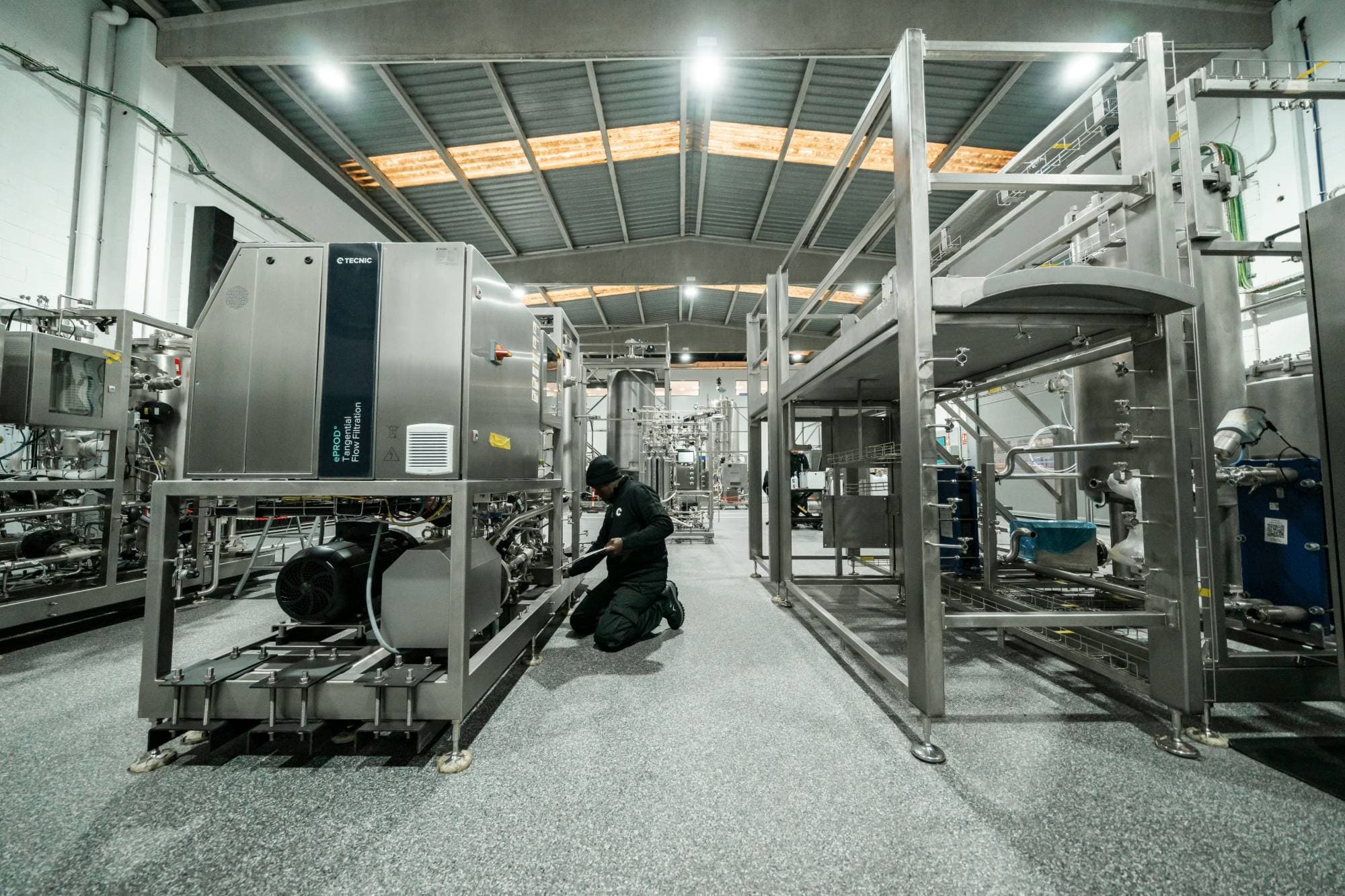
Adopt start-up solutions to decarbonise group operations
 İnci Holding
 SKD Türkiye
Summary
An open innovation platform brings start-up solutions into industrial operations through proof-of-concept trials and venture clienting, cutting energy use and emissions.
Context
Submitted through the COP31 Sustainable Transformation Awards · SKD Türkiye (WBCSD Global Network Partner)
The company is an industrial holding whose head office employs fewer than 50 people and which coordinates the sustainability and competitiveness agenda of its group manufacturing companies.
Industrial groups face a recurring problem when they try to decarbonise: the technical solutions needed for energy efficiency, carbon reduction, circularity, digitalisation, sustainable logistics and occupational health and safety exist in the start-up ecosystem, but they rarely reach the factory floor. Start-ups lack access to industrial operating environments in which to prove their technology, and industrial companies lack a route to test unproven solutions without exposing production.
The company set up an open innovation and corporate entrepreneurship platform in 2022 to close that gap from both sides. The platform brings ventures into real operations as suppliers rather than as pitch-deck presenters, so a solution is tested where it will be used.
A second, complementary mechanism sits alongside it. A grant programme run by the group's foundation supports sustainability-focused solutions developed by postgraduate students, with grants, mentoring, training and access to networks.
Read together, the two mechanisms work on opposite sides of the same market: the platform accelerates demand-side transformation inside industry, while the grant programme feeds supply-side innovation before it becomes investable. The base year for impact measurement is 2022, and the data covers the period from 2022 to 2025.
Location of the initiative: Türkiye, with international sourcing through the Canada-Türkiye Sustainability Challenge; the grant programme reached 25 universities across 18 cities
Solution
The platform is an open innovation and corporate venturing structure that connects the entrepreneurship ecosystem with industrial operations in defined focus areas: energy efficiency, carbon reduction, circular economy, digitalisation, sustainable logistics and occupational health and safety.
Its operating mechanism is venture clienting. Instead of taking equity or running an accelerator, the group companies become customers of the ventures. That single design decision changes the incentives on both sides: the venture gets revenue and a reference deployment in a real industrial environment, and the group gets a solution that has been tested against its own process conditions rather than a demonstration.
Around that core sit three routine activities: open innovation calls that surface candidate solutions, technology matching that pairs a venture with a specific operational problem in a specific group company, and proof-of-concept trials that establish whether the solution performs at production conditions before any wider commitment.
Focus areas are not chosen by the platform in isolation. They are set in line with the business objectives and sustainability priorities of the group companies, and venture selection and pilot deployment are assessed within that frame, which is what keeps the pipeline connected to operational need.
The grant programme completes the model on the supply side. It supports postgraduate students developing sustainability-focused solutions through grants, mentoring, training and network access, strengthening capacity in education, environment and local development, and building the pool of ventures that may later enter the platform.
The result is a two-sided model. The platform shortens the time it takes a sustainable technology to reach the market, while the grant programme widens the set of technologies that exist to be adopted.
Figure 1: İnci Radar Venture Clienting Model

"İnci Radar transforms business challenges into innovation opportunities through a structured venture clienting model, connecting startups with group companies to accelerate collaboration, pilot projects, and long-term value creation."
Figure 2: An integrated innovation ecosystem that transforms technological opportunities into sustainable value, stronger portfolios, and new growth areas.

Impact
Sustainability impact
Climate
The platform is an enabler rather than a direct abatement project. The reductions are realised in the operations of the group companies that adopt the ventures' solutions, that is in their own energy use and emissions, rather than in the platform itself. Through startup and group company collaborations facilitated by İnci Radar, the group companies have implemented a range of energy efficiency and energy-saving projects. As a result, these initiatives have collectively contributed to the reduction of approximately 10,000 tCO2e of Scope 2 emissions to date, demonstrating the tangible climate impact of our open innovation ecosystem. The group allocates the reported reduction to Scope 2 under the GHG Protocol: the energy efficiency and energy saving projects implemented through these collaborations have contributed a reduction of approximately 10,000 tCO2e of Scope 2 emissions to date.
Against the 2022 base year, venture collaborations have created a reduction potential of more than 10,000 tonnes of CO2e. Carbon calculations follow the GHG Protocol standard.
Energy consumption across the group has fallen by 4 to 6 per cent annually. At project level, one deployment delivered 200,000 kWh of energy saving.
Expressed as a comparison for non-technical audiences, the effect created is equivalent in carbon terms to protecting 450,000 trees.
Impact is tracked through project-based indicator monitoring, carbon calculations under the GHG Protocol, energy and resource efficiency indicators, participant feedback and the corporate sustainability reporting cycle, and results are reviewed at board level.
Nature
Circular economy applications introduced through the platform produced material reductions in water and raw material use. These are reported qualitatively rather than as a single figure.
Because solutions are tested in a proof-of-concept before wider deployment, resource-intensive retrofits that would not have performed are stopped early, which avoids material being committed to installations that would later be removed.
The carbon benefit created has been expressed as equivalent to protecting 450,000 trees, a comparison used to communicate the scale of the effect rather than as a land-based measurement.
Social
The grant programme is the social arm of the model. It has provided TRY 3,365,000 in grants and directly supported 20 projects, drawn from 105 applications with reach to 100 projects.
Its distribution matters as much as its size: 25 universities across 18 cities were reached, and at least 150 participants benefited from training and mentoring processes. Local administrations, civil society organisations, universities and ecosystem actors contribute training, mentoring, technical expertise and capacity building.
On the platform side, 200 ventures have been supported and 800 entrepreneurs engaged, which builds sustainability-focused human capital in the entrepreneurship ecosystem rather than only inside the group.
Continuity is supported not only by funding but by technical expertise, mentoring contributions and employee volunteering, so corporate knowledge is transferred systematically into the programme.
Business impact
Benefits
The commercial argument is that sustainability problems get solved faster, at lower cost and with higher impact than through internal development or conventional procurement, because the solution already exists and only has to be proved in context.
Energy cost falls with the 4 to 6 per cent annual reduction in group energy consumption, and the 200,000 kWh saved in one project shows the order of magnitude available at individual deployment level.
Time to market shortens for the ventures as well. Because solutions are tested in real operations, the period between a working prototype and a scalable product is compressed, which is what makes the group a useful customer rather than only a pilot site.
The ecosystem position has commercial value in itself. More than 200 ventures supported, 800 entrepreneurs engaged and more than 40 proof-of-concept trials completed give the group early sight of technologies before they reach the wider market, and international networks bring technology and knowledge transfer with them.
The behaviour change extends past the group. Suppliers, technology providers and logistics partners are drawn into the same sustainable purchasing and co-development practice, which strengthens the group's supply base as well as its own performance.
Costs
The cost base combines grant funding, the internal cost of running proof-of-concept trials in live production environments, technical expertise, mentoring time and employee volunteering. The grant programme alone has committed TRY 3,365,000.
An annual budget of €100,000 is allocated to the platform's open innovation activities, supporting active challenge calls, startup scouting and screening, ecosystem engagement, project facilitation, collaboration platforms, international innovation networks, and ecosystem leadership initiatives that connect emerging technologies with business needs across the group companies.
Proof-of-concept work carries an operational cost that is easy to underestimate: production time, engineering attention and the risk that a trial disrupts a running line. That is the real price of testing in a real environment rather than a laboratory.
The conversion rate is a cost as well. With more than 40 proof-of-concept trials completed against more than 200 ventures supported, most engagements do not become deployments, and the model has to be funded on the assumption that this ratio is normal.
Costs are contained by matching focus areas to the business objectives and sustainability priorities of the group companies before a venture is selected, by using venture clienting instead of equity investment, and by drawing on external funding sources, technology development zones, entrepreneurship networks and multi-stakeholder collaborations to share the cost of the pipeline.
Impact beyond sustainability and business
Co-benefits
The international dimension brings knowledge as well as technology. Through the Canada-Türkiye Sustainability Challenge, more than 50 ventures were assessed, advanced discussions were held with 30 of them and collaborations were started with 8, which demonstrates that the model transfers across jurisdictions.
Collaborations with the European Innovation Council, Here2Next, Eureka and, nationally, with Entertech İstanbul Teknokent and the TÜSİAD entrepreneurship platform strengthen technology and knowledge transfer beyond the group's own supply chain.
The grant programme creates value in education and local development that has no direct commercial return to the group, reaching 25 universities across 18 cities and at least 150 participants.
Potential side-effects
Venture clienting concentrates dependency. A group company that adopts a solution from an early-stage venture takes on the risk that the supplier fails, is acquired or cannot support the installation at scale, which requires exit and continuity planning that a conventional supplier relationship would not.
Reduction potential is not the same as realised reduction. The 10,000 tonnes of CO2e figure is reported as potential created since 2022, and converting potential into audited reduction requires each deployment to be measured in operation.
Tree equivalence is a communication device. It makes the result legible to non-technical audiences but should not be read as a land-based or nature-based outcome.
Testing unproven technology in live production carries operational risk, which is why proof-of-concept trials have to be scoped so that failure is contained rather than disruptive.
Implementation
Typical business profile
The model suits industrial groups and multi-company holdings that operate energy-intensive production sites and have sustainability targets they cannot meet with internally developed technology alone.
Its modular structure means it can be applied at different scales, in different sectors and in different geographies, provided there is a real operating environment in which a venture's solution can be tested and a procurement route that allows a start-up to become a supplier.
Delivery engages the sustainability, energy, production, maintenance, procurement and digital functions of the operating companies, plus a central team that runs calls, matching and pilot governance.
Approach
Set focus areas from operational need, not technology fashion: Define the innovation themes, in this case energy efficiency, carbon reduction, circular economy, digitalisation, sustainable logistics and occupational health and safety, from the business objectives and sustainability priorities of the operating companies.
Run open calls to surface candidate solutions: Publish structured innovation calls into the entrepreneurship ecosystem so the pipeline is created deliberately rather than through incidental introductions.
Match a venture to a named operational problem: Pair each candidate with a specific process in a specific operating company, so the trial has an owner on the industrial side and a defined success measure before it starts.
Buy rather than invest: Use a venture clienting model in which the operating companies become customers of the venture, which gives the start-up revenue and a reference deployment and gives the group a supplier relationship rather than a shareholding to manage.
Prove the solution in production conditions: Run proof-of-concept trials in the real operating environment, scoped so that a failure is contained, and measure the result against the baseline established before installation.
Measure each deployment against a shared method: Track project-level indicators, calculate carbon under the GHG Protocol, record energy and resource efficiency, and collect participant feedback so results are comparable across deployments and companies.
Feed the supply side as well as the demand side: Run a grant programme for postgraduate researchers with grants, mentoring, training and network access, so the pool of solutions available to the platform is replenished.
Integrate results into corporate performance and review them at board level: Fold carbon reduction, energy efficiency, venture collaboration and social benefit indicators into corporate performance processes, report them in the annual sustainability report and review them at board level to secure continuous improvement.
Stakeholders involved
Project leads: The platform and the grant programme are owned at senior management and board level as core elements of the group's sustainability, innovation and social investment strategy. Strategic direction is set by the Board of Directors and the Sustainability Committee, while delivery is coordinated by the platform's executive committee, the foundation's board and the grant programme's advisory board.
Company functions: The governance model spans the relevant units of the holding company and the group companies. Technology and innovation focus areas are set in line with group company business objectives and sustainability priorities, and venture selection and pilot deployments are assessed within that frame. Environmental and social effects are measured regularly and integrated into corporate performance processes.
Main providers: Ventures, technology providers, business partners and investment networks form the supply side of the platform, and technology development zones provide infrastructure for pilot work.
Other: Universities, public bodies, civil society organisations and the entrepreneurship ecosystem contribute knowledge and expertise to programme design and development. International collaborations run with the European Innovation Council, Here2Next, Eureka and the Canada-Türkiye Sustainability Challenge, and national collaborations with Entertech İstanbul Teknokent and the TÜSİAD entrepreneurship platform. In the grant programme, local administrations, civil society organisations, universities and ecosystem actors contribute training, mentoring, technical expertise and capacity building.
Key parameters to consider
The base year for impact measurement is 2022 and the reported data covers 2022 to 2025.
The platform's reach to date is more than 200 ventures supported, 800 entrepreneurs engaged and more than 40 proof-of-concept trials completed. The grant programme has provided TRY 3,365,000 across 20 directly supported projects, drawn from 105 applications with reach to 100 projects, 25 universities and 18 cities, and at least 150 participants in training and mentoring.
The international test of the model produced 50 ventures assessed, 30 taken to advanced discussion and 8 collaborations started.
The principal constraints on scaling are financing, collaboration and ecosystem access. Future expansion is planned through international funds, technology development zones, entrepreneurship networks and multi-stakeholder collaborations.
Impact data is monitored through annual sustainability reports, project progress reports and performance tracking systems.
Implementation and operations tips
Making the group company a customer, rather than an investor or a mentor, is the decision that makes the model work. It gives the venture revenue and a reference, and it forces the group to specify what good performance actually looks like.
Focus areas must be derived from operational priorities. A pipeline built around interesting technology rather than named problems produces trials that nobody in the operating company owns.
Report potential and realised reduction separately. Conflating the two weakens the credibility of both.
Expect most engagements not to convert. With more than 40 trials from more than 200 ventures supported, the funnel has to be resourced for that ratio rather than treated as underperformance.
Pairing the demand-side platform with a supply-side grant programme is what keeps the pipeline from thinning, because it builds the ventures the platform will need in later cycles.