Build climate resilience at an industrial campus
 Siemens Sanayi ve Ticaret A.Ş.
 SKD Türkiye
总结
A manufacturing campus retrofitted with efficient buildings, on-site solar, water reuse and zero waste, managed as one programme rather than as separate projects.
Context
Submitted through the COP31 Sustainable Transformation Awards · SKD Türkiye (WBCSD Global Network Partner)
Siemens Sanayi ve Ticaret A.Ş. is the Turkish arm of an industrial technology group, employing more than 1,000 people and operating a 150,000 m² manufacturing and office campus at Gebze.
Climate change exposes industrial sites to a connected set of risks: rising energy demand and cost; water stress; waste and disposal constraints; and the physical resilience of buildings and infrastructure. Addressing these risks project by project leaves a site exposed on the dimensions not covered.
The commercial case is direct. Energy, water and waste disposal are recurring operating costs at campus scale, decarbonisation targets are linked to executive incentives, and customers and supply chain partners increasingly assess sites against environmental, social and governance (ESG) criteria.
Location of the initiative: Gebze, Türkiye, with a roadmap extending to the Kartal site
Solution
The campus has been converted progressively rather than rebuilt. Work began in 2009 with a LEED Gold certified production building and has developed into a single managed programme covering energy, water, waste, biodiversity and climate risk.
The building layer follows LEED principles, with a high-performance envelope delivering 30% energy savings against ASHRAE 90.1, building automation, and site measures for rainwater, surface drainage, heat and landscaping.
The energy layer combines efficiency with supply. A photovoltaic (PV) plant of 950 kWe AC / 1,024 kW DC was commissioned in 2021 and generates approximately 1.3–1.4 GWh a year on the campus. All remaining electricity is procured as green power, so campus electricity consumption is fully renewable.
Since 2024 the BOLD decarbonisation programme has brought the remaining work under a single structure, covering the exit from natural gas and the electrification of the remaining thermal load, a forward osmosis feasibility study for wastewater recovery, zero waste with source separation into six categories, and biodiversity self-assessment on the campus grounds. ISO 50001 energy management and ISO 14001 environmental management provide the measurement and audit frame across the programme.
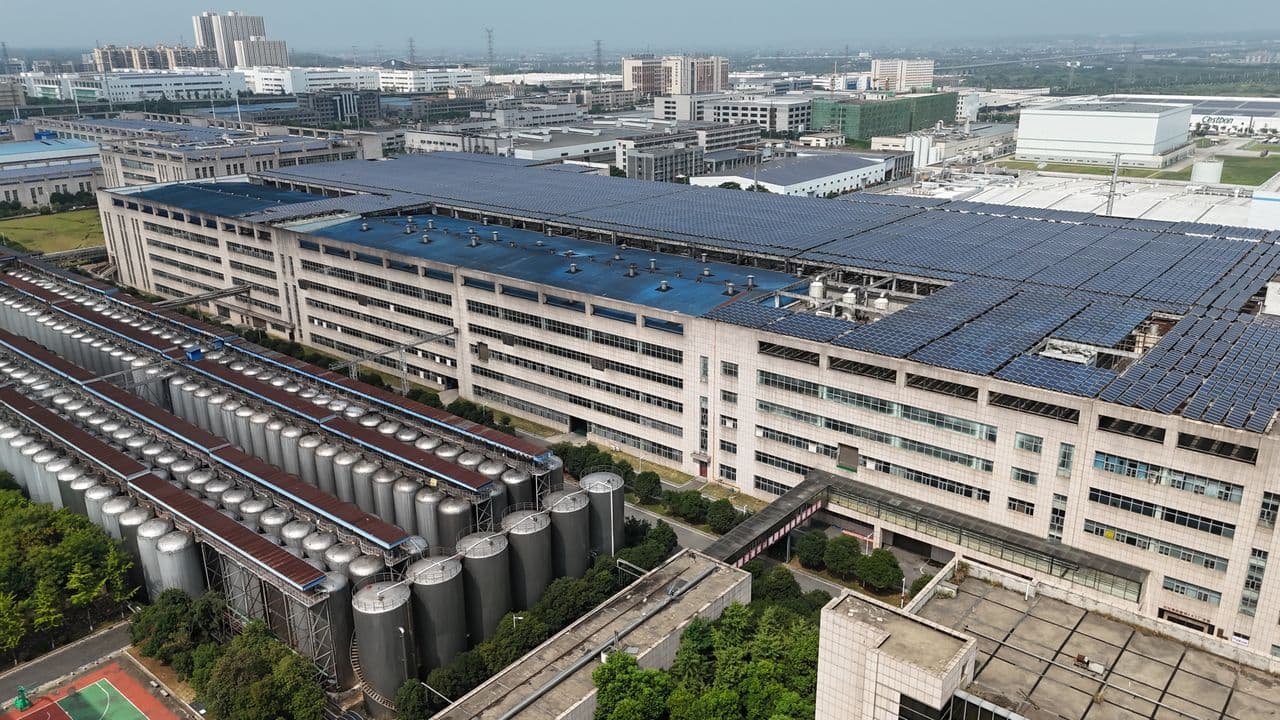
Figure 1: The Gebze campus: the LEED-certified office and production buildings, the on-site solar plant, and the landscaped and permeable areas around them.

Figure 2: Overview of the Gebze production centre: manufacturing facilities, the on-site solar plant, green spaces and the sustainability-focused campus infrastructure that support the site's low-carbon operations.

Impact
Sustainability impact
Climate
This initiative targets Scope 1 and 2. At company level, Scope 1 and 2 emissions have been reduced by approximately 69–70% against a FY2019 base year, against a target of 90% reduction and net zero operations by 2030. The company-wide operational carbon footprint was reported at 4,500 tCO2e in 2025.
Two mechanisms drive this. Energy efficiency measures reduced total company energy consumption by 13% over 2022–2025. On the supply side, the PV plant commissioned in 2021 generates approximately 1.3–1.4 GWh a year on the campus and the balance of electricity is contracted as green power, removing Scope 2 emissions associated with purchased electricity.
Remaining Scope 1 emissions from natural gas are addressed through the BOLD exit and electrification roadmap. Emissions are calculated using the GHG Protocol and the group's global methodologies.
Nature
Water: campus consumption was monitored at 73,769 m³ in 2025. Rainwater harvesting, low-flow fittings and sensor-operated taps deliver a 50% saving in purchased water under the LEED Gold design, and a forward osmosis project together with a water management system are intended to recover wastewater and build resilience to water stress.
Waste: hazardous waste fell from 37.7 tonnes to 28.55 tonnes between 2024 and 2025, a reduction of approximately 24%, while recovered waste rose from 667 tonnes to 715 tonnes. The recycling and recovery rate is tracked at approximately 99%. During construction, 75% of construction waste was recycled, 35% of materials were recyclable and 40% were sourced locally or regionally.
Site ecology: permeable surfaces, heat island reduction and native, low-water planting are combined with biodiversity self-assessments of the campus grounds.
Social
The programme is delivered in part through behaviour change among staff. Training sessions, a weekly bulletin and the Gebze Sustainability Committee established in 2024 give employees a route into the work, and safe working is managed as part of the same agenda. The company reports employee participation qualitatively.
Business impact
Benefits
Energy, water and waste disposal are recurring operating costs at campus scale, so the company-wide 13% energy reduction, the 50% saving in purchased water under the LEED Gold design and the movement of hazardous waste into recovery streams each reduce operating expenditure. On-site generation also reduces the exposure of part of the electricity load to tariff movements.
Risk reduction is the second benefit. A site designed for stormwater management, heat island reduction and water recovery carries lower exposure to physical climate risk, and an ISO 50001 and ISO 14001 certified management system with independent third-party assurance, Science Based Targets initiative (SBTi) aligned targets and CDP disclosure supports readiness for tightening reporting obligations.
The capability built on the campus also transfers. Sustainability services provided to customers contributed to 148,000 tonnes of CO2 reduction at company level, and the campus itself serves as a reference site for customers and partners.
Costs
The company does not disclose investment figures. The cost structure is nevertheless identifiable: capital expenditure for the PV plant, the high-performance building envelope and automation; recurring cost for the green electricity premium, licensed hazardous and non-hazardous waste contractors, certification and third-party assurance; and study cost for the forward osmosis feasibility work, which is completed before capital is committed.
Operating cost moves against these outlays, as energy, purchased water and waste disposal volumes all fall. Costs are contained in three ways. The campus was retrofitted rather than rebuilt, so no new building was required. Energy efficiency investments are assessed on a performance-based payback approach. Investment budgets, long-term executive incentives tied to ESG targets and global methodologies are built into the governance system, so funding does not depend on project-by-project approval.
No subsidies are reported for the programme, which is funded from those dedicated investment budgets. Dependencies include local solar conditions for PV yield, the availability of green electricity contracts, licensed recovery firms for the waste streams, and grid capacity for the electrification of thermal load.
Impact beyond sustainability and business
Co-benefits
ESG criteria and a Supplier Code of Conduct extend the standards applied on the campus into the supply chain, and suppliers of PV, energy efficiency, waste management, water recovery and electrification solutions are engaged as transformation partners rather than as vendors. The campus also serves as a repeatable learning model for customers and business partners.
Implementation
Typical business profile
The model is most relevant to existing manufacturing plants and office campuses that cannot be rebuilt, and is equally applicable to organised industrial zones and public infrastructure operators. Its structure is modular: green building design principles, ISO 50001 energy management, on-site renewable generation, green electricity procurement, water recovery, zero waste and a fossil fuel exit roadmap. An organisation can therefore enter at any module and at any scale, from an early stage of net-zero maturity through to a site already holding certified management systems and working on its residual Scope 1 load.
The functions involved are real estate and facility management, energy management, environmental protection, health and safety, production and procurement. Geographic relevance depends on local solar conditions for on-site generation, on a market offering green electricity contracts, and on the availability of licensed waste recovery capacity and grid capacity for electrification.
Approach
Start with the building envelope: Design or retrofit to a recognised green building standard and target a measurable energy saving against a reference code such as ASHRAE 90.1.
Install site water measures early: Combine rainwater harvesting, low-flow fittings, sensor-operated taps, permeable surfaces and native, low-water landscaping, and meter consumption.
Certify the management systems: Certify energy and environmental management to ISO 50001 and ISO 14001 so that consumption data, targets and audits become systematic rather than project-based.
Commission on-site generation: Size renewable generation to the campus load, then contract the remaining electricity as green power to address Scope 2.
Separate waste at source: Sort waste into defined categories and track hazardous and recovered streams through licensed contractors and invoiced data.
Set a fossil fuel exit roadmap: Define dated steps for the remaining fossil fuel use, covering the exit from natural gas and the electrification of thermal load.
Test water recovery options: Run feasibility studies, such as forward osmosis, before committing capital to the technology.
Establish site governance: Form a site sustainability committee with cross-department membership and report progress to Board and C-level meetings on a quarterly cycle.
Stakeholders involved
Project leads: Project leadership sits with senior management through the group's DEGREE sustainability framework, with the Chair and CEO and the CFO setting the 90% decarbonisation, 100% green electricity and resource efficiency commitments for 2030. The House of Sustainability, made up of topic leads from different departments, translates those commitments into departmental workstreams and reports progress quarterly to Board and C-level meetings. The Gebze Sustainability Committee, formed in 2024, coordinates training, the weekly bulletin, project tracking and departmental contributions on site.
Company functions: Real estate management, environmental protection, health management and safety, energy management, production, procurement and the facility teams hold technical and operational responsibility. They work together through the House of Sustainability, to which each department nominates a topic lead, and through the Gebze Sustainability Committee, which assigns projects, tracks them against the site roadmap and consolidates departmental data into one reported figure.
Main providers: Energy suppliers, PV and technical solution partners, and licensed waste recovery and disposal firms designed and delivered the on-site generation, energy efficiency, waste management, water recovery and electrification measures. They are contracted as long-term transformation partners under ESG criteria and the Supplier Code of Conduct, and their performance is evidenced through metered, invoiced and licensed disposal records rather than self-declaration.
Other: Academic institutions collaborate on knowledge sharing and capability development. Non-governmental organisations and platform memberships extend the work into circularity, ethics and social impact through joint programmes. Suppliers are brought into the same standards through ESG criteria, the Supplier Code of Conduct and supplier audits.
Key parameters to consider
All the technologies applied are commercially mature; none is at demonstration stage. The timeline is long: LEED Gold certification in 2009, PV commissioning in 2021, the BOLD decarbonisation programme from 2024, and a 2030 net zero operations target.
Short-term work covers the BOLD rollout at Gebze and the forward osmosis feasibility study; medium-term work covers a BOLD roadmap for the Kartal site; and long-term work extends the natural gas exit and circularity practices across the Turkish portfolio.
Carbon targets use FY2019 as the base year, while waste and energy progress use 2022 and 2024 comparisons. Data is drawn from the annual sustainability report (1), quarterly environment and waste reports, the energy management system, meter data, procurement records and licensed disposal records. Policy alignment covers the UN Sustainable Development Goals (SDGs), Turkish Sustainability Reporting Standards (TSRS), GRI, the ISO standards and national zero waste targets.
Implementation and operations tips
The decisive design choice was to manage the campus as one system rather than as a set of separate efficiency projects. Combining green building design, ISO management systems, renewable energy, waste reduction and climate risk management under a single structure is what made the results measurable and comparable year on year.
Continuity was the second challenge, and it is addressed structurally. ISO 50001 and ISO 14001 systems, annual sustainability reporting, long-term executive incentives linked to ESG targets, dedicated investment budgets and supplier audits place the programme inside decision-making, investment and reporting processes rather than leaving it dependent on individual sponsors.
Adoption is supported by the demonstration that no new building is required. Existing industrial campuses can be converted to lower-carbon, resilient infrastructure through retrofit, which is the situation most companies are in.