Cut scrap at source to save copper, water and energy
 Elsan
Elsan SKD Türkiye
总结
A mechanical redesign of the wire line prevents surface defects before they form and a reverse osmosis loop recycles process water, cutting scrap, energy and water use.
Context
Submitted through the COP31 Sustainable Transformation Awards · SKD Türkiye (WBCSD Global Network Partner)
The company is a Turkish energy group; the subsidiary described here manufactures copper and aluminium wire products used in transformers, white goods and other industrial sectors, and exports a substantial share of its output.
Production is energy intensive, and the efficient management of the three resource streams it consumes — raw material, energy and water — carries strategic weight for both export competitiveness and financial resilience. Copper is the dominant input cost, and every kilogram lost as scrap has already absorbed the energy and water used to process it.
The Industrial Efficiency Project was launched on 8 May 2025 to analyse efficiency opportunities across those streams and to identify the critical points in resource use. The analysis found that scrap arising from defective production was the single most significant factor: it destroyed raw material, but it also drove additional energy and water consumption and therefore additional carbon emissions.
The company's position is that waste management and a zero-waste approach rest on preventing waste at source rather than on recycling it afterwards, so the engineering work was directed at stopping the defect rather than at reprocessing its output.
The measurement base year is 2024 and the results reported here were achieved during 2025.
Location of the initiative: Türkiye
Solution
The initiative combines a mechanical redesign of the production line with a closed water loop, both monitored digitally.
The mechanical element addresses the physical cause of the defect. Surface faults were being created when wire jammed in the line, so a purpose-designed mechanical improvement was developed to prevent the jamming physically, before the defect can form. Four rollers were integrated into the line to deliver it, at a capital cost of 2,860 TRY.
The redesign is supported by digital data tracking and alarm systems, so a developing fault is signalled rather than discovered at inspection. Both elements of the project are managed through SCADA-based digital monitoring with real-time data verification, and tracked in line with the GHG Protocol and current engineering standards.
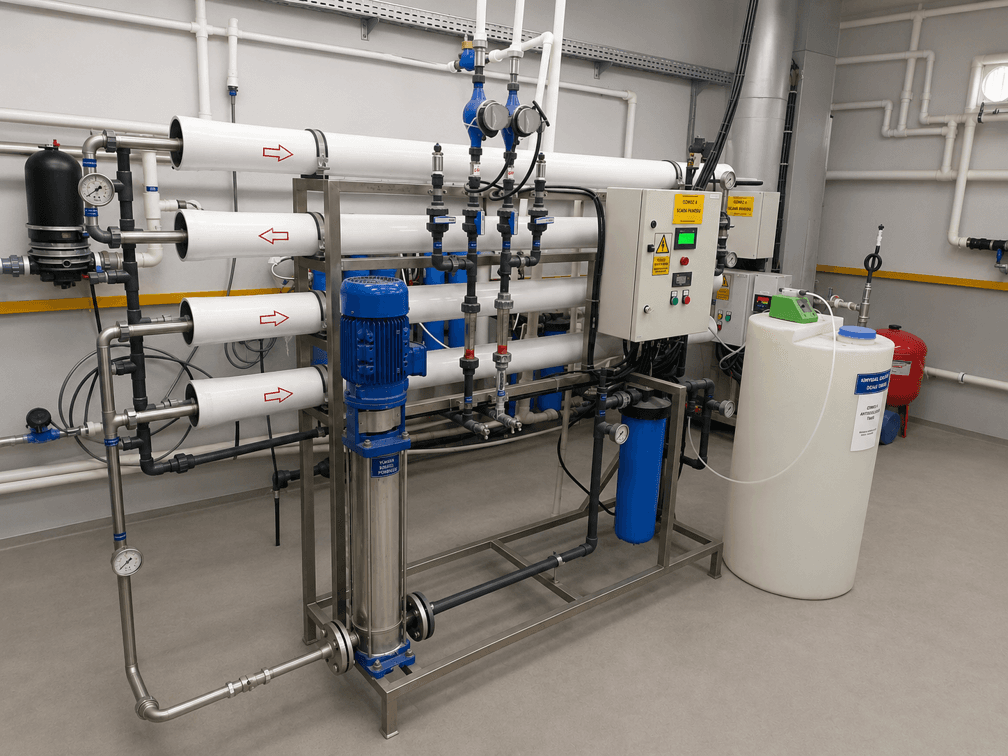
The water element closes a loop that was previously open. Process water is purified through a reverse osmosis system and returned to production, which delivers a 27 per cent gain in water efficiency, equal to 7,400 tonnes of water a year, and prevents 800 tonnes a year of untreated wastewater overflowing into the environment. The investment was 6,000 EUR and it repaid itself in two months.
Taken together the two elements produce more output per raw material and water consumed, and they do so by removing the cause of the loss rather than by treating its consequences.
Figure 1: The redesigned guide and roller assembly on the drawing line: the mechanical change that prevents the defect at source rather than sorting it out afterwards

Figure 2: The reverse osmosis unit that returns process water to the line, delivered for EUR 6,000 and repaid within two months

Impact
Sustainability impact
Climate
The saving is in purchased electricity, so the direct emissions effect sits in Scope 2, while the lower material loss reduces the Scope 1 and Scope 2 emissions embedded in each tonne of finished wire.
Preventing defective output removes the need to remelt and reprocess the material, and that reprocessing is where the energy is consumed. Eliminating it saves 200,000 kWh a year and approximately 50 tonnes of CO2e annually, measured against a 2024 base year and calculated in line with the GHG Protocol.
The result is also tracked as an intensity figure. The specific energy consumption target for the year was 0.093 tonnes of oil equivalent per tonne of production and the outcome achieved was 0.089 tonnes of oil equivalent per tonne, which lowers the carbon intensity of every tonne of enamelled winding wire produced.
Because a substantial share of production is exported to the European Union, reducing the embedded Scope 1 and Scope 2 emissions per tonne also reduces exposure to the Carbon Border Adjustment Mechanism and to any carbon pricing that follows it.
Nature
The reverse osmosis loop reduces industrial groundwater abstraction by 7,400 tonnes a year, a 27 per cent reduction in water consumption, which eases pressure on the local water table rather than transferring the demand elsewhere.
The same system prevents 800 tonnes a year of wastewater from overflowing without control, which stops the pollution at its source instead of managing it after release.
Improvements to the reverse osmosis system also produced indirect savings in the energy and chemicals used to condition process water, so the water measure carries a chemical-use benefit alongside the volume saved.
On the materials side, 11.86 tonnes of copper scrap a year are no longer generated, which avoids both the loss of a mined metal and the reprocessing that would otherwise follow it.
Social
The design was carried out by the company's own engineers and operators rather than by an external provider, and internal stakeholders were brought into the process from the design stage through to implementation, with feedback from the shop floor placed at the centre of the work.
Operator training was run alongside the technical change so that the people running the line understood why the mechanical modification mattered and could recognise the alarm conditions the digital layer generates.
The outcome was then shared beyond the site: the results are reported to external stakeholders and investors through sustainability reporting, which turns an internal engineering improvement into a documented reference for others.
Business impact
Benefits
Efficiency in raw material, energy and water management prevented 1.1 million TRY of cost during 2025.
The individual gains behind that figure are 11.86 tonnes of copper scrap no longer generated each year, 200,000 kWh of energy saved each year and 7,400 tonnes of water saved each year.
The scrap rate target set for 2025 was 5.50 per cent and the rate achieved was 5.27 per cent; the specific energy consumption target of 1.0816 MWh per tonne of production was completed at 1.0351 MWh per tonne.
The payback period is unusually short because the capital requirement was unusually small. The line modification was delivered for 2,860 TRY and the water recovery investment of 6,000 EUR repaid itself within two months.
Lower embedded carbon per tonne protects the export position of the business under the European Union Carbon Border Adjustment Mechanism, which converts an operational improvement into a commercial defence for products sold into that market.
Costs
Capital expenditure was deliberately capped. The energy and material element cost 2,860 TRY for four rollers integrated into the line, and the water element cost 6,000 EUR, with a payback period of two months on the latter.
The larger input was engineering effort rather than money. The mechanical solution had to be designed for the specific failure mode of the line, which required internal engineering time, trials and a period of instability while the modification was proven.
The model also carries continuing operating costs that the headline investment figure does not show: the digital tracking, alarm and SCADA monitoring layer has to be maintained and its data verified, operators have to be trained, and a reverse osmosis system needs membrane replacement, chemicals and routine servicing. The annual operating cost of the reverse osmosis system, the cost of the monitoring layer and the internal engineering time invested in the design are not published.
Costs were held down by designing and building the solution with the company's own engineering staff instead of buying an external package, and by targeting a low capital ceiling from the outset so that the environmental result did not depend on a large investment being approved.
Impact beyond sustainability and business
Co-benefits
The strongest feature of the model is its transferability. The mechanical logic — find the physical event that creates the defect and prevent it — applies to any comparable production process, and the company is extending it across its own value chain and into the wider sector.
Combining a low-cost mechanical modification with digital monitoring gives smaller manufacturers a route to decarbonisation that does not depend on major capital programmes, which matters particularly for developing economies where capital is the binding constraint.
The initiative is reported against Sustainable Development Goal 6, target 6.4 on water-use efficiency, Goal 9, target 9.4 on the sustainability of infrastructure and industrial processes, Goal 12, target 12.5 on waste reduction, and Goal 13, target 13.2 on integrating climate measures into policy and planning.
Potential side-effects
A reverse osmosis system produces residues that have to be managed if the environmental gain is not to be displaced. Spent carbon filters are classified as non-hazardous waste and chemical packaging as contaminated waste, and both are sent to licensed disposal facilities.
The mechanical fix is specific to the failure mode of one line. It cannot simply be copied onto different machinery; each installation needs its own diagnosis, which is the engineering cost that replicating companies should expect.
Adding digital tracking, alarms and SCADA monitoring creates a dependency on data availability and on the people able to interpret it. If the monitoring layer degrades, the mechanical gain remains but the ability to prove and defend it does not.
Implementation
Typical business profile
The approach suits metal wire, cable and comparable continuous-process manufacturers running energy- and water-intensive drawing, coating or enamelling lines, where scrap is treated as a quality statistic rather than as a combined material, energy and water loss.
It is most relevant to exporters exposed to carbon border pricing, because the gain shows up as reduced carbon intensity per tonne of product, and to operators with an in-house maintenance engineering function capable of redesigning a machine element rather than only replacing it.
Delivery engages production, maintenance engineering, energy management, quality, environment and sustainability functions together with the machine operators who run the line.
Approach
Map consumption across the three resource streams: Measure raw material, energy and water line by line so the points at which the three interact become visible, rather than managing each through a separate budget.
Trace scrap back to its physical cause: Analyse defective output until the mechanical event that creates it is identified, instead of accepting a scrap percentage as a fixed characteristic of the process.
Design the fix at the point of failure: Redesign the mechanical component responsible — here four rollers integrated into the line — so that the defect cannot form, rather than adding inspection to catch it afterwards.
Set the capital ceiling before the design starts: Require the solution to fit a low investment envelope, which forces mechanical ingenuity ahead of equipment replacement; the line modification was delivered for 2,860 TRY and the water system for 6,000 EUR.
Instrument the change: Add digital data tracking and alarm systems and connect them to SCADA-based monitoring with real-time verification, so the improvement is proven continuously rather than through periodic sampling.
Close the water loop: Install reverse osmosis treatment so process water is purified and returned to production, and measure both the volume recovered and the wastewater discharge avoided.
Involve operators from the design stage: Bring engineers and machine operators into the design decisions, run operator training alongside the modification, and route shop-floor feedback back into the specification.
Convert the result into standing company targets: Carry the scrap rate and the specific energy consumption figure into the annual target set, track them monthly across all departments and senior management, and publish the outcome in sustainability reporting.
Stakeholders involved
Project leads: Senior management approved the strategic targets under which the project sits and treats sustainability as a form of corporate governance rather than a reporting heading. The project itself was designed and implemented entirely by the company's own engineering staff, and the resulting targets are tracked by every department as well as by senior management.
Company functions: Production, maintenance engineering, energy management, quality, and environment and sustainability worked alongside the machine operators. Engineering designed the mechanical modification, operators tested it in normal production and fed back the adjustments, and energy management carried the resulting figures into the company target set.
Main providers: No external design or engineering provider was engaged. Equipment and components for the line modification and the reverse osmosis system were bought from suppliers, but the diagnosis, the design and the implementation were all internal, which is why the capital requirement stayed as low as it did.
Other: Internal stakeholders — engineers and operators — were involved from the design process through to implementation, with feedback from the shop floor placed at the centre of the project, and operator training was used to raise awareness across the shift teams. External stakeholders and investors receive the results through sustainability reporting and CDP disclosure, and customers in export markets benefit from the lower embedded carbon of the product they buy.
Key parameters to consider
The project was launched on 8 May 2025, the measurement base year is 2024, and the financial and environmental results reported here relate to 2025.
The two interventions have very different cost profiles but similar logic: 2,860 TRY for the mechanical modification and 6,000 EUR for the water recovery system, with a two-month payback on the water investment.
Monitoring runs through SCADA-based digital systems with real-time data verification, and performance is held against annual company targets — a 5.50 per cent scrap target, achieved at 5.27 per cent, and a specific energy consumption target of 0.093 tonnes of oil equivalent per tonne of production, achieved at 0.089.
The approach is applicable to any line with a comparable process, which is why it is being extended across the value chain rather than kept as a single-machine improvement.
Implementation and operations tips
Prevention beats recycling in both carbon and cost terms. Material that is never turned into scrap does not have to be remelted, and it is the remelting that consumes the 200,000 kWh a year this project avoided.
Set the capital ceiling first. A low investment limit pushes teams towards diagnosing the physical cause instead of specifying new equipment, and it is the reason a 2,860 TRY modification could deliver a measurable emissions result.
Measure the three streams together. Scrap looks like a raw material problem in a materials budget and disappears entirely from an energy budget; only a combined view shows that a single defect drives losses in all three.
Put operators in the design room. The people who watch the wire jam know where and when it happens, and that knowledge is what turned a quality complaint into a mechanical specification.
Tie the improvement to a target that outlives the project. Carrying the scrap rate and the specific energy consumption figure into the company target set is what makes the gain permanent rather than a one-year result.