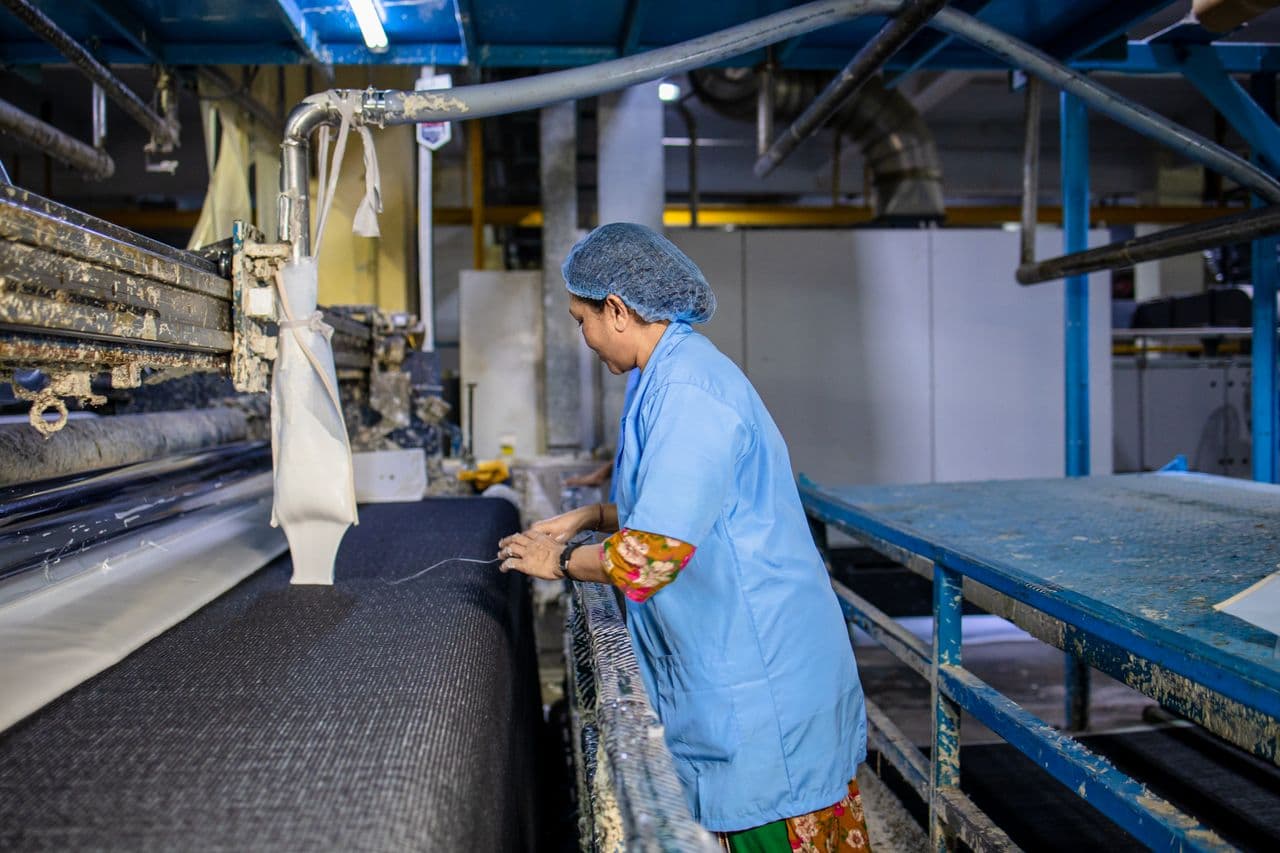
Dye denim without rinsing to eliminate process wastewater
 Çalık Denim
 SKD Türkiye
总结
Denim is dyed without washing boxes, so the rinse water, effluent and spent chemicals that the conventional dyeing route produces are removed at source.
Context
Submitted through the COP31 Sustainable Transformation Awards · SKD Türkiye (WBCSD Global Network Partner)
The company manufactures denim fabric at an integrated mill in Türkiye and employs between 251 and 1,000 people.
Denim production is resource intensive by design. Electricity, water, chemicals and process time are consumed heavily across several production stages, and water use is the consumption that stands out in the life cycle assessment of a denim fabric. Indigo and sulphur dyeing depends on it directly: after each dye application the yarn passes through overflow and continuously fed rinsing tanks that carry away unfixed dyestuff and auxiliary chemicals. Those washing boxes are treated as a fixed feature of the machine, supplied as standard by dyeing equipment makers, and they are the origin of the dye house effluent stream.
The commercial pressure to change is now explicit. Buyers increasingly select fabric produced by methods that consume less water, energy and chemistry and that cause less harm to ecosystems, so the production route itself has become part of the specification rather than an internal manufacturing matter.
The physical pressure is domestic. Reservoir levels in Türkiye have fallen and supply restrictions have been applied in large cities including Istanbul, Ankara, Bursa and İzmir. Using the water resources of the province in which the mill operates responsibly, so that they remain available to later generations, has therefore become a licence-to-operate question rather than an efficiency exercise.
Efficiency work in production has been a constant at the company since it was founded, historically aimed at lowering production cost and raising profitability. Under the 2015 Paris Agreement Türkiye committed to an energy transition that lowers carbon emissions, and the company extended that established efficiency agenda from cost alone to resource consumption and emissions performance. The initiative described here applies the agenda to the largest single water consumer in the process.
Location of the initiative: Malatya, Türkiye
Solution
The approach, applied under the name Dyepro and recorded in the company's process data as the REVO-SU dyeing process, removes the washing stage from indigo and sulphur denim dyeing instead of making it more efficient.
In the conventional route, dye application and rinsing alternate. The yarn is dyed, then washed in overflow and continuously fed tanks so that unfixed dyestuff and auxiliary chemicals are carried out of the material. Those tanks generate the effluent, they consume the thermal energy needed to hold the wash liquor at temperature, and they are the reason a dye house has to be sited where a reliable volume of process water is available.
The redesigned route colours natural denim yarn with the same indigo and sulphur dyestuff families but completes the colouration without passing the material through a washing box at all. Because there is no rinsing step, no dye house effluent and no spent chemical liquor arise at that point in the process. The reduction is obtained by removing the source rather than by treating a discharge afterwards, which is what distinguishes it from effluent recovery or water recycling schemes applied to the same stage.
Shade reproducibility was the condition for commercial acceptance. Conventional dyeings are held to a fixed colour reference, and a fabric supplier is judged on whether a repeat order returns in the same tones. The redesigned route is held to the same fixed reference, so a customer that has already bought fabric produced this way is given a commitment that the shade will be reproduced on the next order. That commitment, rather than the resource figures alone, is what allowed the technology to move from trial to sale.
Because the process no longer depends on a continuous supply of rinse water, natural denim fabrics made with indigo and sulphur dyestuffs can also be produced at sites where water is scarce. This changes where a denim dye house can be located, not only how much water it uses.
The consequences extend past water. Removing the overflow and fed washing operations also removes the thermal and electrical energy used to heat, hold, pump and treat the wash liquor, reduces chemical consumption, and prevents waste chemical formation rather than sending it to treatment. The carbon footprint of the dyed fabric falls with the energy that is no longer consumed.
Figure 1: Functional diagram of the rope dyeing range. On the redesigned route the washing boxes remain on the machine but are not used during dyeing, and the same applies on the slasher dyeing line.

Process | Water (m³) | Energy (kWh) | Chemicals (kg) | CO₂ (tonnes) |
Dyepro | 5,000.0 | 190,000.0 | 237,000.0 | 81.7 |
Standard process | 40,000.0 | 200,000.0 | 296,000.0 | 86.0 |
Water, energy, chemical and carbon consumption per million metres of fabric on the redesigned Dyepro route set against the standard dyeing process, per million metres of fabric.
Impact
Sustainability impact
Climate
The initiative targets Scope 1 and Scope 2 emissions from the company's own dyeing operations.
The Scope 1 effect comes from the fuel burned on site to raise steam for heating and holding the wash liquor in the rinsing tanks. When the tanks are removed from the line, that heat demand is removed with them. The Scope 2 effect comes from the electricity used to pump, circulate, filter and treat the same water, together with the electricity consumed by the abolished washing operations themselves.
Measured on the same per-million-metre basis as the water result, energy consumption falls from 200,000.0 kWh per million metres of fabric on the standard process to 190,000.0 kWh on the redesigned route, and the carbon footprint of the process falls from 86.0 tonnes of CO₂ per million metres to 81.7 tonnes.
The company links the work to the national energy transition commitment made under the 2015 Paris Agreement.
Nature
The environmental result the initiative was designed to deliver is the elimination of dye house effluent from the dyeing stage. Because the overflow and fed washing operations no longer exist, no rinse water is drawn for them, no wastewater is discharged from them and no spent chemical liquor is created that would have to be treated.
The company measures the result per million metres of fabric produced, which allows the redesigned route to be set directly against the standard one. Water consumption falls from 40,000.0 m³ per million metres on the standard dyeing process to 5,000.0 m³ per million metres on the redesigned process. Chemical consumption falls over the same unit of output from 296,000.0 kg to 237,000.0 kg, so the load that would have been carried into the effluent stream is reduced at the point where it is created rather than at the treatment plant.
The company calculates that applying the route to 30 million metres of fabric would save 1,170,000 m³ of water, a volume it expresses as 468 Olympic swimming pools, or the water a single household would consume in 2,125 years. The route can be applied to the whole existing fabric range, but uptake follows customer specification, so it is not yet used on every article; producing the full range with it is the company's stated aim.
A comparative assessment of two otherwise identical fabrics, one produced by the redesigned route and one by the standard route, placed the fabric from the redesigned route in the Green category at Low Impact status.
This matters locally as well as globally. Water restrictions and falling reservoir levels in Türkiye's large cities have made freshwater abstraction by industry a contested issue, and the initiative reduces the mill's claim on the water resources of the province in which it operates.
Avoiding chemical discharge also protects the receiving water body from the dyestuff and auxiliary load that would otherwise pass through treatment, and reduces the sludge that treatment generates.
Social
Securing the water supply of the city in which the mill operates is presented by the company as an intergenerational commitment rather than a compliance measure, made at a time when households in several Turkish cities were subject to supply restrictions.
Internally, the work has had a measurable effect on how staff view the business. Employee satisfaction rose over the course of the project, which the company attributes to the creative and problem-solving nature of the work and to the visible outcome of removing an operation the industry had treated as unavoidable. Sustainability awareness inside the production organisation is described as being kept current by the project rather than by training alone.
Satisfaction and engagement around water conservation in production are tracked through periodic employee satisfaction surveys, the suggestion system and operational feedback mechanisms rather than through a single instrument.
Business impact
Benefits
The direct operating benefit is the removal of a resource-consuming operation from the line, and it is measurable as purchased input. Per million metres of fabric the redesigned route consumes 5,000.0 m³ of water rather than 40,000.0 m³, 190,000.0 kWh of electricity rather than 200,000.0 kWh and 237,000.0 kg of chemicals rather than 296,000.0 kg. Each of those is bought, so the environmental result and the cost result are the same figures viewed from two sides, and the company's long-standing efficiency work has consistently translated reduced production cost into improved profitability.
The commercial benefit is differentiation. The route is not offered by competitors, and it gave the sales organisation a specific, memorable proposition to present rather than a general sustainability claim. Environmentally attentive customers responded with attention and approval during customer visits, and the company expects this to strengthen customer loyalty over time. That expectation is a forward-looking judgement rather than a measured result.
The route has also reached the commercial catalogue rather than remaining a process demonstration: in the Spring Summer 24 collection the article group built on 100 per cent recycled content is specified as carrying water-free fabrics produced by the technology.
The assurance of shade reproducibility converts the environmental story into a purchasable specification. Without it, a buyer would treat the route as a risk; with a fixed dyeing reference and a commitment that repeat orders return in the same tones, it becomes a like-for-like substitution.
Operational flexibility is a further benefit. Because the process does not depend on a continuous supply of rinse water, production can continue in conditions of water scarcity that would constrain a conventional dye house, which reduces exposure to drought-driven production interruption.
Employee satisfaction rose during the project, and the company reports that the work reinforced its position in the sector on sustainable production.
Costs
The cost profile is dominated by development rather than by equipment purchase. The washing boxes are supplied as a standard part of the dyeing machine, so the route had to be designed against the equipment makers' assumptions instead of being bought from them. That places the burden on internal research, development and process engineering and on the trial production consumed while the recipes were being established.
The dyestuff and auxiliary recipe carries the main technical cost driver. Fixation has to be achieved on the yarn without a subsequent rinse, which typically requires a different and often more expensive chemistry than a route that can rely on washing to remove what has not fixed. The saving on water, energy and effluent treatment has to be set against that input cost.
Quality assurance costs rise rather than fall. Because commercial acceptance rests on shade reproducibility, each shade requires a fixed reference and repeat lots have to be verified against it, which adds laboratory and colour management workload.
Operator retraining is a real cost. The control levers available to a dye house operator change when the rinsing tanks disappear, so operating instructions and training material have to be rewritten before the route is run at volume.
Costs are contained by developing the route in-house rather than commissioning it, by converting existing lines instead of installing new ones, and by offsetting input chemistry cost against the water, thermal energy, electricity and effluent treatment that are no longer consumed. Rolling the route across the full product range by 2028 spreads the development cost over a larger volume.
Impact beyond sustainability and business
Co-benefits
Removing the rinsing stage shortens the process, so time — which the company counts alongside electricity, water and chemicals as a production resource — is also released.
Because the route does not require a continuous rinse water supply, it opens the possibility of producing natural indigo and sulphur dyed denim in regions where water availability would otherwise rule out a dye house. That is a locational co-benefit for the wider industry rather than a saving for one mill.
Preventing waste chemical formation reduces the load on the effluent treatment plant, which in turn reduces the sludge that has to be handled and disposed of.
The project has become an internal reference point for what production teams can change, and is credited with keeping sustainability awareness active inside the organisation and raising employee satisfaction.
Potential side-effects
Achieving fixation without a rinse generally shifts the burden onto the dyeing chemistry, so a mill following this route should verify that reduced water and energy consumption are not obtained at the cost of a heavier or more hazardous chemical input. The measured figures show chemical consumption falling to 237,000.0 kg per million metres from 296,000.0 kg, so the quantity has fallen; the composition of the recipe matters as much as the quantity, however, and it is not disclosed here.
Removing the washing stage removes a process buffer. Unfixed dyestuff is no longer carried out of the fabric mechanically, so rubbing and washing fastness on the finished garment depend entirely on fixation performance and require verification against the conventional benchmark before commercial release.
Shade reproducibility becomes a single point of failure. With no rinsing step to even out variation, colour control depends on holding the fixed dyeing reference, which raises the consequence of a process deviation.
The route is stated for natural denim fabrics dyed with indigo and sulphur dyestuffs. It should not be assumed to transfer unchanged to reactive, pigment or other dyeing systems without separate development.
Implementation
Typical business profile
The model suits denim mills and other textile manufacturers running continuous rope or sheet dyeing lines in which rinsing tanks sit between dye applications, and where water, effluent treatment and thermal energy are material cost and permitting issues.
It is most relevant to vertically integrated producers that control both the dyeing recipe and the finished fabric specification, because the route only works if the chemistry and the quality commitment to the buyer are changed together.
Maturity requirements are moderate on equipment and high on process knowledge: no new machine class is needed, but a mill without its own recipe development capability cannot follow the route, since the equipment supply chain does not offer it as a package.
Geographically it is of most value in water-stressed regions and in mills selling to buyers that specify production-route environmental performance.
Delivery engages production, machinery and energy, dyeing recipe development, quality control and laboratory functions.
Approach
Meter water use by process step, not by mill: Measure the water, thermal energy and chemical consumption of each dyeing and rinsing operation separately, so that the washing boxes appear as a discrete consumer rather than being absorbed into a site-level figure.
Treat the washing box as an assumption to be tested: Recognise that overflow and continuously fed rinsing tanks are supplied as a fixed feature of the dyeing machine, and set the design objective as eliminating the operation rather than reducing its water consumption.
Rebuild the dyestuff and auxiliary recipe: Reformulate the indigo and sulphur dyeing chemistry so that fixation is achieved on the yarn without a following rinse, since the rinse is what the redesign removes.
Convert one line and run comparison lots: Rebuild a single dyeing line to operate without washing boxes, keep a conventional line available, and produce paired lots of otherwise identical fabric so that water, energy, chemical and carbon consumption can be compared under the same conditions and on the same unit of output.
Establish a fixed colour reference for every shade: Define the reference before commercial release and require repeat lots to fall within tolerance against it, because a buyer will only substitute the route if repeat orders return in the same tones.
Verify fabric performance against the conventional benchmark: Test rubbing and washing fastness, tensile and tear strength and shade consistency on fabric from both routes, so that the removal of the rinsing stage is not compensated by a quality loss further down the chain.
Rewrite operating instructions and retrain the dye house: Update procedures, control points and training material, because the levers available to operators and maintenance teams change once the rinsing tanks are no longer on the line.
Commit to a dated rollout and report against it: Set a public target date for extending the route across the product range — in this case 2028 — and track progress through the corporate sustainability reporting cycle so the commitment is externally visible.
Stakeholders involved
Project leads: Senior management sponsored the work as part of an efficiency agenda that the company has run in production since it was founded, and which was extended from production cost to resource consumption, carbon footprint and process differentiation. Ownership of the technical result sat with the production and process engineering side of the business rather than with a separate sustainability office, which is why the outcome took the form of a changed process rather than a reporting initiative.
Company functions: The production function and the machinery and energy function carried the initiative jointly. Production owned the dyeing recipe, the trial lots and the shade reference; machinery and energy owned the line conversion and the removal of the water and steam services that fed the washing boxes. Quality control and the colour laboratory verified fastness, strength and shade reproducibility against conventionally produced reference lots before the route was offered to customers. The sales organisation was involved before commercial release so that the reproducibility commitment given to buyers matched what the process could hold.
Main providers: No external solution provider was engaged. Dyeing machinery manufacturers supply washing boxes as a standard element of the equipment, so the redesign was carried out against the prevailing equipment design rather than in partnership with it, and the process knowledge was developed inside the company.
Other: Customers acted as a de facto validation stakeholder. Environmentally attentive buyers responded to the route during customer visits, and their requirement for shade reproducibility on repeat orders set the quality condition the process had to meet. Municipal water users in the province share the benefit of reduced industrial abstraction at a time when supply restrictions have been applied in several Turkish cities.
Key parameters to consider
The route applies to natural denim fabrics dyed with indigo and sulphur dyestuffs. Transfer to other dyestuff classes has not been stated and would require separate development.
No new machine class is required; the change is to the line configuration and the recipe. The binding constraint is recipe development capability, not capital equipment.
Water independence is the parameter with the widest strategic value: because a continuous rinse water supply is no longer needed, the process can run at sites where water availability would constrain a conventional dye house.
Performance is expressed per million metres of fabric, which is the unit in which water, energy, chemical and carbon consumption are compared against the standard process; a mill adopting the route should expect to hold the same denominator if the comparison is to be defensible.
The rollout target is 2028 for extension across all products, so at the time of writing the technology is proven and in commercial production but not yet applied to the whole range.
Implementation and operations tips
Question the operation rather than optimise it. The saving here came from deleting a process step that both the equipment supply chain and the industry treated as indispensable, and no amount of water recovery on the same step would have produced an equivalent result.
Report consumption per unit of output, not per site. Expressing water, energy, chemicals and carbon per million metres of fabric is what made the comparison with the standard process legible to buyers and auditable internally; a site-level total would have hidden the effect of the process change behind changes in production volume.
Solve the commercial objection before the environmental one. Shade reproducibility, not water consumption, was the reason buyers would or would not accept the fabric, so the fixed dyeing reference had to be in place before the route could be sold.
Measure the released resources together. Water, thermal energy, electricity, chemicals and process time all fall when the rinsing tanks are removed, and reporting only the water figure understates both the environmental and the financial case.
Use water scarcity as the framing internally. Falling reservoir levels and urban supply restrictions made the case concrete for production teams in a way that a corporate target did not, and the visible outcome is credited with raising employee satisfaction.
Set a dated rollout target. A commitment to extend the route across the full product range by 2028 keeps the work funded after the first commercial lots, which is the point at which process projects of this kind usually stall.