Monitor birds and bats to make wind power nature positive
 Fiba Yenilenebilir
  SKD Türkiye
总结
Bird and bat monitoring on a migration route feeds a command-based turbine shutdown protocol, so collision risk is managed while clean generation continues.
Context
Submitted through the COP31 Sustainable Transformation Awards · SKD Türkiye (WBCSD Global Network Partner)
Fiba Renewables is an energy company generating electricity from a fully renewable portfolio in Türkiye, with 170 employees by the end of 2025.
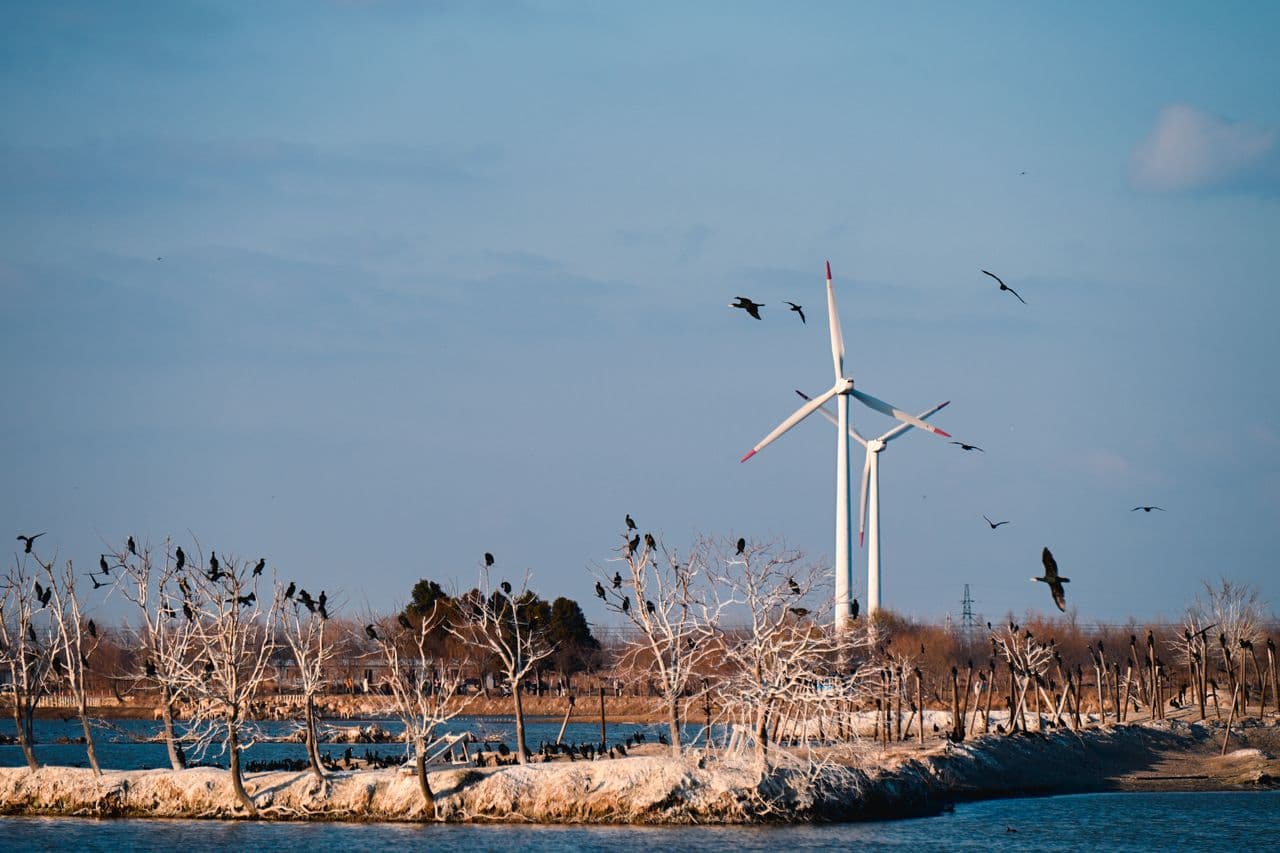
At the company's Tayakadın and Kızılcaterzi Wind Power Plants, located on an important bird migration route in Türkiye, biodiversity management combines migration-period bird observations, breeding surveys for sensitive species, ground- and nacelle-level acoustic bat monitoring, carcass surveys, survey-efficiency and scavenger-removal assessments, GenEst-based collision analyses, and a Command-Based Turbine Shutdown Protocol.
The transition to renewable energy is essential to addressing climate change, but renewable energy infrastructure can also create biodiversity-related risks if potential impacts on wildlife are not adequately identified and managed.
This is particularly relevant for wind power plants located along bird migration routes, where interactions between turbines and migratory birds and bats require systematic assessment and mitigation.
Two external pressures made resolving this a business requirement rather than a research interest. National environmental legislation requires wildlife impacts at wind projects to be assessed and managed, and the financial institutions lending to the projects apply international environmental performance standards, which require monitored, evidence-based management of biodiversity risk over the life of the asset.
The company set up the programme in 2021 to close that evidence gap: to determine, monitor and reduce the effects on bird and bat species using scientific methods, and to bring the resulting data into operational decision-making and process management strategies rather than filing it as a compliance record.
Location of the initiative: Tayakadın and Kızılcaterzi wind power plants, Türkiye
Solution
The programme brings five monitoring methods and one operational control together into a single biodiversity management system, so that observation feeds intervention rather than sitting alongside it.
Bird observation covers the migration seasons, recording species, numbers and passage through the periods when the risk is concentrated. For sensitive species such as the imperial eagle, this is extended into detailed breeding monitoring across 5 km buffer zones around the plants, which captures resident breeding pairs rather than only birds in transit.
For bats, acoustic monitoring is conducted at both ground and nacelle level, implemented in 2022, during active periods in spring, summer and autumn. The resulting data are used to assess bat activity, species, behaviour, migration patterns and collision risks.
Carcass searches provide the direct evidence of collisions, but raw counts understate mortality because searchers miss carcasses and scavengers remove them. The programme therefore measures searcher efficiency and predator removal alongside the searches, and processes the results through GenEst, an internationally accepted analysis model, to produce annual collision mortality estimates rather than raw find counts.
The key operational component is the Command-Based Turbine Shutdown Protocol. During migration periods, experts directly observe bird movements and, when potentially hazardous passages are identified, turbine operations can be temporarily stopped. This converts biodiversity monitoring from a primarily observational activity into an operational risk-management mechanism.
Three full-time wildlife specialists inside the health, safety, environment and sustainability directorate run the programme, and results are reported on a regular cycle to management and to the lenders whose environmental performance requirements the projects are financed against.
Figure 1: The monitoring and management process for birds (top) and bats (bottom): migration observation or acoustic monitoring, scheduled carcass searches and experimental studies, mortality estimation with GenEst, risk assessment and mitigation measures, and the turbine shutdown protocol

Impact
Sustainability Impact
Climate
The programme does not itself reduce greenhouse gas emissions, and no Scope 1 or Scope 2 abatement is claimed for it. Its climate role is that of an enabler, and it has run continuously since 2021 across the two wind power plants rather than as a fixed-term study.
That role is practical rather than nominal. Biodiversity risk at migration-route sites is one of the constraints that delays or restricts wind development, and since its introduction in 2022 the command-based turbine shutdown protocol has allowed collision risk to be managed while clean electricity production continued without interruption, because turbines are stopped for observed risky passages rather than curtailed across whole migration seasons. Precautionary seasonal curtailment at the same sites would remove output, and with it the avoided emissions that output represents, for the length of each migration season.
The same monitoring record is what keeps the plants financeable. The projects are financed by international financial institutions applying environmental performance requirements over the life of the asset, so the evidence base built since 2021 protects the continuity of low-carbon generation at these sites and is carried into the biodiversity risk assessment of the company's future renewable investments.
No greenhouse gas figures are reported for the biodiversity programme itself, which is consistent with its function: the carbon benefit belongs to the generation the plants deliver, not to the monitoring system.
Nature
The programme's contribution is the conversion of an unmeasured risk into a monitored and actively managed one. Before implementation, data on bird and bat movements at the sites was limited; the monitoring programme identified the periods that carry risk, and the command-based turbine shutdown protocol has since been used to reduce collision risk substantially during those periods.
Between 2021 and 2025, 3,928 hours of bird observation were carried out at Tayakadın and Kızılcaterzi: 2,825 hours and 1,103 hours respectively. Monitoring covers migration periods, buffer zones and breeding periods, while activity intensity, sensitive-species observations, collision risks and annual mortality are followed as key indicators.
Bat monitoring was conducted from two different points over 438 and 415 nights within two years, generating 7,912 bat records. The cumulative assessment found impacts on bat populations to be between one and fourteen times below the acceptable threshold for all species assessed.
Following the introduction of the Command-Based Turbine Shutdown Protocol in 2022, experts directly monitored migration movements during migration periods. Across Tayakadın and Kızılcaterzi, 174,873 migratory birds belonging to 33 species were recorded passing safely through the sites, with no collisions observed during these monitoring activities.
Annual mortality estimates from the GenEst analysis and the number of turbine shutdown events are not disclosed.
The methodological content is where the nature value sits. Detailed breeding monitoring in 5 km buffer zones around the plants covers sensitive species such as the imperial eagle, so protection extends to breeding populations rather than only to migrating individuals. Nacelle-level acoustic monitoring, implemented in 2022, measures bat activity at rotor height, which is the height at which the risk exists. Carcass search results are corrected for searcher efficiency and scavenger removal before being modelled through GenEst, which produces defensible annual mortality estimates instead of an undercount.
The data set also has value beyond the two sites. It contributes to the scientific record on how wind generation affects biodiversity in Türkiye, and is used to standardise biodiversity-based risk assessment for the company's future investments.
Social
The project strengthens biodiversity knowledge and awareness among the people directly involved in its implementation. Local stakeholders and site teams contribute to monitoring and awareness activities, while academic experts and consultants contribute to the development of monitoring methodologies and evaluation of results.
Employing three full-time wildlife specialists in-house creates specialist ecological roles inside an energy company, which is a different employment pattern from commissioning seasonal surveys, and keeps the knowledge inside the operating team where the shutdown decisions are made.
Other companies in the renewable energy sector have been able to draw on the methods applied here and adapt comparable practices to their own projects, so the social value extends to the sector's capacity to manage the same risk.
Regular monitoring and reporting processes give stakeholders a route to see the results and to feed comments back, which the company treats as the basis for long-term shared value creation around the sites. The project also supports knowledge exchange among company teams, specialists, consultants and other stakeholders involved in biodiversity management.
Business Impact
Benefits
The clearest business benefit is financing reliability. The projects are financed by international financial institutions that apply environmental performance requirements over the life of the asset; a monitored, evidence-based biodiversity management system satisfies those requirements and keeps the environmental risk profile of the investment defensible to lenders.
Effective environmental risk management also strengthens the regulatory position. Wildlife impact monitoring at wind projects is a national legislative expectation, and holding continuous scientific data means compliance is demonstrated with evidence rather than argued from assumptions.
The project enables biodiversity risks to be incorporated directly into operational and environmental management processes. Continuous monitoring provides site-specific evidence for identifying high-risk periods, evaluating mitigation measures and improving biodiversity management over time.
Costs
Implementation requires resources for long-term field monitoring, technical monitoring equipment, specialist personnel, external consultancy services, data analysis and regular reporting. The governance model also includes three full-time wildlife specialists within the company's health, safety, environment and sustainability directorate, who play a critical role in implementation.
The programme is a continuing operating cost rather than a one-off investment. It requires long-term monitoring across migration and breeding seasons, technical equipment investment including ground and nacelle-level acoustic detectors, expert consultancy for methodology and analysis, three full-time specialist salaries, and regular reporting.
Carcass searching and the associated searcher efficiency and scavenger removal trials are labour-intensive and must be run on a fixed schedule to remain statistically valid, which means the cost does not fall once the system is established.
Impact Beyond Sustainability And Business
Co-benefits
The methods developed here transfer directly to other wind projects. The command-based shutdown protocol is applicable at any plant on a migration corridor, GenEst modelling and searcher efficiency analysis allow impact assessment to international standards at any site, and the buffer zone and breeding monitoring approach offers a method for conservation-oriented planning more widely.
The accumulated data contributes to scientific knowledge on wind energy and biodiversity in Türkiye beyond the two project sites, and existing environmental management systems, academic collaborations and the environmental performance criteria of international financial institutions provide the levers through which the approach spreads to other operators.
Potential side-effects
The monitoring intensity that makes the results credible is also what makes them costly. Continuous multi-season observation, two-level acoustic monitoring, corrected carcass searching and in-house specialists represent a level of effort that a smaller operator with a single plant may not be able to sustain, and a partial version of the programme would produce less defensible estimates.
Results are also site-specific. Species composition, migration timing and topography differ between corridors, so the methodology transfers but the thresholds and risk windows do not; another operator has to rebuild its own baseline.
Finally, the programme depends on specialist availability. Wildlife ecologists with wind energy experience are a limited pool, and a monitoring system built around in-house expertise carries a continuity risk if those roles cannot be filled.
Implementation
Typical Business Profile
The model suits wind power operators whose plants sit on or near migration corridors, protected areas or habitats used by sensitive species, and particularly those financed by institutions applying environmental performance standards over the asset's life.
It is most relevant for operators running plants rather than developing them, because the value comes from continuous monitoring through operation rather than from a single pre-construction assessment, and from having a control room able to act on the monitoring output.
Delivery engages an environment and sustainability function with in-house ecological expertise, site operations and control room teams able to execute turbine stoppages, and external ecological and analytical specialists for methodology and modelling.
Approach
Establish what makes the site sensitive: Confirm the plant's position relative to migration routes and identify which species groups, seasons and passages carry the risk, so that monitoring effort is concentrated where collisions are plausible rather than spread evenly.
Build the ecological capability in-house: Employ full-time wildlife specialists within the health, safety, environment and sustainability function, so that species expertise sits with the operating team that has to act on it rather than arriving seasonally with a contractor.
Run structured observation through the migration seasons: Record bird species, numbers and passages across the spring and autumn windows on a fixed protocol, so that year-on-year comparison is possible.
Extend monitoring to breeding populations of sensitive species: Survey 5 km buffer zones around the plants for species such as the imperial eagle, so that resident breeding pairs are protected as well as migrating individuals.
Monitor bats acoustically at rotor height as well as at ground level: Install detectors on the nacelle in addition to ground stations, because ground activity does not represent exposure in the rotor-swept zone and only nacelle data supports a defensible activity measure.
Correct carcass search results before using them: Run searches on a fixed schedule and measure searcher efficiency and scavenger removal, then estimate annual mortality through the GenEst model, so that reported figures reflect actual mortality rather than what was found.
Convert observation into a real-time operational control: Put a command-based turbine shutdown protocol in place giving the wildlife team authority to stop specific turbines during risky passages, with a defined instruction route to the control room and a log of every event.
Report on a cycle and feed the data forward: Report monitoring results and mortality estimates regularly to management and to lenders, use them to revise mitigation measures, and carry the data set into the biodiversity risk assessment of future investments.
Stakeholders Involved
Project leads: Three full-time wildlife specialists working within the occupational health and safety, environment and sustainability directorate run the monitoring programme and hold the technical judgement behind shutdown decisions. The sustainability committee and its sub-working groups integrate biodiversity risk into the company's environmental performance and risk management processes, which is what keeps the programme part of operational governance rather than a standalone study.
Company functions: Site operations and control room teams execute the turbine stoppages the protocol calls for, which requires the instruction route between the wildlife team and the control room to be defined in advance. Environmental and sustainability reporting functions consolidate the monitoring output for corporate disclosure, and site personnel support the field monitoring activity.
Main providers: Specialist ecological consultancies and academic advisers contribute to the development of the monitoring methodologies and to the evaluation of results, and equipment suppliers provide the ground and nacelle-level acoustic monitoring systems.
Other: Public authorities set the environmental regulatory framework the monitoring has to satisfy, and local administrations are engaged around the sites. Academic experts contribute methodology and interpretation. International financial institutions lending to the projects apply environmental performance requirements that shape the monitoring and reporting cycle, and finance projects whose environmental risks are demonstrably managed. Local communities and site teams take part in monitoring and awareness activities, and other renewable energy companies have adapted the methods to their own projects.
Key Parameters To Consider
The programme has run since 2021 across two wind power plants and is designed as continuous monitoring rather than a fixed-term study.
Monitoring parameters: migration-season bird observation; detailed breeding monitoring within 5 km buffer zones for sensitive species; acoustic bat monitoring at ground and nacelle level; scheduled carcass searches with searcher efficiency and scavenger removal trials; annual collision mortality estimation through GenEst.
Five indicators are tracked: species activity, sensitive species observations, collision risk, turbine shutdown events and annual estimated mortality.
The corporate reporting context around the programme comprises site-specific environmental and social reports such as the bird and bat monitoring and carcass monitoring reports, CDP disclosure covering climate, reporting aligned with ISSB (IFRS S1–S2) and TCFD, and independent third-party external assurance, which is why the biodiversity data is prepared to a standard that survives external review.
Implementation And Operations Tips
Correct the carcass counts before reporting them. Searcher efficiency and scavenger removal trials feel like overhead until the raw counts are compared with the corrected estimates, at which point the difference determines whether the impact assessment is credible.
Give the ecology team operational authority. A monitoring programme that can only recommend produces reports; one that can trigger a turbine stop through a defined command route produces avoided collisions.
Target the stoppages. Blanket seasonal curtailment is simple to administer and expensive to run; observation-triggered stops preserve generation while addressing the passages that actually carry the risk.
Keep the specialists in-house. Seasonal contractors deliver surveys, but continuity of judgement across years — knowing which passage in which weather matters — is what makes the protocol work, and that only accumulates in permanent roles.