Redesign an alloy around recycled metal to cut carbon
 SKD Türkiye
总结
A widely used rolled aluminium alloy was reformulated to run on more than 95 per cent recycled metal, cutting its verified cradle-to-gate footprint by around 83 per cent.
Context
Submitted through the COP31 Sustainable Transformation Awards - SKD Türkiye (WBCSD Global Network Partner)
The company manufactures flat-rolled aluminium products and employs more than 1,600 people.
Demand for low-carbon materials has risen across the sectors that buy aluminium. The footprint of the metal is dominated by the production of primary aluminium, so buyers increasingly ask for documented product-level figures rather than corporate averages, and that requirement passes down to the mills that cast and roll the metal.
The 3423 grade sits at the centre of that pressure. It is a widely used alloy in aluminium rolled products and is one of the grades with a significant share of the company's product portfolio and of its customer base. Reducing the footprint of this one grade therefore reaches a large part of the business rather than a niche.
The work was set up under the company's 2050 Decarbonisation Roadmap and the parent group's green transformation action plan, and is followed through the corporate scorecard indicators used to monitor sustainability performance, so it is managed as part of the corporate strategy rather than as a single product improvement.
The company discloses climate data through CDP and obtains independent third-party external assurance, which means the product-level result reported here sits inside an already audited reporting framework.
Location of the initiative: Two production facilities, one in Istanbul and the other one in Kocaeli, Türkiye.
Solution
The response was to change the material itself rather than to rely on procurement of low-carbon energy alone.
The 3423 grade was reformulated so that more than 95 per cent of its input is recycled aluminium. Secondary metal is remelted rather than produced from ore, so the change removes the most energy-intensive stage from the supply chain of the product while the grade keeps the mechanical and surface properties it is specified for.
Three technical work streams sit behind the result: raising the share of recycled raw material, adjusting the alloy design so that the target mechanical and surface properties survive at high secondary content, and improving the production parameters that govern casting and rolling with recycled input.
The environmental result is quantified with an Environmental Product Declaration, prepared using life cycle assessment to the ISO 14040 and ISO 14044 standards. The boundary is cradle-to-gate, covering the life cycle stages from raw material supply to the factory gate, and the declaration was built on actual production data for the 2023 baseline year.
The declaration was put through independent verification and published on the company's website, so customers can use the figure in their own value chain reporting instead of relying on a supplier statement.
The alloy completed pilot production, entered serial production in 2023 and was commercialised, which means the case rests on a grade that customers can buy in volume rather than on a laboratory result. Industrial trials at 12 different customers confirmed that it performs across different production processes.
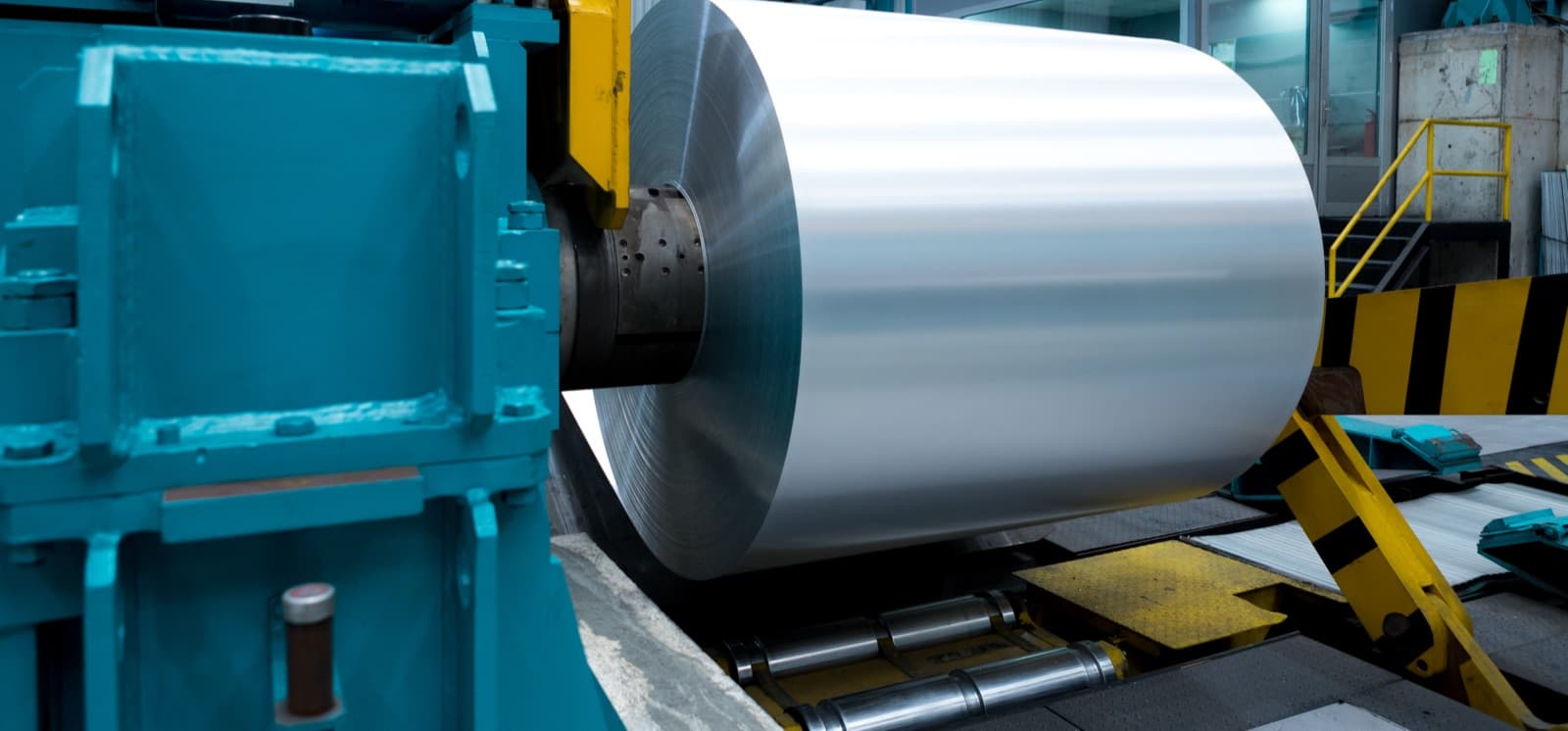
Figure 1: Rolled aluminium coil leaving the line at one of the company's two production facilities. The company reports that it holds no product photograph specific to the 3423 grade.

Impact
Sustainability Impact
Climate
The initiative acts on the carbon footprint of the product rather than on a single corporate emissions scope.
Measurement follows the Environmental Product Declaration methodology, with life cycle assessment to ISO 14040 and ISO 14044 and a cradle-to-gate boundary running from raw material supply to the factory gate. The baseline year is 2023, the year in which the conventional 3423 alloy entered application, and the comparison is made per tonne of product.
Before the initiative the conventional product carried a footprint of 10.48 tCO2e per tonne of product. The alloy developed with more than 95 per cent recycled content carries 1.79 tCO2e per tonne of product, a reduction of approximately 83%.
For the customers that buy the alloy the saving falls in their value chain (Scope 3) emissions, in Category 1, purchased goods and services, because it lowers the embodied carbon of a purchased input. The company classifies the same flow as category 4.1 under ISO 14064-1. Inside the company the shift to secondary metal reduces the upstream emissions carried by primary aluminium purchases, and energy consumption per tonne of product is tracked alongside the footprint so that the Scope 1 and Scope 2 effect of the melting and rolling route stays visible.
Performance is followed through four indicators: product carbon footprint in tCO2e per tonne of product, recycled content as a percentage, primary aluminium use as a percentage, and energy consumption in kWh per tonne of product.
The results were independently verified and the declaration published for stakeholders, so the figure can be audited rather than taken on trust.
Nature
High secondary content displaces primary aluminium, which reduces the demand for virgin raw material and keeps metal that already exists in circulation instead of extracting more.
This is the resource efficiency side of the initiative: the same rolled product is delivered from a material stream that would otherwise have to be treated as scrap, which supports the circular economy approach the company reports against.
Because the alloy carries a significant share of the product portfolio, the material saving is repeated across every customer that takes the grade.
Social
Publishing a verified product footprint gives customers, buyers and other stakeholders access to comparable data on the material they purchase, which supports informed choice rather than reliance on supplier claims.
Transparency is treated as an operating principle here: the declaration is available on the company's website rather than shared only with individual accounts.
Business Impact
Benefits
The commercial benefit is access to a growing segment of demand. Customers for the grade are being asked for low-carbon materials in turn, and a verified declaration lets the company answer that requirement with documentation.
Because 3423 carries a significant share of the product portfolio and covers a large part of the customer base, the low-carbon version can be sold into existing accounts rather than requiring a new market to be opened.
Industrial trials at 12 different customers confirmed performance across different production processes and compliance with customer requirements, which removes much of the qualification risk that normally slows the adoption of a reformulated grade.
The company's sales network and its customer base across several sectors support the spread of the product, and because customers supply their own downstream markets the effect widens as the material moves towards the final product.
Supplying a documented low-carbon input also helps customers reduce their own value chain emissions, which strengthens long-term commercial relationships rather than producing a one-off sale.
Costs
The cost base is the work required to raise recycled raw material use: securing sustainable supply of recycled input, alloy design optimisation, improvement of production parameters, and the corporate resource allocation dedicated to low-carbon products.
Recycled input brings a technical constraint as well as a cost. Alloy chemistry and surface quality have to be held inside specification while the secondary share rises, which is why the design and process parameter work runs alongside the sourcing effort rather than after it.
Environmental Product Declaration preparation and independent verification are recurring costs, because the declaration has to be maintained against actual production data rather than issued once.
Costs are contained by working inside an existing product family instead of creating a new grade, by running industrial trials at customers rather than building separate qualification capacity, and by close supplier collaboration on the supply of recycled raw material.
Continuity is underwritten by investment in raising recycled raw material use, product development activity, the declaration programme and dedicated corporate resource allocation for low-carbon products.
Impact beyond sustainability and business
Co-benefits
The approach offers a scalable model for industrial companies in developing economies, because it shows that decarbonisation can be advanced through recycled raw material use, life cycle based measurement and customer-oriented product development rather than through a single large capital project.
Because the grade feeds many sectors, and because customers in turn supply their own value chains, the effect widens as the material travels towards the final product.
The declaration itself is a shared asset: once verified and published, every customer can use the same figure in their own reporting, which avoids duplicated assessment work across the value chain.
Potential side-effects
The principal trade-off is technical. Recycled content can only rise as far as the required mechanical and surface properties allow, which is why alloy design and production parameters had to be optimised in parallel rather than simply raising the scrap share.
Scaling depends on the availability and quality of suitable recycled raw material. That is why supplier collaboration on sustainable supply is treated as part of the project rather than as a procurement task, and any company copying the model should expect input supply, not alloy design, to become the binding constraint.
A product-level figure is also not a corporate reduction. The footprint per tonne falls sharply, but total emissions depend on production volume, so the declaration should be read alongside absolute inventory data.
Implementation
Typical Business Profile
The model fits metal producers and, more broadly, manufacturers of standardised material grades that are sold on to many downstream sectors, where the footprint of the product is dominated by raw material rather than by conversion.
It is most relevant for companies that have a research and development function able to change material specification, a melting and casting operation able to handle secondary input, and a customer base willing to run industrial trials on a reformulated grade.
Delivery engages product management, sustainability, research and development, production, quality, supply chain and sales functions working to a shared indicator set.
Approach
Select the grade with the widest reach: Identify the alloy that carries a significant share of the product portfolio and covers the largest part of the customer base, so that a single reformulation reaches the highest volume rather than a specialist product.
Set the baseline before changing the product: Calculate the cradle-to-gate footprint of the conventional grade using life cycle assessment to ISO 14040 and ISO 14044, fix the baseline year, and record the result per tonne of product so later comparisons are like for like.
Raise recycled input in controlled steps: Increase the share of recycled raw material in the melt while testing at each step that the mechanical and surface properties required by the specification are retained.
Optimise the alloy design: Adjust the alloy composition so that the target properties hold at recycled content above 95 per cent, rather than accepting a downgraded grade or a restricted application range.
Adjust the production parameters: Revise casting and rolling parameters for secondary input so that surface quality and mechanical performance are reproducible in serial production and not only in the pilot.
Secure the recycled raw material supply: Work with suppliers on sustainable supply of recycled input, because the reformulation is only as scalable as the material stream behind it.
Prove the product at customers: Run industrial trials across different customer production processes, use technical evaluations and regular feedback to refine performance, and treat successful trials as the evidence base for wider application.
Verify, publish and commercialise: Complete an Environmental Product Declaration on actual production data, submit it to independent verification, publish it for stakeholders, and move the grade from pilot to serial production so customers can buy it.
Stakeholders Involved
Project leads: Senior management owns the initiative, which is positioned among the priority items of the company's sustainability and decarbonisation strategy and linked directly to the 2050 Decarbonisation Roadmap and the parent group's green transformation action plan. Performance indicators are followed and assessed on a regular cycle at that level, so the work is directed as a strategic transformation rather than delegated to a single technical function.
Company functions: Product management, sustainability, research and development, production, supply chain and sales teams run the initiative jointly, with quality joining the decision-making on material specification. Research and development, production, quality and sustainability contributed the technical judgements on how far recycled content could rise, while product management and sales carried customer requirements back into the design work, so the specification was set by demand and process capability together.
Main providers: Suppliers of recycled raw material are the critical external party. The company works closely with them on sustainable and continuous supply of the recycled input used in the alloy, since the recycled share in the product cannot exceed what the input stream can reliably deliver. Independent verification bodies review the Environmental Product Declaration, and third-party assurance providers audit the wider sustainability disclosures in which the result is reported.
Other: Customers are active participants rather than recipients. Their expectations for low-carbon products and their sustainability requirements shaped the project design, and 12 of them ran industrial trials, provided technical evaluations and gave regular feedback that was used to improve product performance and environmental characteristics. Internal stakeholders across the company also contributed through the decision-making process, so expectations from both sides of the value chain were integrated into product development.
Key Parameters to Consider
The baseline year is 2023 and the boundary is cradle-to-gate, so the reported reduction covers raw material supply through to the factory gate and excludes use and end-of-life stages.
The declaration is built on actual production data, which means it has to be maintained as production changes rather than treated as a permanent figure.
Scalability comes from the application range of the grade and from the share it holds in the portfolio; a grade with a narrower application range would deliver a smaller absolute result for the same technical effort.
The limiting technical parameter is the property specification: recycled content is bounded by the mechanical and surface requirements of the application, not by the melting process alone.
Implementation and operations tips
Measure at product level and publish the figure. Customers need a verified number they can put into their own reporting, and a declaration prepared to recognised life cycle standards does more commercial work than a general statement about recycled content.
Fix the baseline before touching the product. Without a footprint for the conventional grade calculated on the same boundary, the improvement cannot be defended.
Treat alloy design and process parameters as one problem. Raising the scrap share without redesigning the alloy tends to cost properties, which is what limits recycled content in practice.
Use customer trials as the qualification route. Running trials across different customer processes proves transferability faster than internal testing and builds the demand that justifies serial production.
Secure the input stream early. Recycled raw material supply, not laboratory work, is usually the constraint on scaling a high-recycled-content grade.