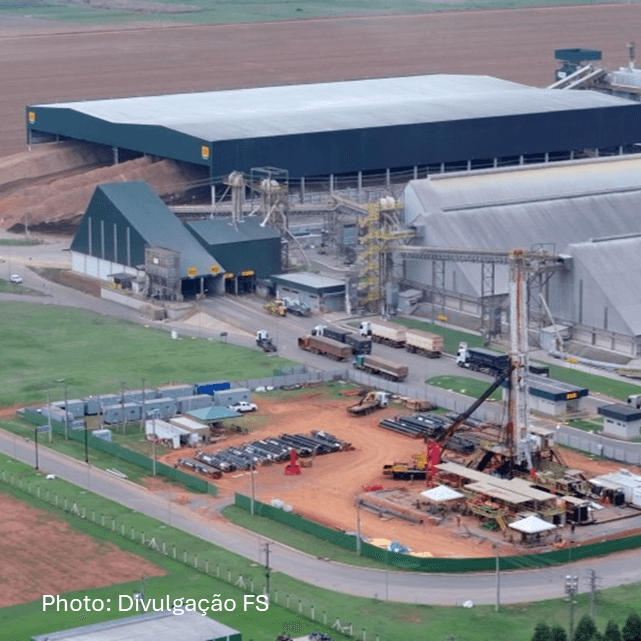
Capture and store CO2 from corn ethanol fermentation
 FS Indústria de Biocombustíveis
 CEBDS
CEBDS总结
Capture CO2 from bioenergy fermentation and store it 1,200 m underground, ensuring safe, leak-proof carbon removal through validated geological reservoirs.
Context
FS Fueling Sustainability is the first 100% corn-based ethanol and animal feed company in Brazil. A collaboration between the Brazilian agribusiness group Tapajós Participações S/A and the US-based Summit Agricultural Group, the company has manufacturing facilities in the cities of Lucas do Rio Verde, Sorriso, and Primavera do Leste in the state of Mato Grosso, and an office in São Paulo, São Paulo.
FS faced the challenge of reducing the carbon footprint of corn ethanol production, which generates significant CO2 during fermentation. To address this, the company implemented a decarbonization strategy using BECCS (Bioenergy with Carbon Capture and Storage).
Location: Brazil
Impact
Sustainability impact
Climate
Carbon-Negative Ethanol: Captures 423,000 tons of CO₂ from second-crop fermentation. This captured carbon contributes to a negative carbon footprint, and the overall balance achieves a net CO₂ removal from the atmosphere.
Long-Term Storage: Injects CO₂ into geological reservoirs ~1,200 meters underground, ensuring secure and permanent carbon removal.
Greenhouse Gas Reduction: Directly lowers emissions from ethanol production, contributing to climate mitigation.
Regional Leadership: Positions Brazil as a leader in carbon removal in Latin America.
Global Influence: Inspired the controlling shareholder to launch the largest carbon capture project in the US, amplifying global climate impact.
Regulatory Alignment: Supports national and corporate net-zero and sustainability goals, aligned with the Fuel of the Future legal framework.
Business impact
Costs
Phase 1 Investment: ~R$110 million for studies and well drilling.
Phase 2 Investment: ~R$350 million to scale BECCS operations.
Implementation
Approach
Geological Validation
Conduct technical studies to identify porous formations suitable for CO₂ storage.
Drill stratigraphic wells to confirm geological feasibility.
Ensure sealing layers prevent leakage.
Carbon Capture Process
Capture CO₂ released during fermentation.
Dehydrate and compress the CO₂ for safe storage.
Storage & Injection
Inject CO₂ into geological reservoirs ~1,200 meters underground.
Monitor reservoirs to ensure long-term stability.
Regulatory & Environmental Compliance
Secure approvals from the National Petroleum Agency (ANP).
Align the project with Brazil’s Fuel of the Future legal framework.
Obtain environmental licensing to operate safely and sustainably.