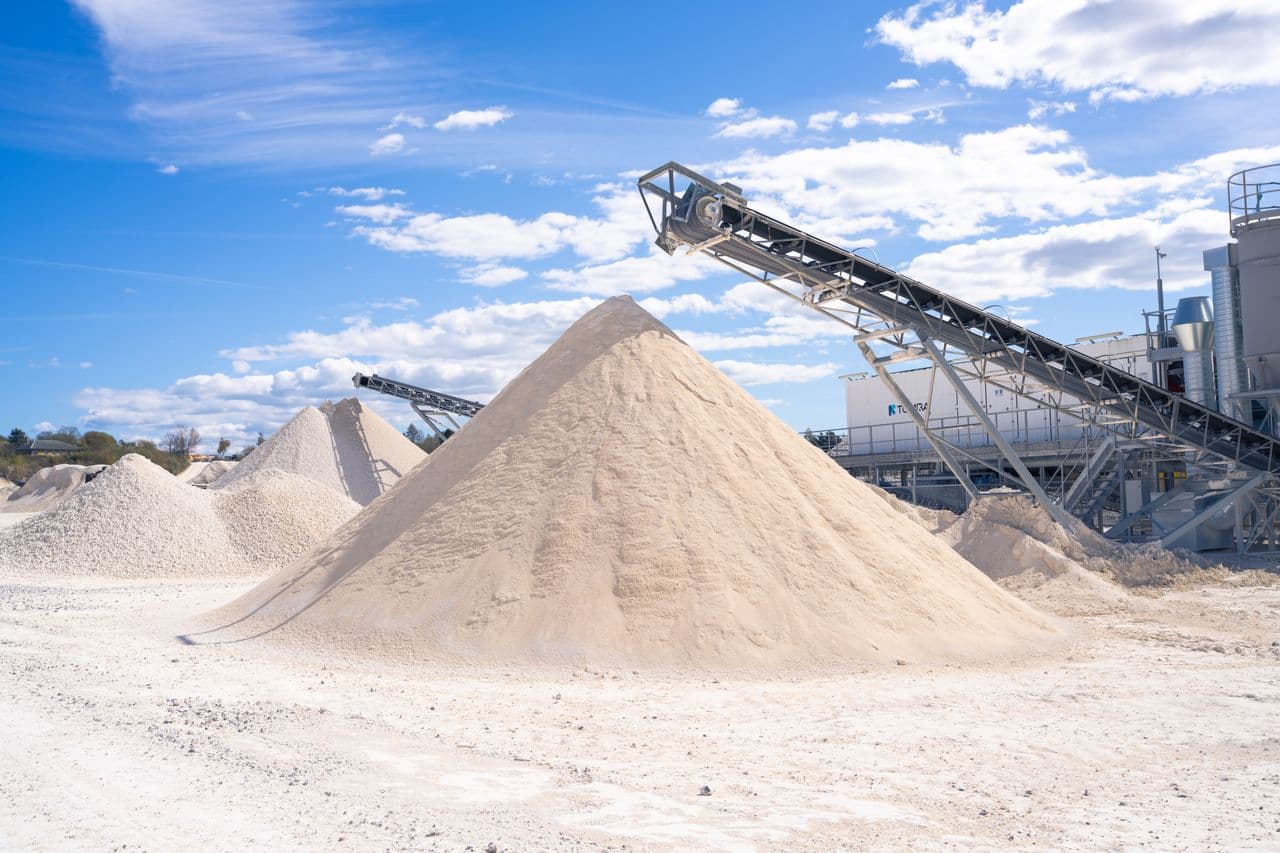
Convert a fertiliser by-product into circular soil inputs
 Toros Tarım Sanayi ve Ticaret A.Ş.
 SKD Türkiye
总结
Phosphogypsum from phosphoric acid production is granulated with biogas compost and off-specification nitrate to make soil improvers instead of being stockpiled.
Context
Submitted through the COP31 Sustainable Transformation Awards · SKD Türkiye (WBCSD Global Network Partner)
The company is a fertiliser producer in the manufacturing sector, with more than 1,000 employees.
Phosphoric acid production generates phosphogypsum as a by-product. The material is conventionally treated as waste and sent to stockpiles, which occupy land indefinitely and grow for as long as production continues. The company frames the opportunity against global stockpiles that it estimates at more than 6-7 billion tonnes. At its Mersin site approximately 3 million tonnes sit in a passive stockpile, and at the Samsun production site the volume continues to rise because phosphoric acid production is ongoing.
The material itself is not inert waste. Phosphogypsum supplies calcium and sulphur to plants and improves the water holding capacity of soil, which matters in the semi-arid cereal regions where the company’s customers farm. The obstacle is physical and commercial rather than agronomic: the material is a fine powder that farm equipment cannot spread, and it carries the regulatory and commercial status of a waste rather than of a raw material.
The initiative was started in 2024 by the company’s research and development centre. It was developed voluntarily rather than in response to a legal obligation, with 2024 set as the base year. The objective is to move phosphogypsum from waste management into resource management: to reduce the stockpile area, to convert the material into products with an economic value, and to combine it with secondary streams from other sectors in the same value chain.
Location of the initiative: Mersin, Samsun, Eskişehir and Şanlıurfa provinces, Türkiye
Solution
The approach treats three separate waste and off-specification streams as inputs to one product family, which is what makes it an industrial symbiosis model rather than a recycling project.
The first stream is phosphogypsum drawn from the stockpile at the company’s own site. The second is compost left after biogas production at the group’s renewable energy plant. The third is off-specification nitrate fertiliser rejected by the fertiliser production line, which would otherwise be reprocessed or discarded.
Granulation is the technical core. Converting the powder into granules allows the material to be handled, stored and spread with the equipment farmers already own, which removes the practical barrier to use. Binder systems based on lignosulphonate were evaluated from three different suppliers, and granulation parameters were optimised for each formulation.
Three products came out of the work: a phosphogypsum-based granule, a CAN 20 nitrate fertiliser recovered from the off-specification stream, and a Mixture Soil Conditioner combining phosphogypsum with the biogas compost. The relationship between the three input streams and the resulting product family is illustrated in the diagram below.
Method discipline rather than new equipment is what moved the products from laboratory to pilot scale. Six Sigma methodology and statistical design of experiments were used to identify the critical granulation parameters, optimise them at laboratory scale, confirm them statistically, and then transfer the confirmed conditions to pilot production. The technical result was independently recognised in 2025 with first place in the Six Sigma category of a national lean and Six Sigma conference best practice competition.
Agronomic performance was then tested in greenhouse conditions and in repeated field trials across two provinces before any commercial claim was made. The initiative has completed the pilot stage; product registration and commercialisation are in progress.
Figure 1: Circular production pathway converting phosphogypsum, biogas compost and off-specification nitrate fertiliser into three granular agricultural products through product-specific formulation and granulation.

Following formulation optimisation and pilot-scale granulation, the agricultural performance of the resulting products was evaluated under greenhouse and field conditions. These trials were designed to determine whether the circular inputs could provide measurable agronomic benefits under practical growing conditions, with particular attention to plant development, nutrient uptake, resilience to frost and grain yield. The following results summarise the performance of the PG-based treatments across the different experimental conditions.
Visual assessment following the frost event in the Eskişehir field trial indicated that the plots receiving PG-containing treatments, particularly T.O.K.+PG, maintained a denser, greener and more uniform crop cover than the untreated control and several treatments without PG. The lower degree of visible canopy thinning suggests that these plants were less affected by frost and showed better post-frost recovery. This response may be related to the contribution of PG-derived calcium and sulphur to plant nutrition and stress resilience, together with the soil-improving effect of the organic component in the T.O.K.+PG treatment. Although these observations suggest a protective effect, quantitative measurements of plant survival, biomass and final yield are required to confirm the response.
Increasing the application rate of phosphogypsum-derived sulphur generally improved both plant sulphur concentration and dry-matter production relative to the untreated control. Plant sulphur concentration increased progressively from 25 ppm onwards, reaching a maximum increase of 101% at 1,500 ppm S. Although the response declined slightly at 3,000 ppm S, it remained 84% above the control, suggesting that sulphur uptake approached a plateau at the highest application rate. Dry-matter production showed a clearer response at the higher doses, increasing by 11%, 15% and 23% at 150, 1,500 and 3,000 ppm S, respectively. The corresponding greenhouse observations were consistent with these results, as plants receiving the higher PG-derived sulphur rates displayed more vigorous growth without evident symptoms of phytotoxicity. Overall, the findings indicate that PG can provide plant-available sulphur and support biomass production, although the most suitable application rate should be selected by considering both nutrient uptake and plant growth.
Grain-yield results from the 2022–2024 field trials showed that PG-containing treatments generally performed better than the untreated control across both Eskişehir and Şanlıurfa. The yield response became more pronounced when PG was applied at the higher rate or combined with conventional and organomineral fertilisers. DAP+PG produced the highest yield in Şanlıurfa in 2023, while the 3× PG treatment showed particularly strong performance in Eskişehir and Şanlıurfa in 2024. Similarly, T.O.K.+PG generally achieved higher yields than T.O.K. alone, particularly in the 2023 and 2024 trials. Although the magnitude of the response varied between locations and years, the overall results indicate that PG can contribute to grain production both as a standalone soil input and as a complementary component of fertiliser formulations. The variation among years also highlights the importance of soil and climatic conditions in determining the agronomic response.
Figure 2: Grain yields obtained from different fertiliser and soil amendment treatments in the Eskişehir and Şanlıurfa field trials conducted between 2022 and 2024.

Following laboratory-scale optimisation, trial production was carried out at the Meram facility to evaluate the performance of the selected formulations under pilot-scale operating conditions. Different formulations were tested by varying the binder type and dosage, filler material and target nitrogen content. The trials were used to assess the processability of the mixtures, granule formation, product homogeneity and drying behaviour, as well as the suitability of the existing production infrastructure for scale-up. The produced granules were subsequently spread on separate trays for drying and further evaluation of their physical and chemical properties.
Impact
Sustainability impact
Climate
No emissions figure is available for the initiative. Effect data covers the 2024 to 2026 period of laboratory, pilot production, greenhouse and field work, with 2024 as the base year, and over that period no life cycle assessment and no GHG Protocol accounting have been carried out. Neither the Scope 1 effect at the production sites nor the Scope 2 effect of the electricity used in granulation has been calculated, and no avoided-emissions claim is made.
The enabling mechanisms are identifiable but unquantified, and each acts in the value chain rather than inside the company’s own operations. Drawing phosphogypsum from the approximately 3 million tonne passive stockpile at the Mersin site displaces primary raw material that would otherwise have to be mined and processed. Returning the compost left after biogas production to the land keeps organic matter in the soil instead of sending it for disposal, and recovering off-specification nitrate as CAN 20 avoids reprocessing it. The improvement in water holding capacity that produced an average yield increase of 15-35 per cent across three years of field trials means more grain from the same area and the same application.
None of these has been converted into carbon dioxide equivalent, and the expected effect should not be asserted before it is calculated.
A comparative life-cycle and GHG assessment will be conducted for the three granulated products against functionally equivalent conventional fertilisers or soil improvers. The assessment will cover raw-material sourcing, transportation, granulation and agricultural use, with results expressed as kg CO2-eq per tonne of product and per unit of nutrient delivered. The final Scope 3 classification will be confirmed after defining the organisational and product-system boundaries. Purchased external inputs are expected to fall under Scope 3 Category 1, while emissions associated with the agricultural use of sold nitrogen-containing products are expected to be assessed under Category 11. Any avoided emissions relative to conventional alternatives will be calculated and reported separately rather than deducted directly from the company’s Scope 1, Scope 2 or Scope 3 inventory.
Nature
The direct nature effect is the diversion of material from permanent storage. Phosphogypsum that would remain in a stockpile becomes an input to three product classes, which reduces the land committed to storage and removes a long-term source of dust and runoff at the stockpile face.
Two further streams are diverted in the same value chain: compost remaining after biogas production at the group’s renewable energy plant, and off-specification nitrate fertiliser from the production line. Three by-products are therefore used inside one chain rather than managed separately as wastes.
In the soil, the trials associate phosphogypsum and compost combinations with improved water holding capacity and biological activity. That supports water use efficiency and reduces drought stress in the field, which in semi-arid cereal areas is the difference between a crop and a failed one.
Social
The agronomic results reach farmers directly. In greenhouse trials on maize, the Mixture Soil Conditioner and the phosphogypsum blended with off-specification nitrate produced 10 per cent and 32 per cent more dry matter yield than the control.
Seven field trials were run over three years in Eskişehir and Şanlıurfa, six of them on wheat and one on maize, examining phosphogypsum used alone and with compost. Across the repeated trials the treated plots produced an average yield increase of 15-35 per cent against the control plots, with the highest result of approximately 30-50 per cent at the PG 3X dose rate. Applications combined with organic conditioners produced increases of 20-35 per cent and were consistent across different climates.
Plants in treated areas also showed greater resilience to abiotic stress such as drought and frost, which reduces the year-to-year income volatility that farmers carry.
Converting the powder into granules matters socially as well as technically: it means a farmer can apply the product with existing equipment, without new machinery or specialist handling.
Business impact
Benefits
The initiative converts a stored liability into product inventory. Material that carried only storage cost becomes an alternative raw material for three product classes, and the stockpile area that would otherwise keep growing has a route to reduction.
Resource efficiency improves across the group because streams that were managed separately are used together. Off-specification nitrate returns to the market as CAN 20 rather than being reprocessed, and compost from the group’s own biogas plant becomes a product input rather than a disposal question.
The product range widens without new production infrastructure, since granulation uses existing facilities and the pilot production ran at the group’s renewable energy plant.
Agronomic evidence from repeated trials supports the commercial case for the products and provides the data needed for registration. Independent recognition in 2025 at a national lean and Six Sigma conference best practice competition, where the work took first place in the Six Sigma category, confirmed the technical method.
Internally, the decision to fund three employee-proposed projects at once rather than selecting one built a portfolio effect: the granulation, CAN 20 and Mixture Soil Conditioner routes reinforced each other and shared the same experimental base.
Costs
The cost base to date is research and development rather than capital investment: laboratory work, statistical experiment design, binder procurement and testing from three suppliers, pilot production runs of approximately 100 kg for each of the three formulations, three years of greenhouse and field trials in two provinces, and the registration process now under way.
Costs continue beyond the pilot. Product registration, user acceptance work and commercial-scale production planning are the main outstanding items, and the company identifies them as the principal risks alongside the technical ones.
The economics also depend on logistics. Phosphogypsum is bulky and low in value per tonne, so the distance between the stockpile, the granulation facility and the farm determines whether the product competes.
Costs are contained by using existing production infrastructure, by sourcing all three input streams from inside the group or from its own production lines, and by proving the parameters statistically at laboratory scale before committing pilot production capacity.
The economic performance of the three granulated products was evaluated through a 5,000-iteration Monte Carlo simulation conducted in Minitab. The minimum, most likely and maximum input values were obtained from the Production and Process Planning Unit and supported by the raw-material prices and operational cost records available at the time of the study. The model included raw materials, labour, equipment operation, transportation and other production expenses, together with the expected annual sales volumes and selling-price ranges. Triangular probability distributions were applied to the uncertain cost inputs, while sales volumes and selling prices were varied within the ranges defined by the planning data.
Financial results are presented in constant 2024 prices and were converted using the exchange-rate assumption applied in the original analysis (TRY 34 per USD). The estimated unit production costs were approximately USD 180 per tonne for the phosphogypsum granule, USD 350 per tonne for the phosphogypsum–off-specification fertiliser granule and USD 260 per tonne for the compost-based soil improver. Planned annual sales volumes are approximately 5,000 tonnes, 9,000 tonnes and 8,000 tonnes, respectively, corresponding to a total projected annual volume of 22,000 tonnes. The Meram facility has an existing production capacity of approximately 200 tonnes per day; therefore, the projected annual sales volume could theoretically be produced in approximately 110 operating days, subject to production scheduling, product changeovers, maintenance requirements and market demand. As commercial-scale production is planned to utilise the existing granulation infrastructure, no dedicated capital investment is currently required and a conventional payback period is therefore not applicable. Minor equipment modifications, packaging, maintenance and working-capital requirements will be assessed during the final commercial-scale planning stage. All financial estimates will be updated using prevailing operational costs, market prices and exchange rates before full commercial deployment.
Impact beyond sustainability and business
Co-benefits
The model is transferable to other by-product streams. What was demonstrated is a method for taking a stored industrial residue, combining it with secondary streams from other sectors, and granulating the result into a product that existing equipment can handle.
The link with the group’s biogas plant creates a two-way relationship: the plant supplies compost and hosts pilot production, so a renewable energy asset gains a materials role alongside its energy role.
The statistical method has value beyond this product family. Critical parameters identified and confirmed at laboratory scale transferred to pilot production without rework, which is a repeatable route for other formulation projects in the company.
Potential side-effects
The environmental claim is not yet closed. Without life cycle assessment or greenhouse gas accounting, the net effect of granulating, transporting and spreading the material has not been compared with leaving it in the stockpile, and that comparison should be completed before the products are marketed on environmental grounds.
Regulatory status is the main external dependency. A material classified as waste cannot simply be placed on the market as a soil input, and product registration governs when and where the products can be sold.
User acceptance is a second dependency. Farmers are being asked to apply a product derived from an industrial by-product, and the evidence base has to be strong enough and local enough to overcome that reluctance.
Agronomic results also vary with dose. The trials show a wide range, from 15-35 per cent on average up to approximately 30-50 per cent at the PG 3X dose, so dose guidance by soil type is necessary if users are not to be disappointed or to over-apply.
Implementation
Typical business profile
The model suits manufacturers that hold large volumes of a stockpiled mineral by-product and that also sell into agriculture, because the same organisation then controls both the residue and the route to market.
It applies to phosphogypsum stockpile sites, fertiliser production plants, biogas plants and other sectors producing organic residues, and it can be implemented using existing production infrastructure rather than a dedicated plant.
Delivery requires a research and development function with formulation and statistical capability, production and laboratory teams able to host pilot runs, an agronomy capability for greenhouse and field trials, and a regulatory affairs function to manage product registration.
Approach
Reclassify the residue before designing the product: Establish internally that the stockpiled material is a by-product with a potential use rather than a waste, because that decision determines whether resources are allocated to storage management or to product development.
Inventory the secondary streams available in the group: List the residues and off-specification outputs from other plants, in this case compost from biogas production and off-specification nitrate fertiliser, and test which of them complement the main residue chemically.
Identify the barrier to use, not only the value: Establish why the material is not used today; here the obstacle was the fine powder form, which no farm spreading equipment can handle, so granulation became the core of the project.
Optimise granulation with statistical experiment design: Use Six Sigma methodology and design of experiments to identify the critical granulation parameters, optimise them at laboratory scale and confirm them statistically before any scale-up.
Evaluate binder systems from more than one supplier: Test alternative lignosulphonate binders side by side, take technical feedback from each supplier, and adjust the formulations against the granule strength and handling characteristics the product needs.
Transfer the confirmed conditions to pilot production: Produce a defined quantity of each formulation, in this case approximately 100 kg each, at an existing plant rather than at a new facility, and verify that laboratory parameters hold at scale.
Prove agronomic performance in greenhouse and field in parallel: Run controlled greenhouse trials for dry matter yield and multi-year field trials at more than one location and on more than one crop, with control plots and several dose rates, so that the yield claim is defensible across climates.
Run registration and commercialisation as a planned phase: Treat product registration, user acceptance and commercial-scale production planning as the named risks after the pilot, and sequence the work so that trial data supports the registration dossier.
Stakeholders involved
Project leads: The company’s research and development centre leads the initiative, within the sustainability and innovation objectives of the business. Three separate employee proposals relating to phosphogypsum were submitted through the group’s lean and Six Sigma programme; senior management judged all three to be of strategic importance and decided to support the granulation, CAN 20 and Mixture Soil Conditioner routes simultaneously rather than selecting one. Senior management funded the work on technical and sustainability grounds and reviewed the outputs directly as the year-end jury.
Company functions: Research and development coordinates the work and holds the experimental records and performance reports. Production and laboratory teams ran the pilot production jointly with the group’s renewable energy plant, which acted both as compost supplier and as the pilot production site. Agronomy teams ran the greenhouse and field trials, and the functions responsible for registration and investment support the commercialisation phase.
Main providers: Three lignosulphonate binder suppliers took part in product development, providing alternative binder systems that were assessed for technical performance. Their technical feedback was used to optimise granulation parameters and product formulations and to select the solutions transferred to pilot production.
Other: The scientific basis and methodological approach were built on knowledge and research experience gained during doctoral work at Ankara University, which fed directly into project design, the choice of experimental approach and the interpretation of results. Farmers hosting the field trials in Eskişehir and Şanlıurfa provided feedback that was used to improve application conditions. The group’s renewable energy plant participated as an internal partner in both material supply and pilot production.
Key parameters to consider
The initiative has completed pilot scale; registration and commercialisation are in progress, so the yield results are trial results rather than commercial performance.
Effect data comes from laboratory, pilot production, greenhouse and field work over 2024-2026, with 2024 as the base year. Monitoring is carried out through research and development records and performance reports.
Five key performance indicators were tracked: the number of products developed, the number of formulations transferred to pilot scale, the pilot production quantity, agronomic performance and the product development success rate.
Field trials need repetition across seasons. Three years of trials at two locations were required before the yield range could be stated with confidence, which sets the realistic timeline for anyone repeating the work.
The company reports through CDP on climate, water and forests, applies reporting aligned with ISSB standards IFRS S1 and S2 and with TNFD, and obtains independent third-party assurance.
Implementation and operations tips
Solve the handling problem first. The agronomic value of phosphogypsum was known; what prevented its use was that a fine powder cannot be spread, so the granulation work created more value than any change to the chemistry.
Fund the portfolio, not the best single idea. Supporting three related proposals at once let the granulation, nitrate recovery and compost blending routes share one experimental base and one pilot campaign.
Use statistical experiment design before scaling. Parameters confirmed statistically at laboratory scale transferred to pilot production without rework, which is where most formulation projects lose time.
Test at more than one location and on more than one crop. Consistency across two provinces and across wheat and maize is what makes the yield claim credible to farmers who do not share the trial site conditions.
Start the registration conversation early. For a by-product entering the agricultural market, regulatory status determines the commercial timetable more than technical readiness does.