Decarbonise renewable energy operations
 Fiba Yenilenebilir
  SKD Türkiye
总结
Hybrid solar on operating wind farms, site electrification and the end of on-site LPG use cut Scope 1 and 2 emissions by about 80 per cent against a 2023 baseline.
Context
Submitted through the COP31 Sustainable Transformation Awards · SKD Türkiye (WBCSD Global Network Partner)
Fiba Renewables operates a 100% renewable energy generation portfolio in Türkiye, with 170 employees by the end of 2025. However, producing renewable electricity does not eliminate greenhouse gas emissions arising from a company's own operational activities.
The company therefore developed a decarbonisation approach that extends beyond the renewable nature of its core business and addresses emissions generated through its own operations.
The programme, run under the name “Leaving No Trace: Our Net-Zero Emission Journey”, was launched in 2024 as a transformation programme addressing the whole value chain rather than the operational perimeter alone. In 2024, the company's net-zero targets aligned with the Paris Agreement's 1.5°C pathway were validated by SBTi. The company committed to reducing absolute Scope 1 and Scope 2 emissions by 42% by 2030 compared with a 2023 base year, alongside a 42% reduction target for Scope 3 emissions.
The company's greenhouse gas emissions are calculated annually under the operational control approach in accordance with ISO 14064-1:2018 and the GHG Protocol, supported by independent verification, and results are published in the annual sustainability report.
Location of the initiative: Türkiye — four operating power plants and company sites
Solution
The company translated its science-based climate target into an operational decarbonisation roadmap focusing on the main sources of Scope 1 and Scope 2 emissions. In line with its science-based emission reduction target for 2040, the company has defined the following activities within its decarbonisation roadmap: decarbonisation and effective management of greenhouse gas emissions in its value chain, transition to refrigerants with low global warming potential in air conditioning systems, transition from fossil fuel use to renewable resources, energy efficiency and production optimisation with hybrid power plants, electrification, and transition to 100% renewable energy use.
One of the first major actions focused on purchased electricity. In 2024, the company sourced all of its electricity consumption from I-REC-certified renewable sources. This reduced Scope 2 emissions in 2024 by 99.5% compared with the 2023 base year. The use of 100% renewable electricity was maintained in 2025, and the company's 2025 greenhouse gas inventory reports zero market-based emissions from purchased electricity.
The company progressively reduced fossil fuel consumption in stationary combustion sources and introduced electrification and lower-carbon alternatives. LPG consumption was reduced by 23% in 2024 compared with 2023 and eliminated by 2025. This directly addressed Scope 1 emissions associated with stationary combustion. The company also began transitioning vehicles used in its operations towards hybrid vehicles, reducing fossil-fuel-related emissions from mobile combustion sources.
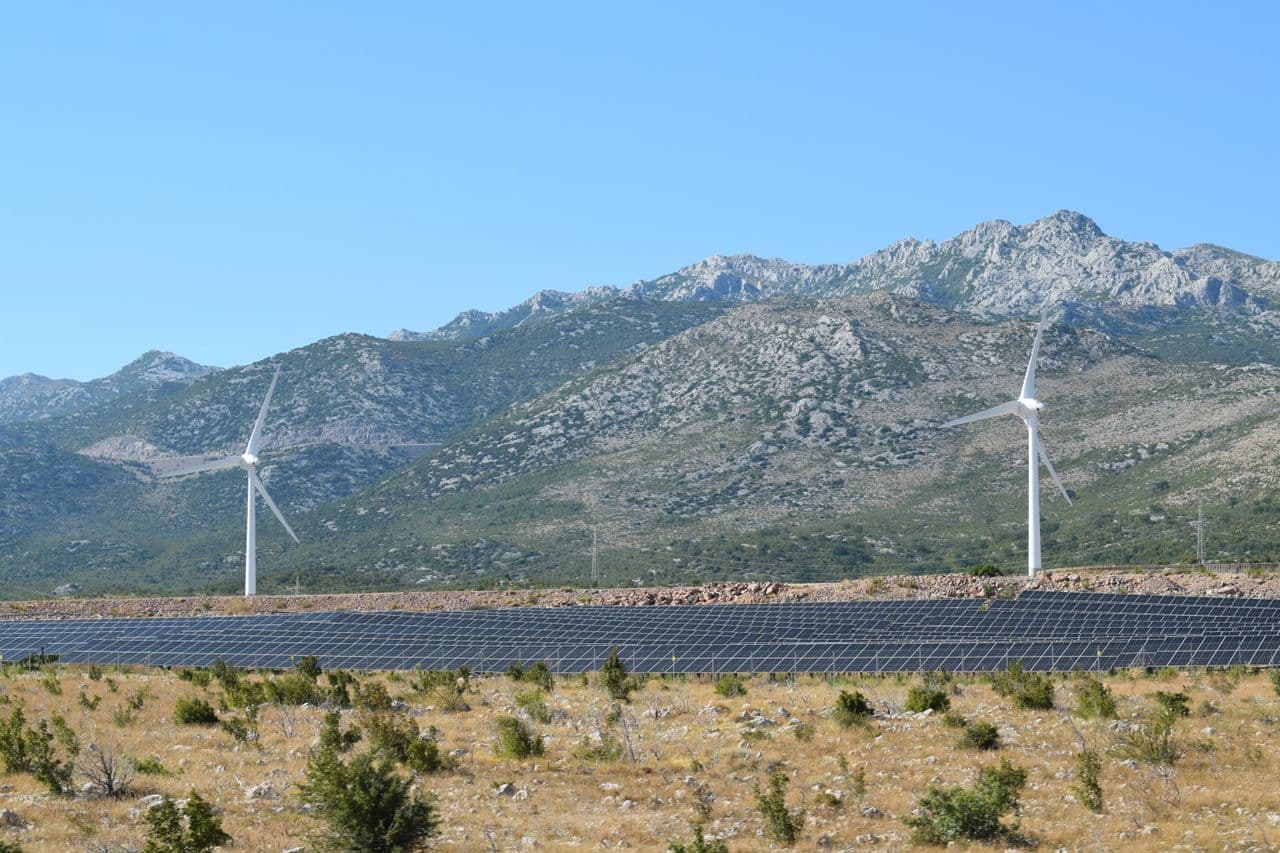
The largest structural action is the integration of solar power plants as a supplementary resource to the four operating wind power plants. A total of 149 MW of solar capacity was accepted by the Ministry of Energy and Natural Resources at the end of 2025 and entered production.
Self-consumption is addressed with equipment that would otherwise have become waste. Solar panels whose efficiency had declined below the level required for commercial generation are taken out of the commercial fleet and redeployed to supply the company's own energy needs, which turns a disposal problem into an internal supply source.
SF6 (sulphur hexafluoride) used in electrical switchgear represents another potential source of direct greenhouse gas emissions. In 2025, the company strengthened its Scope 1 emissions management by introducing monitoring and control systems for SF6 used in generation operations. This action was integrated into the company's wider approach to improving greenhouse gas monitoring and reducing fugitive emissions.
The decarbonisation roadmap is supported by an increasingly robust greenhouse gas data and monitoring infrastructure. Scope 1, Scope 2 and Scope 3 emissions are calculated annually in accordance with ISO 14064-1:2018 and the GHG Protocol. The company regularly reviews its calculation scope and strengthens its data monitoring infrastructure, while supporting its emissions reporting through independent verification.
Figure 1: Scope 1 and Scope 2 emissions against the 2023 base year: 2,079.28 tCO²e in 2023, 865.2 tCO²e in 2024 and 430.6 tCO²e in 2025, set against the 42 per cent reduction milestone for 2030 and the 90 per cent reduction pathway for 2040, with the roadmap measures placed along the pathway

Impact
Sustainability Impact
Climate
Scope 1 and Scope 2 emissions fell by approximately 80 per cent against the 2023 base year by 2025. That result exceeds the 42 per cent reduction the company committed to for 2030 under its SBTi-validated target, and was delivered by four measures together: reducing fossil fuel dependency, strengthening emission monitoring systems, introducing SF6 monitoring and control mechanisms, and maintaining 100 per cent renewable electricity use.
On Scope 1 specifically, LPG consumption fell by 23 per cent in 2024 against 2023 and was eliminated entirely by 2025, with the equipment electrified. The operational fleet moved to hybrid vehicles.
On Scope 2, renewable electricity generated by the company and used for its own consumption rose 25 per cent in 2024 against 2023 to reach 57,000 kWh, preventing 36 tCO²e. In 2025 self-consumption from own generation rose to 76,000 kWh, preventing 46 tCO²e.
The largest absolute climate effect comes from generation rather than from the operational perimeter. The hybrid plants' solar installed capacity produced 191,912 MWh of additional clean electricity in 2025, delivering approximately 123,000 tCO²e of carbon reduction.
On Scope 3, critical suppliers are assessed and their emissions brought into the inventory. Approximately 61.4% of the indirect emissions from the activities of critical suppliers are included in Scope 3 emissions. These represent approximately 95.3% of the company's Scope 3 emissions and approximately 94% of its supply chain volume in 2024. Suppliers covering all of the critical supplier base are included in 2025, approximately 84.7% of Scope 3 emissions.
The Scope 3 inventory is reported under GHG Protocol categories 1 to 7: purchased goods and services, capital goods, fuel- and energy-related activities, upstream transportation and distribution, waste generated in operations, business travel, and employee commuting.
Nature
Hybrid power plants add generation capacity to plants that already exist. Because the solar capacity uses grid connection and balance-of-plant infrastructure of four operating wind farms, the additional 191,912 MWh was produced without grid infrastructure that an equivalent standalone solar development would have required.
Reusing declining-efficiency solar panels for internal supply keeps functioning equipment out of the waste stream. Panels that no longer meet commercial generation thresholds still produce electricity, and redeploying them for the company's own consumption postpones end-of-life processing while displacing purchased electricity.
The switch to refrigerants with lower global warming potential and the introduction of monitoring and control for sulphur hexafluoride address two gas streams that are small in volume but disproportionate in effect, and that are typically managed only at equipment failure rather than continuously.
Social
The company prioritises environmental and social impact analyses in its investment projects and maintains relations with its stakeholders within the scope of stakeholder engagement. In this context, the “Leaving No Trace: Our Net-Zero Emission Journey” project was developed with the participation of various stakeholder groups.
Employees are treated as participants rather than as an audience. Monthly sustainability bulletins, training programmes and awareness activities support behavioural change inside the company, and emission reporting teams based at operating sites take part in data collection and performance monitoring, which gives operational staff a direct role in the decarbonisation results rather than a reporting obligation.
Environmental engineers working at the operation sites carry out data collection, verification and performance monitoring, which is what makes the emissions data traceable and auditable.
Sustainability indicators are included in senior executive performance evaluations, covering installed capacity growth, availability rate, greenhouse gas emission reduction and the extension of environmental, social and governance practices through the supply chain, so that accountability for the targets sits with the people who control the investment decisions.
Suppliers gain from the same requirements. Critical suppliers pass through environmental, social and governance assessment and are supported in aligning with climate expectations, which builds capability in businesses that serve other customers as well.
Business Impact
Benefits
The hybrid power plants produced measurable operational gains beyond the emissions result. Comparing 2024 with 2025 across the four plants converted to hybrid operation, internal consumption fell by an average of 10 per cent and the average capacity factor rose from 31.6 per cent to 41.1 per cent.
That combination — lower own consumption and higher capacity factor — is evidence that the hybrid model strengthens production continuity, balances the fluctuations caused by weather conditions and makes considerably better use of existing infrastructure.
The company's roadmap provides a practical example of moving from a science-based commitment to measurable operational implementation: establish a baseline, identify controllable emission sources, implement source-specific interventions, measure the results and continue raising ambition as performance improves. Reaching approximately 80 per cent reduction against 2023 well ahead of a 2030 milestone of 42 per cent also demonstrates that the company is implementing actions aligned with its sustainability strategy and effectively embedding its targets into its operational processes.
Costs
The main cost is capital. Adding 149 MW of solar capacity to operating wind plants requires panel and inverter procurement, civil and electrical works, permitting and formal acceptance by the energy authority, and the internal project capacity to manage all of it in parallel with running the plants.
Measurement is a continuing cost. Annual inventory calculation to ISO 14064 and the GHG Protocol, emission monitoring infrastructure, SF6 monitoring and control mechanisms, external assurance and CDP and ISSB-aligned disclosure all require specialist resource that a smaller operator would find heavy.
Extending to Scope 3 adds a further burden: assessing all critical suppliers against environmental, social and governance criteria in 2024 and 2025 and bringing their emissions into the inventory requires supplier data that is often not held in a usable form and has to be built through the procurement relationship.
Costs are contained by redeploying declining-efficiency panels rather than buying equipment for self-consumption; and by using one data set for the inventory, assurance, CDP and financial-reporting disclosures.
Impact Beyond Sustainability And Business
Co-benefits
Solar and wind output at the same connection point are complementary across the day and the season, so the same grid capacity carries more energy without reinforcement.
Bringing climate criteria into purchasing spreads the requirement to suppliers who also serve other customers, so the assessment process raises practice beyond the company's own value chain.
Redeploying declining-efficiency panels demonstrates a second-life route for solar equipment that the industry will need at scale as early installations reach the end of their commercial lives.
Potential side-effects
Adding solar capacity brings its own material footprint — panels, mounting structures and inverters, with an eventual end-of-life waste stream — which offsets part of the resource benefit of reusing existing sites.
Part of the approximately 80 per cent Scope 1 and Scope 2 reduction rests on maintaining 100 per cent renewable electricity procurement, which depends on the continued availability of certified supply and is a market-based rather than a physical reduction; the underlying consumption reduction and the LPG elimination are the more durable components.
Scope 3 coverage depends on supplier data quality. Critical supplier coverage was approximately 61.4 per cent in 2024 and extended to all critical suppliers in 2025, and the share of Scope 3 emissions captured shifts between years as the supplier mix changes, which makes year-on-year comparison of Scope 3 less stable than for the operational scopes.
Implementation
Typical Business Profile
The operational elements — removing fossil fuel from stationary sources, electrifying equipment, monitoring high global warming potential gases and extending climate criteria into procurement — transfer to sectors outside energy that are pursuing emission reduction with a distributed asset base.
Delivery engages a sustainability committee and its working groups, site environmental engineers, investment and project functions, procurement and supply chain management, and human resources for the training and awareness elements.
Approach
Set a validated reduction pathway before selecting measures: Commit to science-based targets — here a 1.5°C-aligned net-zero commitment for 2040 and a 42 per cent Scope 1 and Scope 2 reduction by 2030 against a 2023 base year — so that project selection is measured against a curve rather than against ambition.
Build the inventory to an external standard: Calculate greenhouse gas emissions annually in accordance with ISO 14064 and the GHG Protocol, place environmental engineers at operating sites to collect and verify the data, and subject the results to independent assurance, so that reductions are demonstrable rather than asserted.
Remove fossil fuel from stationary sources rather than making it more efficient: Cut LPG use at sites — down 23 per cent in 2024 — and then eliminate it entirely by electrifying the equipment concerned, which converts a Scope 1 source into a Scope 2 one that renewable procurement can then address.
Electrify the mobile fleet on the replacement cycle: Move operational vehicles to hybrid models as they come up for renewal, so that the transition is funded through the existing fleet budget rather than as an additional investment.
Supply own consumption from own generation: Redeploy solar panels whose efficiency has fallen below commercial generation thresholds to on-site supply, raising self-consumption from own generation to 57,000 kWh in 2024 and 76,000 kWh in 2025, which avoids both purchased electricity and equipment disposal.
Hybrid power plants: Add solar capacity to operating wind farms using their land, grid connection and infrastructure, and take the additions through formal acceptance with the energy authority — 149 MW accepted at the end of 2025 across four plants.
Close the residual gas sources: Introduce monitoring and control mechanisms for SF6 in switchgear, switch refrigerants to gases with lower global warming potential, and strengthen the emission monitoring infrastructure, because these sources are limited in volume but disproportionate in impact.
Extend the pathway into the value chain: Integrate climate criteria into purchasing, assess all critical suppliers against environmental, social and governance requirements annually, bring their emissions into the inventory, and support the internal shift with training and monthly sustainability bulletins.
Stakeholders Involved
Project leads: The sustainability committee owns the programme, with implementation and follow-up carried by working groups reporting to it together with the sustainability team. Sustainability indicators are built into senior executive performance evaluations — covering installed capacity growth, availability rate, greenhouse gas reduction and the spread of environmental, social and governance practice through the supply chain — which is the mechanism that keeps the targets connected to investment decisions.
Company functions: Teams of environmental engineers at the operating sites carry out data collection, verification and performance monitoring, which is what makes the emissions data accurate and traceable. Investment and project functions deliver the hybrid power plant, procurement carries the supplier assessment and the climate criteria in purchasing, and communications and training functions run the monthly bulletins and awareness programmes.
Main providers: Solar equipment manufacturers and engineering contractors deliver the hybrid capacity additions, and independent assurance providers verify the reported greenhouse gas data before publication.
Other: Public institutions play a central role in the permitting and acceptance of the hybrid power plant investments; the acceptance of 149 MW of solar capacity by the Ministry of Energy and Natural Resources was one of the programme's milestones. Suppliers contribute through the value chain dimension, local communities are engaged through a stakeholder engagement mechanism run from the project design stage through to operation, and employees participate through training, bulletins and site-level reporting roles.
Key Parameters To Consider
Emissions are calculated annually to ISO 14064 and the GHG Protocol and published in the annual sustainability report.
Net zero across the value chain by 2040 under an SBTi-validated 1.5°C-aligned commitment, with an interim 42 per cent reduction in Scope 1 and Scope 2 by 2030 against 2023.
149 MW of solar capacity accepted by the energy authority at the end of 2025 across four operating wind plants, producing an additional 191,912 MWh in 2025.
The reduction depends on measures with different durability. Fuel elimination and electrification are physical and permanent; the renewable electricity component depends on continued procurement of certified supply.
Disclosure framework comprises SBTi-validated targets, CDP reporting on climate, reporting aligned with ISSB (IFRS S1–S2) and TCFD, and independent third-party external assurance.
Implementation And Operations Tips
Put the data collection with the sites. Environmental engineers based at operating locations produce verifiable data because they can see the sources; a centrally compiled inventory relies on figures nobody has checked at source.
Adding solar to an operating wind plant uses the same grid connection and the resulting output improvement is visible in the same asset's utilisation rate.
Look at what is being written off. Panels no longer efficient enough for commercial generation still produce useful electricity; redeploying them for self-consumption delivered a measurable saving from equipment already regarded as waste.
Expect Scope 3 coverage to move. Because supplier mix changes year to year, the share of Scope 3 emissions captured in the inventory will fluctuate even when the assessment process is unchanged, and this needs to be explained alongside the figure rather than discovered by a reviewer.