Embed species thresholds into renewable plant operations
 Enerjisa Enerji Üretim A.Ş.
 SKD Türkiye
总结
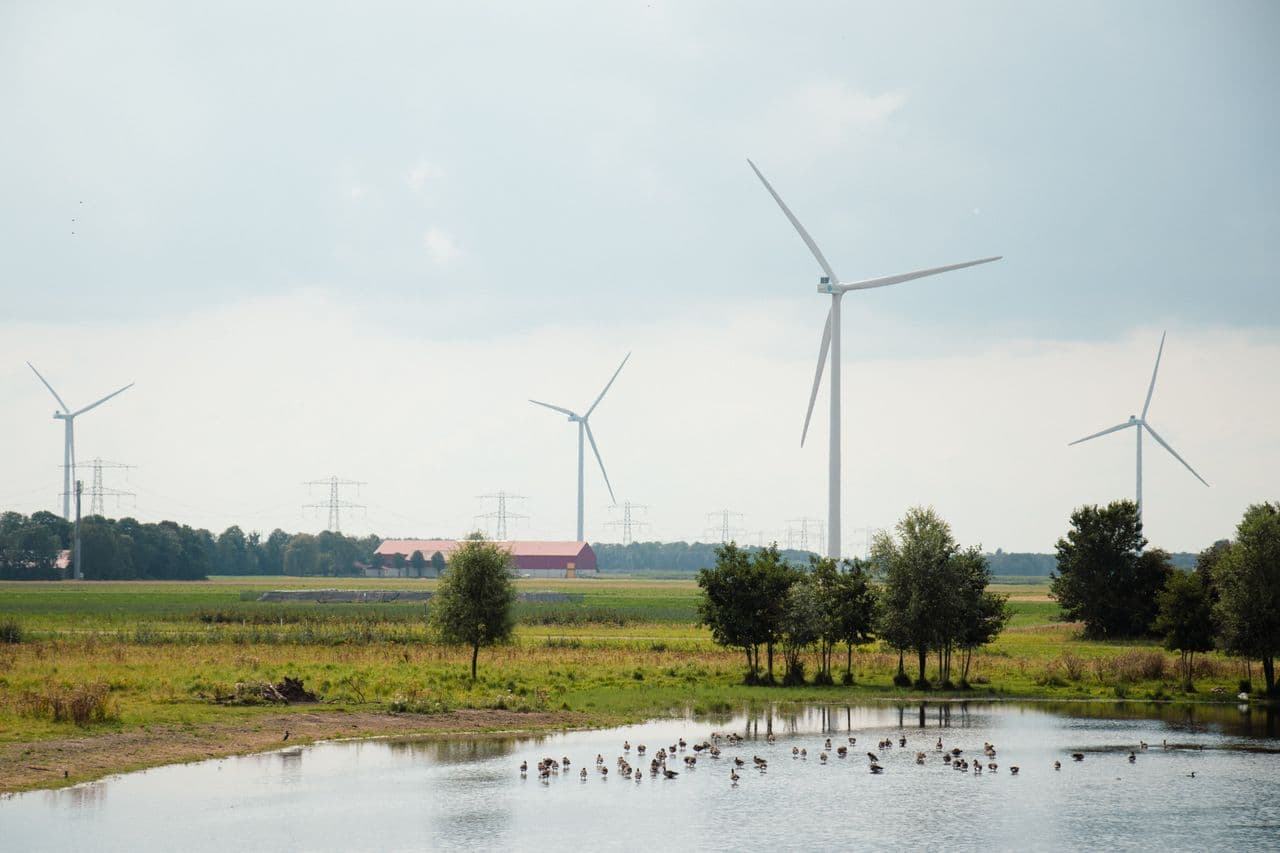
Wind farms are run to measured ecological thresholds, with turbines stopped for birds and bats and priority plants relocated before ground works begin.
Context
Submitted through the COP31 Sustainable Transformation Awards · SKD Türkiye (WBCSD Global Network Partner)
The company generates renewable electricity in Türkiye and operates 18 wind farms. The biodiversity management model was initially implemented at 14 wind-farm sites; this is the initiative’s initial scope, not the company’s total operating portfolio. The company has 1,250+ employees.
Wind generation displaces fossil fuel emissions, but it occupies land. Turbines stand on ridges and open ground that are also flight paths for migrating birds, foraging routes for bats, habitat for endemic plants with very restricted distributions, and territory for large carnivores. Rotor collision, habitat loss during construction and disturbance of movement corridors are real effects, and they fall on exactly the species that are hardest to replace.
Environmental permitting sets a minimum standard, but a permit is a snapshot. It does not say what an operator should do when post-construction monitoring shows that a species is being killed at a rate its population cannot absorb, and it does not put a number on the point at which generation should stop.
The response was to build a management model that treats biodiversity as an operating parameter rather than as a permitting obligation. Sensitive biological assets are identified, ecological thresholds are calculated, site-specific measures are applied, corrective and preventive actions are recorded, and the chain is verified annually. Where monitoring shows that a threshold has been crossed, turbines are stopped and the lost generation is accepted.
The company has allocated a dedicated budget to biodiversity management. Performance data feeds CDP reporting and ISSB (IFRS S1 and S2) and TCFD aligned disclosure, with independent third-party assurance.
Location of the initiative: Wind farms in Aydın, Çanakkale, Kırklareli, Edirne and Muğla provinces, Türkiye
Solution
The model runs on one logic applied to different species groups: identify what is sensitive, measure it, set a threshold, act when the threshold is reached, and verify.
For flora, sensitive, endemic and conservation-priority species are identified before and during construction, then relocated to suitable habitat and monitored afterwards for survival, flowering, reproduction, shoot production, desiccation or loss, and habitat integrity. Collected seed is deposited with the Türkiye Seed Gene Bank rather than held on site.
For birds, post-construction monitoring establishes what is actually flying through the site. Where carcass searches show collision risk, a turbine stop protocol places trained observers on watch through the risk period, with authority to stop machines while a bird is inside the risk envelope.
For bats, mortality estimation modelling converts carcass search results into an annual mortality estimate, which is compared with the population threshold the species can sustain. Where the estimate exceeds the threshold, seasonal curtailment is applied to the specific turbines responsible.
For large carnivores, the programme investigates how wolves use landscapes shared with wind farms and livestock. GPS telemetry, camera trapping, field surveys and geographic information systems will map home ranges and movement corridors. Comparison of northern control and southern impact areas will help assess construction and operational effects alongside other human pressures.
Beyond the plant boundary, the company works on the pressure that climate change places on the same habitats. A forest fire coordination centre was built in Muğla Province, where forests have experienced fires and face a high wildfire risk, and handed over to the Muğla Regional Directorate of Forestry. Afforestation is carried out with the national forestry authority and a forestry foundation as a planned reforestation programme in which species diversity, site suitability and growth performance are tracked, rather than as a commemorative planting exercise.
The chain from field data to operating decision is what holds the model together. A corporate biodiversity unit defines methods, sets threshold values, assures data quality, updates monitoring protocols and manages the evidence chain, while operations, maintenance and control room teams carry out the stops and curtailments that the data calls for.
Figure 1: Species-specific monitoring and triggers lead to targeted operating actions, with annual review.

Bat figures (Harmancık): “136 estimated/year” means an estimated 136 common pipistrelle deaths per year, not the number of carcasses found. “Threshold 116/year” means a population-based annual mortality threshold of 116 bats (Potential Biological Removal, PBR), not the number of bats in the population. Comparing these values led to seasonal curtailment at the five turbines shown.
Figure 2: Akköy wind farm in Aydın, January–May 2026: 81 stop interventions across 92 recorded bird movements.

Impact
Sustainability Impact
Climate
The initiative is a nature programme delivered inside a renewable generation business, and it does not target the company's own Scope 1 or Scope 2 emissions.
Its climate contribution runs through carbon sink capacity and ecosystem resilience. More than 1.5 million saplings have been planted in the last five years; between 2021 and 2025 the recorded total was 1,510,066 saplings, with 1,095 hectares afforested and rehabilitated, equivalent to 1,535 football pitches. The work is delivered with the national forestry authority and a forestry foundation for ecosystem restoration, carbon sink capacity, erosion control, habitat quality and the protection of local environmental values. The planting programme covers six tree species, with an average success rate of 88%.
The forest fire coordination centre, a 300 m² facility with an 8-screen monitoring set-up handed to the Muğla Regional Directorate of Forestry, addresses the physical climate risk of wildfire, which is the fastest route by which a warming climate removes forest carbon and habitat at the same time.
There is a deliberate trade-off in the other direction: stopping turbines for birds and bats reduces renewable generation, and that commercial production loss is accepted in order to protect populations.
Nature
Flora
At Gaia and Falp wind farms in Muğla, 123 plant specimens from 17 endemic, restricted-range and/or conservation-priority taxa were relocated — 97 at Gaia and 26 at Falp wind farms — and 1,030 seeds were sown. At the Edirne wind farm, approximately 590 plant specimens were taken into protection from nine turbine areas. The work covers Linum tauricum subsp. bosphori (Critically Endangered; CR) and Tripleurospermum baytopianum (Endangered; EN), both endemic to Türkiye; the restricted-range Fritillaria stribrnyi, Ferulago confusa and Onosma bornmuelleri; and the CITES-listed orchids Ophrys mammosa and Spiranthes spiralis. Survival, flowering, reproduction, shoot production, desiccation or loss and habitat integrity are monitored after relocation.
Birds
At Akköy wind farm in Aydın, two pelican fatalities in the 2025 carcass searches triggered a turbine stop protocol, brought into force on 1 December 2025. Between January and May 2026 monitoring ran for 151 days, 10 hours a day with two simultaneous observers, producing 3,020 observer-hours. Stops were applied on 81 of 92 bird movements, giving 892 minutes of stoppage in total, and interventions covered 308 Dalmatian pelican passages. The average command-to-rotor-stop response was 15 seconds against a good-practice expectation of 30 to 60 seconds, and no collision was recorded.
Bats
At Harmancık wind farm in Çanakkale, the Generalized Mortality Estimator (GenEst) put annual common pipistrelle (Pipistrellus pipistrellus) mortality at 136 individuals per year against a population-based annual mortality threshold (Potential Biological Removal; PBR) of 116 individuals per year. This approximately 17% exceedance triggered seasonal curtailment on turbines 1, 3, 4, 5 and 10.
Large carnivores
At Balkaya wind farm in Kırklareli, the 12-month programme is designed to fill a knowledge gap on wolf presence, movements and habitat use in Turkish Thrace, the European part of Türkiye. It aims to undertake the region's first capture-and-GPS-collaring study of wolves, linking individual movements with wind-farm development, habitat connectivity and free-ranging livestock. The goal is to advance scientific understanding while strengthening wolf conservation with local communities.
Social
The forest fire coordination centre strengthens the response capacity of the regional forestry directorate for early detection, inter-agency coordination and direction of field teams, which protects the settlements and livelihoods inside and around those forests as well as the ecosystems themselves.
At Balkaya, wolf conservation is linked to rural livelihoods in a landscape used for free-ranging livestock. The programme will work with livestock owners, herders and local communities to understand predation and grazing practices and develop practical, non-lethal prevention measures. It aims to reduce livestock losses, the risk of retaliatory killing and human–wolf conflict, supporting long-term coexistence.
Business Impact
Benefits
Biodiversity management protects the licence to operate and the financing base. Independent consultants and financial institutions assess whether practice complies with national regulation and international standards, and demonstrable threshold management, reliable data and an auditable evidence chain are what those assessments require. For a renewable developer with a pipeline of new sites, that record is a precondition for permitting and for financing the next project.
Measured thresholds also reduce the cost of protection. Because curtailment is applied to the specific turbines identified by the mortality model — five turbines at the Çanakkale site — and stops are applied only while a bird is inside the risk envelope, the generation given up is a fraction of what a blanket seasonal shutdown would cost. The 15-second command-to-rotor-stop response supports rapid intervention, while limiting each stop to the risk window contains generation loss.
Embedding biodiversity requirements in procurement and contractor agreements shifts part of the delivery load to the supply chain and reduces the risk that an incident caused by a contractor becomes the company's regulatory problem.
Building the field data into corporate disclosure means the same evidence serves operating decisions, CDP reporting, ISSB and TCFD aligned reporting and independent assurance, instead of requiring a separate reporting exercise.
Costs
Direct costs are covered by a dedicated biodiversity budget supporting the corporate biodiversity unit, expert consultants, monitoring equipment, relocation and afforestation work.
An additional cost is lost generation. Turbine stops and seasonal bat curtailment mean electricity that is not produced and not sold, and commercial production loss is explicitly accepted in order to protect populations. These interventions entail revenue forgone.
Monitoring is labour-intensive. Sustained observer coverage, carcass searches, camera trap networks, GPS telemetry and long-term mammal monitoring require continuing staff time and specialist support.
Costs are contained by targeting. Thresholds identify which turbines and which periods matter, so intervention is concentrated instead of applied across the whole plant, and the same monitoring data serves permitting, lender reporting and disclosure. Allocating biodiversity duties contractually to contractors spreads the field workload.
Generation forgone has a commercial cost that the company accepts to protect biodiversity. The company does not disclose electricity prices, generation-loss calculations or revenue estimates.
Impact Beyond Sustainability And Business
Co-benefits
Seed collected during the flora work is deposited with the Türkiye Seed Gene Bank, which puts the genetic material of restricted-range and threatened taxa beyond the fate of any single site.
The forest fire coordination centre serves a public forestry directorate across a whole region, so its benefit reaches forests that have no connection with the company's plants.
Afforestation is run as a planned reforestation programme with species diversity, site suitability and growth performance tracked, which produces erosion control, habitat quality and carbon sink benefits alongside the tree count.
The Balkaya study is intended to contribute to the literature on wolf responses to wind-farm development and human land use. Linking movement ecology with local livestock knowledge can inform habitat connectivity and coexistence measures beyond the project boundary.
Potential side-effects
Protection and generation are in direct tension. Every stop and every curtailed hour is renewable electricity not produced, which is a climate cost incurred to secure a nature benefit. It is managed by narrowing the intervention to specific turbines and specific moments rather than by widening the shutdown.
Flora relocation is not a guaranteed rescue. Transplanted specimens can fail, which is why survival, flowering, reproduction, shoot production and desiccation or loss are monitored after the move, and why seed banking runs in parallel as insurance.
Observer-based stop protocols depend on human attention. Performance across 10 hours a day for 151 days rests on observer training, rotation and discipline, and any relaxation degrades the protection. Automated detection would reduce that dependence but is not part of the current arrangement.
Mortality estimates carry uncertainty. Modelled figures such as 136 individuals a year against an annual mortality threshold of 116 individuals depend on search effort, carcass persistence and detection probability assumptions, so thresholds have to be revisited as data accumulates rather than treated as settled.
Wolf capture and GPS collaring remain subject to permits, ethical approval and veterinary supervision. Conflict reduction and improved conservation are programme objectives, not yet demonstrated outcomes.
Implementation
Typical Business Profile
The model suits renewable generation developers and operators, particularly onshore wind, whose assets sit in open landscapes carrying migratory, endemic or protected species, and more broadly any infrastructure operator whose plant can be modulated in real time to reduce an ecological effect.
It assumes an operating asset base rather than a single site, because the value comes from applying one methodology across a portfolio with different ecosystems, and it assumes a control room able to stop and restart plant on instruction.
Delivery engages an asset management and sustainability directorate, a dedicated corporate biodiversity unit, environment and health and safety teams, operations and maintenance, control room operations and procurement, supported by external ecologists, botanical institutions and veterinary specialists.
Approach
Identify the sensitive biological assets on each site: Survey flora, birds, bats and mammals before and during construction, and record which species are endemic, threatened, migratory or listed under international conventions, so that protection is aimed at the species that cannot be replaced.
Calculate an ecological threshold for each risk: Convert monitoring data into a defensible number — for bats, an annual mortality estimate from a mortality estimation model set against a population continuity threshold — so that the point at which operations must change is defined in advance rather than argued after an incident.
Rescue and bank the flora before ground works: Relocate specimens of priority species to suitable habitat, sow seed at the receiving site and deposit collected seed with a national gene bank, and record the number of specimens and seeds moved so that the work can be verified.
Put post-construction monitoring in place: Run carcass searches and structured observation on operating sites, because the collision risk that matters is the one measured after the turbines are turning, not the one predicted at permitting.
Write a turbine stop protocol with clear authority: Define the risk period, the observer coverage, the trigger for a stop and who may issue it, and give control room and operations and maintenance teams the mandate to stop machines while a protected bird is inside the risk envelope.
Curtail the specific turbines the data identifies: Where the mortality estimate exceeds the threshold, apply seasonal curtailment to the turbines responsible rather than to the whole plant, which keeps the generation loss proportionate to the ecological risk.
Put biodiversity duties into contracts: Require contractors to report critical biodiversity events within 24 hours, to support site records with geographic information system data and to complete corrective actions, so that the standard travels with the work.
Verify, correct and report annually: Record corrective and preventive actions, have methods, data quality and results reviewed by independent consultants and expert bodies, verify annually, and feed the results into corporate disclosure and into the following year's thresholds.
Stakeholders Involved
Project leads: The programme is overseen by the asset management and sustainability directorate, which manages budget planning, procurement, field application and operating decisions as one structure. At its centre is a corporate biodiversity unit responsible for defining methods, setting threshold values, assuring data quality, updating monitoring protocols and managing the evidence chain from the field. Expert teams generate the site data; the biodiversity unit converts it into decisions.
Company functions: Operations and maintenance and control room teams carry out the turbine stops and bat curtailment in real time, which is where the ecological decision becomes an operating one. Environment and health and safety, asset management and the biodiversity unit set and monitor the standard. Procurement embeds biodiversity requirements into supply and contractor agreements so that the model extends beyond directly employed teams.
Main providers: Independent consultants, universities, botanical institutions and specialist ecology organisations carry out flora relocation, bird and bat monitoring, camera trapping, telemetry, mortality estimation modelling, population threshold modelling and geographic information system analysis. In the large carnivore programme KuzeyDoğa, a conservation non-governmental organisation (NGO), works alongside mammal ecologists, veterinarians and geographic information specialists. Construction and field contractors operate under contractual biodiversity obligations, including 24 hour reporting of critical events and completion of corrective actions.
Other: The national directorate for nature conservation and national parks and other public authorities contribute to permitting and species protection work. The regional forestry directorate operates the fire coordination centre, and the national forestry authority and a forestry foundation deliver the afforestation programme with the company. Financial institutions assess compliance with national regulation and international standards. Local livestock owners and herders will help shape practical coexistence measures through dialogue with the large carnivore team.
Key Parameters To Consider
The programme was initially implemented at 14 wind-farm sites across different ecosystems, and the same five-step logic — identify, measure, set a threshold, act, verify — is applied to each species group, which is what makes it portable rather than site-specific.
Budget is a live parameter: the model requires a dedicated, recurring biodiversity allocation rather than one-off project funding.
Monitoring intensity drives both cost and credibility. Sustained observer coverage, long-term mammal monitoring and continuing carcass searches across the portfolio indicate the resources a comparable operator should plan for.
Thresholds are provisional by design. The bat annual mortality estimate of 136 individuals is compared with a population-based annual mortality threshold of 116 individuals; both must be revisited as monitoring data accumulates, and annual verification is the mechanism for doing so.
Implementation And Operations Tips
Set the threshold before the incident. The value of the model is that the point at which generation stops is calculated from population data in advance, so the decision is not negotiated under commercial pressure after a carcass has been found.
Narrow the intervention as far as the data allows. Curtailing five identified turbines seasonally, or stopping turbines only while birds are inside the risk envelope, protects the species at a small fraction of the cost of a blanket shutdown — but this works only if the monitoring is precise enough to justify the narrowing.
Separate the people who generate data from the people who decide on it. Field ecologists produce evidence and a corporate unit converts it into operating instructions, which keeps method and data quality independent of the commercial consequence of the decision.
Give the control room the mandate. A protocol that requires escalation before a turbine can be stopped will not work at the speed a bird flies, so the authority has to sit with the team that can act in seconds.
Write biodiversity into contracts rather than into guidance. A 24 hour incident reporting obligation and mandatory corrective action are enforceable; a request in a briefing pack is not.