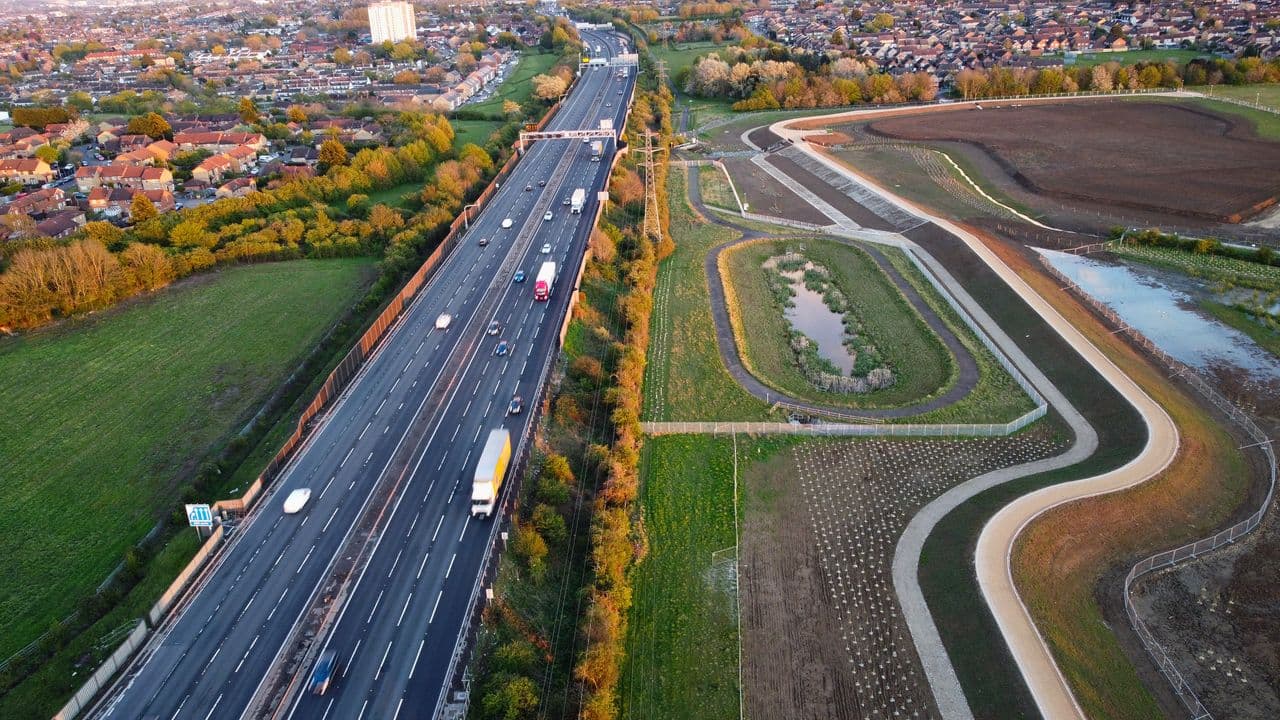
Integrate biodiversity into motorway construction
 ENKA İnşaat ve Sanayi A.Ş.
 SKD Türkiye
总结
A contractor integrated biodiversity management into the design and construction of a 112 km motorway, reducing the habitat area affected from 962.2 ha to 268 ha.
Context
Submitted through the COP31 Sustainable Transformation Awards · SKD Türkiye (WBCSD Global Network Partner).
ENKA İnşaat ve Sanayi A.Ş. is a construction and engineering company with nearly 20,000 employees, delivering large-scale infrastructure projects internationally.
Motorway construction affects critical and natural habitats along the route. The 112 km Morava Corridor Motorway in Serbia crosses riparian and gallery forests, thermophilous deciduous forests and naturalised standing water habitats. The Environmental and Social Impact Assessment (ESIA), carried out in 2019, predicted a total habitat impact area of 962.2 ha and an ecological quality loss of 577.3 quality hectares.
Project financing carried biodiversity requirements set by International Finance Corporation Performance Standard 6 (IFC PS6), by UK Export Finance (UKEF) and by the Multilateral Investment Guarantee Agency (MIGA). These include no net loss of biodiversity and net gain in suitable areas. Compliance had to be demonstrable and independently verifiable, and ecological constraints directly shape construction sequencing on a corridor of this length.
Location of the initiative: Morava Corridor Motorway, Serbia
Solution
The biodiversity management system was established in 2019 alongside the ESIA and has since been applied across the project life cycle. Habitats along the corridor were mapped in detail and classified as critical, natural or modified, and the IFC PS6 mitigation hierarchy was applied to each class, with no net loss targets and net gain targets where site conditions allowed.
Ground-truthing then tested the desk classification against field conditions. Survey work confirmed that 4.44 million m2 showed lower ecological sensitivity than the ESIA had assumed, and this area was reclassified from critical or natural habitat to modified habitat, concentrating protection and management measures on the areas where sensitivity was confirmed.
The measures that follow from the classification span pre-construction ecological screening, beginning with 9 assessments and 2 bird breeding and wintering surveys; buffer zones around nests found to be active; seasonal construction planning around sensitive periods; invasive alien species (IAS) control; fish translocation in aquatic ecosystems; and continuous biological monitoring feeding adaptive management.
Impact is accounted for in two dimensions: area in hectares and ecological quality through the Quality Hectare (QH) methodology. ESIA quality coefficients were applied proportionally to field data so that predicted and actual outcomes remain directly comparable.
Performance is verified by an independent Environmental and Social Consultant, whose assessments confirmed that the methodology used and the results obtained comply with IFC PS6. Results are also published in corporate sustainability reporting (1).
Figure 1: Habitat map of the motorway corridor classifying critical, natural and modified habitat along the route

Habitat Type | ESIA QH | Field-Verified QH (Equivalent) | Change |
Highly artificial non-saline standing waters / Naturalised ponds | 5.7 | ~2.1 | -63% |
Riparian and gallery woodland | 337.5 | ~100.0 | -70% |
Thermophilous deciduous woodland | 234.1 | ~58.6 | -75% |
Total (selected habitats) | 577.3 | ~160.7 | -72% |
Quality-hectare comparison for selected habitats: the ESIA estimate, the field-verified equivalent and the resulting change.
Impact
Sustainability impact
Climate
This initiative is an enabler. It is designed to protect biodiversity rather than to reduce greenhouse gas emissions, and no scope-specific reduction figure is reported against it.
The activity it modifies falls under Scope 1, covering fuel combustion in construction plant under the company's operational control, and Scope 3, Category 1: Purchased goods and services, covering the subcontracted works that apply the same measures on site. Seasonal construction planning, buffer zones and pre-construction screening change how and when that plant and those works are deployed.
The enabling contribution is avoided clearance. Reducing the habitat impact area from the 962.2 ha predicted in the 2019 ESIA to 268 ha over the 2019 to 2025 reporting period leaves vegetation and soils undisturbed across riparian and gallery forests, thermophilous deciduous forests and naturalised standing water habitats. The company does not quantify the resulting emissions effect.
Nature
Based on the company's monitoring data, the habitat impact area was reduced from the 962.2 ha predicted in the ESIA to 268 ha, a reduction of 72%. Measured in ecological quality, the loss fell from 577.3 quality hectares to 160.7 quality hectares, also a reduction of 72%.
Reductions by habitat type are reported as 70% in riparian and gallery forests, 75% in thermophilous deciduous forests and 63% in naturalised standing water habitats.
Protection measures secured 3,858 m2 of critical habitat and safeguarded the ecological integrity of a further 409,985 m2 of natural habitat.
According to monitoring data, 187 field surveys were carried out between 2022 and 2025, focused on birds and otter, an annual average of 47 biological surveys. In 2025, invasive alien species control was applied over 157,165 m2, 8 aquatic ecological surveys were completed and fish translocation was carried out at two points.
Social
In 2025, 321 employees were trained on the biodiversity measures, extending the practice to subcontractors working on site. Local communities took part through regular site information sessions, at which environmental monitoring results, habitat management practices and invasive species control activities were shared.
A grievance management system, regular stakeholder meetings and annual environmental performance reporting provide the feedback mechanism, and observations and suggestions received from local stakeholders have been incorporated into habitat management, aquatic ecosystem protection measures and site practice.
Business impact
Benefits
The model meets the biodiversity requirements attached to international project financing under IFC PS6, UKEF and MIGA, which is a condition of access to that financing. Verification by the independent Environmental and Social Consultant confirmed compliance, reducing exposure to audit findings, remediation requirements and consequent delay.
Ground-truthing also delivered operational value. Confirming that 4.44 million m2 was less ecologically sensitive than predicted allowed protection measures to be aligned with field conditions rather than with conservative desk assumptions, concentrating effort and cost where they affect outcomes.
Addressing ecological risk at design stage reduces late-stage redesign and construction disruption, and supports the stakeholder relationships that underpin licence to operate.
The experience has been captured in corporate procedures and technical guides, so that biodiversity management forms a standard component of design, planning, procurement, construction and environmental management on subsequent projects rather than a project-specific exercise.
Costs
The main cost drivers are the baseline ESIA and habitat mapping, repeated field verification and biological monitoring (187 surveys between 2022 and 2025, an average of 47 a year), specialist ecologists, invasive alien species control across 157,165 m2, aquatic surveys and fish translocation, employee and subcontractor training, twice-yearly audits and independent consultant verification. Seasonal construction planning and nest buffer zones also constrain scheduling.
The company identifies initial implementation cost as one of the main barriers to wider adoption, alongside gaps in local ecological data, availability of expert capacity and regulatory variation between countries.
Costs are partially offset by the use of standard methodologies, independent expert support, training and adaptive management. Early ground-truthing is the principal lever, since it removes protection requirements from areas that field data shows do not need them. Reusing the corporate procedures and technical guides on subsequent projects spreads the initial development cost across a portfolio.
Impact beyond sustainability and business
Co-benefits
The programme changes contractor and subcontractor environmental practice on site, and builds local ecological data and specialist capacity in a geography where baseline information was limited. Because habitat classification, ground-truthing, the quality hectare method, the mitigation hierarchy, invasive species management, fish translocation, adaptive monitoring and independent verification are modular, the same structure can be adapted to energy projects, industrial facilities and other large-scale infrastructure in different geographies.
The approach also contributed to external recognition: the Morava project received the environmental management award within the International Road Federation Global Road Achievement Awards in 2024.
Potential side-effects
Seasonal construction planning and buffer zones around active nests constrain the construction programme and equipment deployment. These constraints are anticipated through pre-construction ecological screening of each work front and managed through adaptive planning rather than treated as unplanned interruptions.
Implementation
Typical business profile
The model is most relevant to contractors and developers of large linear and site-based infrastructure, including motorways, railways, energy projects and industrial facilities. It applies particularly where project finance carries lender biodiversity requirements such as IFC PS6 or export credit and guarantee agency standards, and equally to companies treating environmental and social responsibility as a core element of their operating model. The relevant functions are design, planning, procurement, construction and environmental management. It is suited to geographies where local ecological baseline data is limited and has to be generated in the field.
Approach
Establish the baseline: Commission an Environmental and Social Impact Assessment at project inception and classify every habitat along the route as critical, natural or modified.
Verify the classification in the field: Ground-truth the desk classification with field surveys before construction, and reclassify areas where measured sensitivity differs from the prediction.
Apply the mitigation hierarchy: Set no net loss targets for each habitat class and net gain targets where site conditions allow.
Integrate ecological constraints into the programme: Plan buffer zones around nests found to be active, seasonal scheduling around sensitive periods, and pre-construction ecological screening of each work front before it opens.
Address aquatic and invaded habitats: Run parallel measures, including fish translocation at identified points and invasive alien species control on a twice-yearly audit cycle.
Quantify impact in two dimensions: Measure both area and ecological quality using a quality hectare method so that predicted and actual outcomes remain comparable.
Build capacity and monitor continuously: Train site staff and subcontractors, and carry out regular biological surveys that feed adaptive management decisions.
Verify and disclose: Confirm results through an independent environmental and social consultant and report annually into corporate sustainability disclosure.
Stakeholders involved
Project leads: Project leadership sits with Bechtel ENKA joint venture senior management, with oversight from the Sustainability Committee, which reports to the Board of Directors, and from corporate risk management mechanisms. The project organisation implements the measures on site and reports performance upward through that chain, so that biodiversity results are reviewed alongside project risk rather than in a separate stream.
Company functions: Design, planning, procurement, construction and environmental management teams coordinate implementation: ecological constraints are agreed at design stage and carried into construction sequencing and subcontract scope. The Corporate Sustainability and Compliance Department provides oversight, audit, performance tracking and corporate sustainability reporting, creating a feedback loop between site practice and corporate governance.
Main providers: An independent Environmental and Social Consultant reviews the methodology and the results and verifies IFC PS6 compliance, with its findings fed back into the management plan. Academic institutions and technical ecology specialists carry out ground-truthing and biological monitoring alongside the project teams. Subcontractors apply the measures on site following training delivered by the project organisation.
Other: Financing institutions set the applicable biodiversity requirements and review performance against them as a condition of continued financing. Public institutions, local authorities, NGOs and local communities are engaged through site information sessions, regular stakeholder meetings and a grievance management system, and the observations received are incorporated into habitat management and site practice.
Key parameters to consider
The component methods are established practice: the ESIA process, the IFC PS6 mitigation hierarchy, habitat classification and the quality hectare methodology. The baseline year is 2019 and reported data cover the period from 2019 to 2025. The approach has to be integrated at design stage to deliver its intended benefit.
Key prerequisites include:
local ecological baseline data, or the survey capacity to generate it
access to specialist ecologists
an independent environmental and social consultant for verification
a monitoring intensity of approximately 47 biological surveys a year, together with twice-yearly invasive species audits
Regulatory requirements vary by country, so the applied standard has to sit above local minimum compliance. Corporate reporting is aligned with CDP (climate, water and forests), ISSB (IFRS S1-S2) and TCFD (2).
Implementation and operations tips
The reported challenges are gaps in local ecological data, availability of expert capacity, regulation that differs between countries, and the cost of first implementation. These are addressed through standard methodologies, independent expert support, training programmes and an adaptive management approach.
Early ground-truthing delivers most of the value, because desk-based habitat classification tends to over-predict sensitivity and commit the project to measures that field data does not support.
Retaining specialist staff, corporate knowledge and technical capacity is treated as a company responsibility, and the experience is written into procedures and technical guides so that it is retained beyond the end of a project. Wider adoption is supported by rising investor and public expectations on biodiversity and by treating nature-related risk as a project risk.