Replace mowing with grazing to decarbonise solar sites
 Borusan EnBW Enerji Yatırımları ve Üretim A.Ş.
 SKD Türkiye
总结
Controlled sheep grazing replaces mowing and herbicide at a solar plant, cutting fuel use, maintenance cost and fire risk while supporting local livestock farmers.
Context
Submitted through the COP31 Sustainable Transformation Awards · SKD Türkiye (WBCSD Global Network Partner)
The company develops and operates renewable electricity generation assets in Türkiye and employs between 51 and 250 people.
Solar plants have a vegetation problem that is rarely designed for. Grass grows in front of and between the panel rows across the whole site area, and if it is not controlled it shades the lower edge of the modules and reduces output. Dry grass left standing through the summer is also a fire load sitting directly under electrical equipment.
The conventional answer is mechanical and chemical. Petrol strimmers and diesel equipment cut the vegetation on a repeating cycle, and herbicide suppresses regrowth. That cycle consumes fuel and consumables, generates emissions on a site whose entire purpose is to avoid them, and puts chemicals into soil that the operator will hold for decades.
It is also a pure cost. Maintenance in this model produces nothing except the absence of grass.
The plant sits in a rural area where livestock farming is the local economic activity, and where forage costs are a permanent pressure on small producers. The company treated that adjacency as the starting point rather than as a constraint, and in 2025 replaced the maintenance model at the Saros solar plant with controlled grazing.
Performance is compared against the 2024 operational maintenance model, in which mechanical weed clearance and conventional maintenance methods were used.
Location of the initiative: Saros Solar Power Plant, Çanakkale, Türkiye
Solution
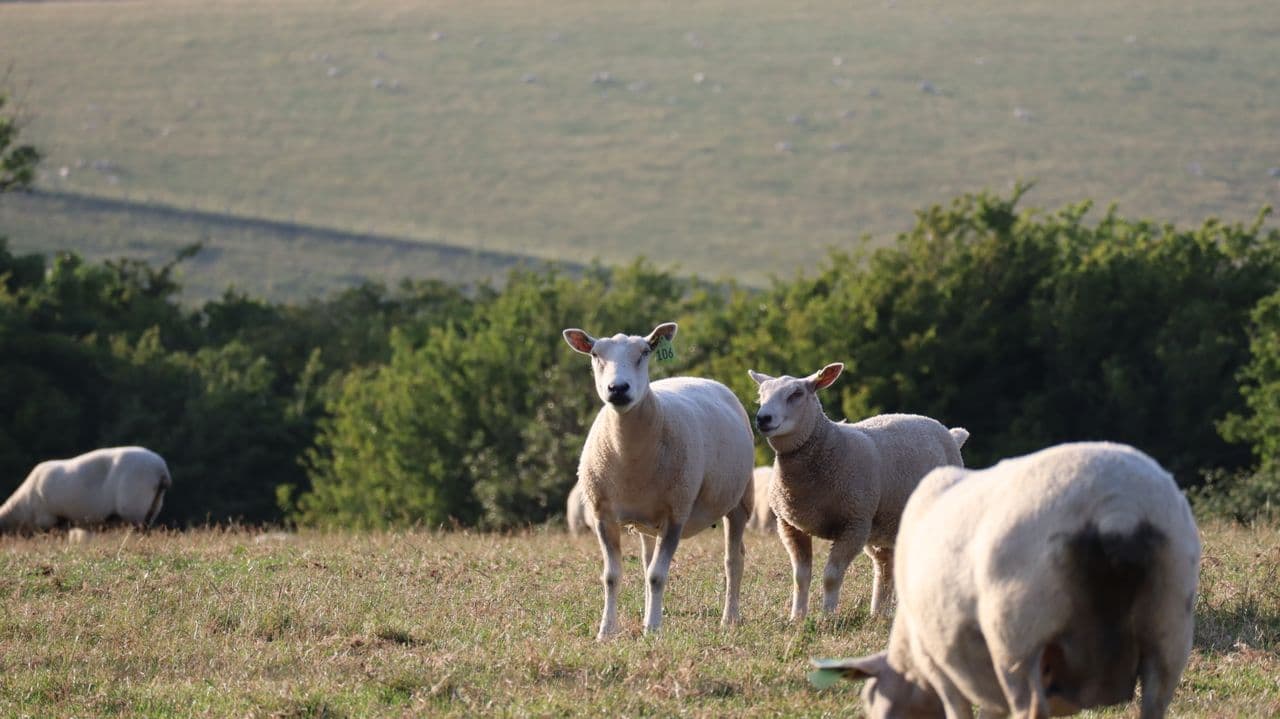
Sheep do the vegetation control. Animals from livestock farmers living next to the plant graze the site under a controlled arrangement, which removes the need for both mechanical cutting and chemical herbicide.
The arrangement runs on an existing local activity rather than on a new contracted service. The neighbouring producers supply and tend the sheep and lambs, and in exchange their animals feed on vegetation the operator would otherwise have paid to destroy. Neither side buys a service from the other; each side stops paying for something.
Grazing periods are planned rather than continuous. Timing and duration are set according to seasonal conditions and grass development, so vegetation stays short without the site being overgrazed.
The site is prepared for animals as an operational requirement. Water points and shaded areas are provided inside the plant, and physical protective barriers keep animals away from electrical equipment. Continuous contact with the livestock owners covers animal health and site conditions, so welfare and operational continuity are managed together.
The vegetation that is not grazed does not become waste. Approximately 3,000 bales of natural grass were taken by local producers, so biomass that the previous model treated as material to be cut and left is now forage entering the local economy.
The model was implemented inside the existing operational maintenance budget, with no additional external financing, and was designed as a recurring multi-year maintenance model rather than a one-off exercise.
Figure 1: Sheep grazing between the module rows at the Saros solar plant, with the wind turbines of the same site in the background

Figure 2: Mechanical maintenance in 2024 compared with the grazing model in 2025: maintenance cost down 36 per cent to TRY 2,558,000, herbicide use down from 1,000 litres to zero, and 7.99 tCO²e of annual emissions avoided

Impact
Sustainability Impact
Climate
The initiative removes Scope 1 emissions from fuel burned by the site's own mechanical vegetation-clearing equipment, and avoids further emissions in the local livestock supply chain that would have arisen from feed and bedding the animals no longer need.
The environmental benefit was calculated for the period from June 2025 to January 2026 using an emission factor based avoided emissions method, multiplying each avoided quantity of consumption by the relevant emission factor. The approach is consistent with the GHG Protocol, IPCC guidance and the emission factor sources used in the company's greenhouse gas management.
The components are as follows. Avoiding 1,120 litres of petrol prevented 2,587 kg CO2e. Avoiding 240 litres of diesel prevented 643 kg CO2e. Avoiding the use of 112 strimmer lines prevented 85 kg CO2e. Avoiding 37,500 kg of animal feed prevented 3,306 kg CO2e. Avoiding the use of 12,839 straw bales delivered a reduction of 1,369 kg CO2e.
Together these amount to 7,990 kg CO2e, or 7.99 tonnes of CO2e, for the period.
The feed and straw bale components sit with the neighbouring livestock farmers rather than in the company's own fuel consumption, and are reported as avoided emissions in the value chain.
Nature
Chemical herbicide use was eliminated in full, a 100 per cent reduction against the previous maintenance model. Soil chemistry and the soil biology that depends on it are no longer exposed to a repeating application on a site the operator will hold for the plant's full life.
Grazing controls vegetation without disturbing the soil surface, which mechanical clearance does, so seed banks and ground-level habitat survive between cycles rather than being reset each time.
Approximately 3,000 bales of natural grass were used by local producers instead of being cut and discarded, keeping the biomass inside a productive cycle rather than converting it to waste.
Social
Local livestock farmers received approximately 1,000,000 TRY of forage cost saving, since the grazing that maintains the plant replaces feed they would otherwise have bought. For small rural producers, feed is one of the largest and least controllable cost lines, so the benefit lands where it is most useful.
The relationship is structural rather than charitable. The farmers are integrated into the maintenance value chain as the providers of a service the plant needs, which gives the arrangement a commercial logic on both sides and a reason to continue year after year.
Site safety improves for the people who work there. Removing accumulated dry grass lowers the fire risk in a plant full of electrical equipment, and removing herbicide application removes an exposure route for the field teams.
Internally the project was delivered with employee volunteering at every stage, alongside the site operations teams and the internal functions responsible for maintenance.
Business Impact
Benefits
Approximately 2,558,000 TRY of maintenance cost was avoided in the 2025 implementation period, measured against the 2024 baseline. The largest single financial effect of the project is therefore the disappearance of a recurring operating cost, not a new revenue line.
Generation performance is protected. Preventing grass from shading the panel rows removes a yield loss that the previous model only corrected periodically, between mowing cycles.
Fire risk falls with the dry grass load, which reduces both the probability of an outage and the exposure behind it.
Dependence on external maintenance contractors is reduced, because a nature-based service model replaces bought-in mechanical clearance and chemical application. That lowers exposure to contractor availability and to fuel and consumable prices.
The financial benefit is indirect and recurring rather than a one-off return, which suits an asset that will be operated for decades.
Costs
The project required no additional external financing. It was delivered within the existing operational maintenance budget, which is why it could be approved without a separate investment case.
The costs that do arise are site preparation and coordination: water points and shaded areas inside the plant, protective physical barriers around electrical equipment and cabling, standard operating procedures for grazing planning, animal welfare and equipment safety, and the field team time needed to plan grazing periods and stay in daily contact with the livestock owners.
The model has an enabling condition that cannot be bought. It depends on livestock farming existing close to the site. Where it does not, the arrangement would require transporting and housing animals, which changes the economics entirely.
It is also seasonal. Grazing periods follow grass development, so the maintenance calendar is set by the vegetation rather than by the operator's schedule.
The site preparation, barrier and procedure development costs were limited to approximately TRY 30,000. This amount was used to purchase a sheep shearing machine for local livestock farmers, supporting the implementation of the project activities.
Impact Beyond Sustainability And Business
Co-benefits
The same model applies wherever land under or around industrial assets has to be kept clear: wind farms, transmission corridors and industrial site perimeters all carry the same recurring vegetation cost and the same fire exposure.
Scaling needs no significant investment, which is what makes the transfer realistic. The requirement is an agreement with local producers, not capital.
The arrangement creates a durable relationship with the community around the plant. An operator whose neighbours have a direct economic interest in the site functioning well has a different local position from one whose neighbours have none.
It also changes how maintenance is understood internally. A cost centre becomes a mechanism that produces environmental, financial and social results simultaneously, which is an easier proposition to defend in a budget review than an environmental measure alone.
Potential side-effects
Three risks decide whether the model is repeatable: grazing planning, animal welfare and equipment safety. They are managed through standard procedures, protective physical barriers and regular monitoring, but they are permanent operational obligations rather than set-up tasks.
Animals in an electrical installation are the central hazard in both directions. Cabling, inverter stations and mounting structures need physical protection, and the animals need water, shade and monitored health conditions in a site that was not designed for them.
Overgrazing is a real failure mode. Vegetation cover holds soil on a site that has been graded and disturbed during construction, so grazing intensity has to be planned by area and period rather than left to run.
The model also transfers a dependency. The plant now relies on neighbouring producers continuing to keep livestock, and the producers rely on continued access to the site. Both sides need the arrangement to be documented well enough to survive a change of personnel.
Implementation
Typical Business Profile
The model suits operators of solar and wind generation sites, transmission corridors and industrial land where vegetation management is a recurring maintenance cost carried over the asset's whole life.
It is most relevant where the asset sits in a rural area with active livestock farming within reach, since the arrangement runs on an existing local activity rather than on a service that has to be created.
Delivery engages site operations, maintenance and sustainability functions, and requires a working relationship with neighbouring producers rather than a procurement process.
Approach
Set the baseline before changing the method: Record one full season of conventional maintenance (fuel volumes, consumables, contractor cost and herbicide quantity) because the result is reported as a difference against that record, and a model implemented without a baseline cannot be evidenced afterwards.
Map the vegetation against the risk it creates: Identify where grass shades panel rows, where dry material accumulates and where fire risk concentrates, so grazing intensity can be planned area by area instead of applied uniformly across the site.
Approach the livestock farmers who already live next to the site: Deal directly with neighbouring producers and agree that they supply and tend the animals, so the arrangement rests on an existing activity and both parties gain by stopping a cost rather than by buying a service.
Plan grazing periods around grass development and season: Set the timing and duration of each period according to seasonal conditions and vegetation growth, so the site is controlled without being overgrazed and the soil cover is retained.
Prepare the site before animals enter: Provide water points and shaded areas inside the plant and install protective physical barriers around electrical equipment and cabling, treating this as a precondition of the first grazing period rather than as a later improvement.
Write the three risks into procedures: Convert grazing planning, animal welfare and equipment safety into standard operating procedures with regular monitoring, since these are the conditions that determine whether the model can be repeated at another site by people who were not involved in the first one.
Keep a continuous line to the animal owners: Maintain daily contact with the livestock farmers on animal health and site conditions, so welfare and operational continuity are managed jointly and in advance rather than after an incident.
Measure across four categories and report: Track financial, environmental, operational and social indicators through regular field inspections, maintenance records, financial reports and information from local stakeholders, and feed the results into corporate sustainability reporting so the model is documented as a repeatable practice.
Stakeholders Involved
Project leads: The project was run by the site operations teams together with the internal functions responsible for maintenance processes, and was delivered with employee volunteering at every stage rather than through a dedicated project organisation. It is positioned in corporate reporting as a good practice case and assessed as a model that can be extended across the group.
Company functions: Field operations plan and supervise the grazing periods and hold the daily relationship with the animal owners. The maintenance function releases the mechanical and chemical clearance activity and re-plans the maintenance calendar around vegetation growth. The sustainability function defines the avoided emissions calculation and consolidates the environmental, financial and social results into corporate reporting.
Main providers: Livestock farmers living next to the plant supply and tend the sheep and lambs and are integrated into the value chain as the providers of the vegetation control service. They are not treated as an external maintenance contractor: the arrangement is reciprocal, with the plant providing grazing, water and shade and the producers providing the animals and their care.
Other: The surrounding rural community benefits through reduced forage costs and continued access to the site. Other sites in the group are the intended next application, and the results are shared as a sector good practice example so that other renewable operators can adopt the same maintenance model.
Key Parameters To Consider
Performance is monitored through five indicators: avoided maintenance cost in TRY, the reduction in chemical herbicide use as a percentage, avoided greenhouse gas emissions in CO²e, the economic contribution to local livestock farmers in TRY, and indicators covering protected generation performance and site safety.
Two practices are replaced simultaneously (mechanical mowing and chemical herbicide application) and the results should be read as the combined effect of removing both, not of either alone.
Impact data covers the 2025 implementation period, with the avoided emissions calculation running from June 2025 to January 2026. Data is collected through regular field inspections by site operations teams, maintenance records, financial reports and information obtained from local stakeholders.
The comparison baseline is the 2024 operational maintenance model. Any organisation adopting the approach needs an equivalent reference period, since the entire result is expressed as a difference against it.
The model was designed as a recurring multi-year maintenance model, not a single season's experiment, and requires no significant capital investment to extend to further sites.
Implementation And Operations Tips
Capture the baseline season before the first animal arrives. The avoided cost and avoided emission figures are only as credible as the record of what was being consumed before.
Count what the farmers stop buying, not only what the operator stops buying. The feed and straw bale components are a substantial share of the emission result and would be invisible in a calculation drawn only from the operator's own invoices.
Provide water and shade before the first grazing period. Site preparation is what converts an arrangement that works for one season into one that the animal owners will return to.
Put grazing planning, animal welfare and equipment safety in writing early. These are the three questions every other site will ask, and answering them in procedure form is what makes the model transferable.
Present the result as three outcomes at once. A maintenance change that delivers cost, emission and community results together survives budget scrutiny more easily than an environmental measure presented on its own.