Reuse mobile solar plants across successive building sites
 Saya Holding / Folkart
 SKD Türkiye
总结
Solar plants installed at a construction site are dismantled when the project ends and rebuilt at the next one, so the same asset keeps displacing grid electricity.
Context
Submitted through the COP31 Sustainable Transformation Awards · SKD Türkiye (WBCSD Global Network Partner)
Saya Holding, through its Folkart property development business, builds residential and mixed-use projects and employs between 251 and 1,000 people.
Construction is among the priority sectors for climate transition because of its energy use and emissions, but its energy demand sits on sites that exist only for the duration of a project. That temporary character is what blocks renewable investment: a solar installation assessed over the life of one construction site rarely produces an acceptable return, so site power is drawn from the grid by default.
When a project completes, the position gets worse rather than better. Energy infrastructure installed on the site is frequently left unused or is not carried into the next project, and components that cannot be recycled become waste.
There is no legal obligation in the sector to use renewable energy on construction sites, so the company was not responding to a compliance requirement.
The response, developed in 2022, was to change the unit of account: to treat the solar plant as a mobile asset owned by the company and moved between sites, rather than as a fixed installation belonging to a single project. The programme is now embedded in corporate practice under the description of green asset management, and additional site equipment is assessed on the same basis.
The five sites are Folkart Country, Folkart Nova, Folkart Mona and Folkart Orion in İzmir and Folkart Nefes in İstanbul. The systems are currently in operation at Mona and Orion; the other three projects have been completed.
Location of the initiative: Türkiye, İzmir and İstanbul
Solution
A solar plant is installed on an active construction site and supplies its operations directly. When work on that site finishes, the system is dismantled, transported and rebuilt on the next site, and continues to generate there.
The circularity rate achieved is 100 per cent: the equipment is reused rather than replaced, so the same asset produces emission reductions across several projects instead of one. The programme has been applied on five projects: Country, Nefes, Nova, Mona and Orion.
The operating principle is on-site generation and consumption. Output is used first for site loads, grid supply is drawn when demand exceeds generation, and surplus generation is consumed on site rather than exported, so the system does not place an additional load on the network. This is what makes renewable supply workable on temporary sites despite regulatory and infrastructure constraints on connection and export.
The assets are managed as a pool rather than as project equipment. Transfers and installations, performance monitoring, integration with digital infrastructure, and preventive and predictive maintenance are handled centrally and recorded, so each unit carries its own history between sites.
What the model changes is the investment case. A conventional site installation is assessed against the remaining months of one project; a transferable asset is assessed across its full working life, which is what makes the return acceptable in a sector where the site itself is temporary.
Figure 1: Mobile solar plant on the roofs of the site facilities at the Folkart Mona project in İzmir, one of the two sites where the systems are currently in operation

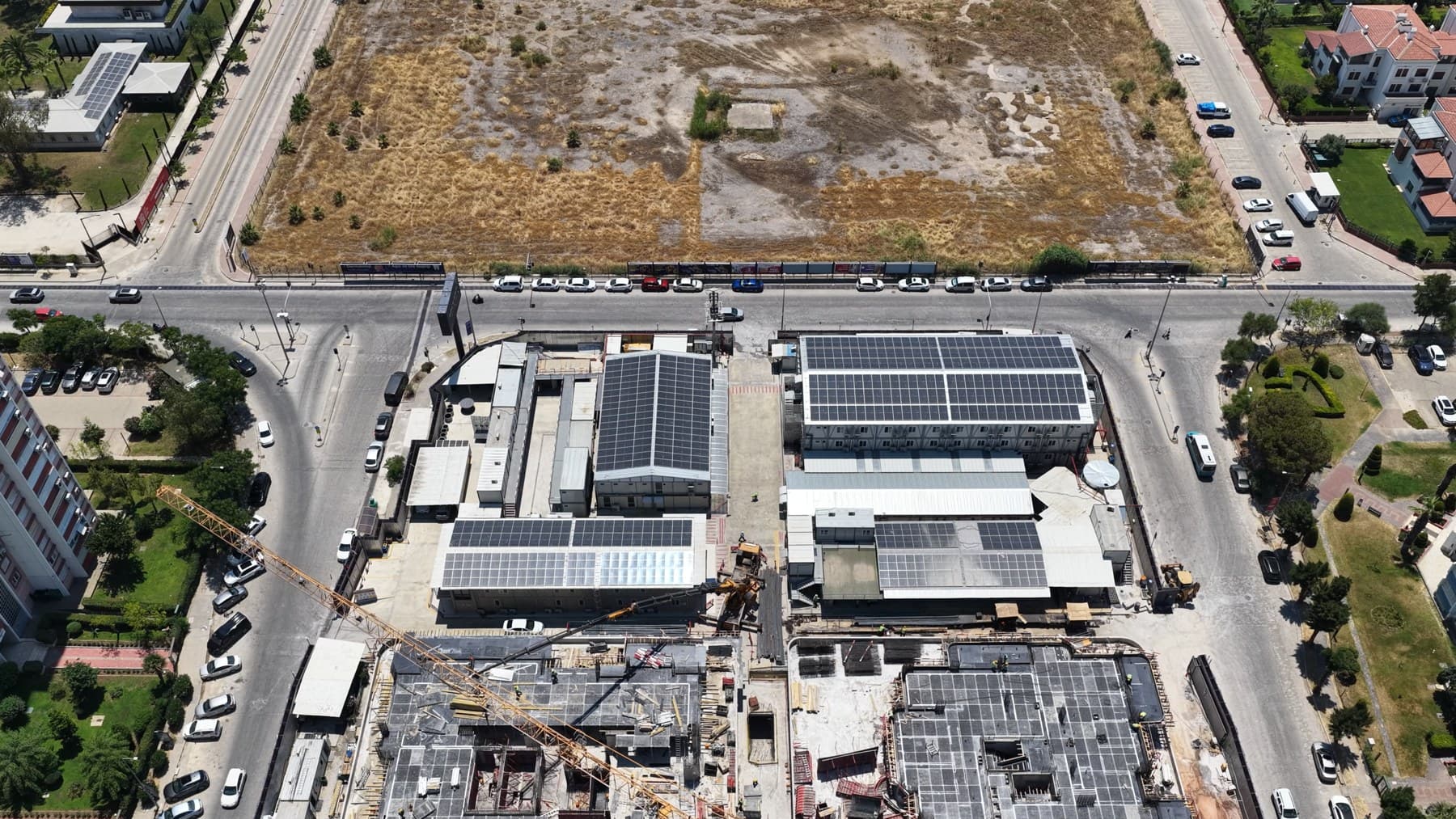
Figure 2: Aerial view of the Folkart Orion site in İzmir, with the mobile solar plant installed on the site buildings beside the construction works

Impact
Sustainability Impact
Climate
The programme contributes primarily to Scope 2 emission reductions, because the electricity generated on site replaces electricity that would otherwise be drawn from the national grid.
Since 2022 the programme has generated 793,332 kWh of renewable electricity and prevented 350.65 tonnes of CO2e from being emitted. Emission reduction is calculated using the ISO 14064 methodology with the Türkiye national electricity grid emission factor, rather than with a self-selected factor.
A second climate effect comes from the asset reuse itself. Because systems are transferred between sites rather than replaced, demand for new equipment falls and the embodied carbon of manufacturing that equipment is avoided. This part of the benefit is not quantified. The company does not report the emissions of dismantling and transporting the assets between sites either.
The programme also forms part of the company's climate transition plan, where it is treated as a response to energy cost exposure and to future carbon pricing risk rather than only as an emissions measure.
Nature
Asset circularity is the environmental contribution the company identifies as most significant after generation itself. Transferring systems between sites extends the economic life of the equipment and reduces the requirement for new equipment.
In the sector's normal pattern, energy infrastructure left behind at a completed project becomes waste, including components that cannot be recycled. Moving the system removes that disposal event entirely rather than managing it.
The effect reaches into the supply chain: fewer units manufactured means lower upstream resource use and lower supply chain emissions, so the benefit is one of material circularity and resource efficiency as well as electricity generation.
Social
In urban construction sites, replacing grid-supplied electricity reduces emissions associated with building activity inside the city, which is where the sites and the surrounding residents are.
Knowledge and experience transfer around the reused green assets is carried out by site management teams, together with internal training, so that each transfer builds capability among site staff rather than depending on a single technical group.
Employees are treated as a stakeholder group in the programme rather than as recipients of it, and the practice of green asset management has become part of the company's internal working vocabulary.
Business Impact
Benefits
The investment of USD 296,013 has produced 793,332 kWh of electricity, with an economic value of TRY 2,779,550 for the generation to date, and the assets remain available for further projects.
Site energy costs fall because part of the load is met by generation on site rather than by purchased electricity, and the saving repeats at each successive project instead of ending with the one that funded the installation.
Equipment expenditure falls as well. A transferred system is a system that does not have to be bought again, which shortens mobilisation for new sites and removes a procurement step from each project start.
The programme increases operational resilience against energy price movements and against future carbon pricing risk, which is how it is positioned inside the company's climate transition plan.
Because there is no legal requirement for renewable energy on construction sites, the practice also gives the company a demonstrable position in a sector where the default is grid supply.
Costs
The capital cost was USD 296,013 for the systems in the programme, committed without a regulatory obligation to justify it. The cost per transfer cycle, the payback period on the initial investment and the maintenance cost of the asset pool are not published.
The recurring cost is the transfer cycle itself: dismantling at project completion, transport, reinstallation and recommissioning at the next site, together with the labour and coordination each move requires. Generation stops while an asset is between sites, so availability is lower than for a fixed installation of the same capacity.
Maintaining the pool adds preventive and predictive maintenance, performance tracking and integration with digital infrastructure, all carried by technical units rather than by individual projects.
Repeated dismantling and reinstallation places mechanical stress on modules, mounting systems and cabling, so component selection and handling discipline determine whether 100 per cent circularity is sustained over further cycles.
Sizing is constrained by the on-site consumption model: because surplus is consumed on site rather than exported, a system larger than the site's load profile would not return the additional investment.
Impact Beyond Sustainability And Business
Co-benefits
The approach transfers to any activity that operates from temporary sites (infrastructure works, mining, events and similar operations) where the same argument against fixed renewable investment applies.
Inside the company, the concept of green asset management now extends beyond solar plants: other site equipment used on a rotating basis is assessed on the same circular basis.
For the sector, the programme demonstrates a route to renewable supply that works within existing regulatory and infrastructure constraints on connection and export, which is a practical template rather than a policy proposal.
Investment decisions run through the Sustainability Committee to senior management, which gives a governance route for further green asset proposals rather than requiring each one to be argued from first principles.
Potential side-effects
Every transfer carries its own emissions and cost (dismantling, transport and reinstallation), and these have not been quantified against the avoided grid emissions, so the net figure is incomplete.
Generation is interrupted between sites. A fixed plant produces continuously; a mobile one produces only when installed, which means annual yield per kilowatt of capacity is structurally lower.
Handling risk accumulates. Modules and mounting components are designed for a single installation, and repeated assembly increases the probability of damage, which would erode the circularity rate over successive cycles.
The on-site consumption model caps the size of the system at the site's own demand. Where site load is small or intermittent, the addressable share of consumption is limited, so the model reduces grid dependence rather than eliminating it.
Implementation
Typical Business Profile
The model fits construction and property development companies running a pipeline of successive projects, where sites are temporary but the sequence of sites is continuous, so an asset can move from one to the next without a long idle period.
It is most relevant for developers with an internal technical office capable of managing equipment as a corporate asset pool, since the value depends on tracking, maintaining and redeploying units rather than on the installation itself.
The approach also transfers to any operator with temporary or rotating operational sites and predictable electrical load on them.
Delivery engages the central technical office, project directorates, procurement, finance and site teams, with investment decisions taken by senior management on the recommendation of the Sustainability Committee.
Approach
Reclassify renewable equipment as a corporate asset: Record the solar plant against the company rather than against one project budget, so its business case is assessed over its working life instead of over the months remaining on a single site.
Size the system to the site load profile: Match capacity to the electricity the site actually consumes, because surplus generation is consumed on site rather than exported and therefore returns nothing above the load.
Design for dismantling from the outset: Select mounting systems, cabling and inverter arrangements that can be taken apart and rebuilt without loss of components, since the ability to move the asset determines whether it is a mobile plant or a fixed one.
Operate on generation and consumption at the site: Use output first for site loads, draw grid supply only when demand exceeds generation, and consume surplus on site so no additional load is placed on the network and no export arrangement is required.
Register every unit in a green asset pool: Track location, performance, transfer history and maintenance record for each system centrally, so redeployment decisions are made on data rather than on recollection.
Maintain preventively and predictively with digital integration: Run condition monitoring and scheduled maintenance through the technical units and record the results, because repeated handling is the main threat to reuse.
Plan the transfer alongside project completion: Schedule dismantling, transport and reinstallation into the closing programme of one site and the mobilisation of the next, to minimise the period in which the asset generates nothing.
Calculate avoided emissions with a recognised method: Apply the ISO 14064 methodology with the national grid emission factor, and submit the results to independent third-party external assurance.
Govern investment through a standing committee: Route proposals for further green assets, improvements and additional investment through the Sustainability Committee to senior management, so that green asset management becomes a repeatable decision process rather than a single approval.
Stakeholders Involved
Project leads: The programme is coordinated by the company's central technical office and managed through the joint work of project directorates, procurement, finance and site teams. Investment decisions are assessed by senior management within the framework of Sustainability Committee recommendations. Energy generation and consumption, investment requirements, green asset management and carbon calculations are monitored on a regular cycle, which keeps the programme connected to the company's carbon reduction targets and energy cost strategy rather than to individual project economics.
Company functions: Technical units manage equipment transfers and installations, performance monitoring, integration with digital infrastructure, and preventive and predictive maintenance, and record all of it. Site management teams carry the knowledge and experience transfer between sites and deliver internal training on the reused assets. Procurement and finance handle asset registration and the investment case, and the sustainability function holds the carbon accounting and the assurance process.
Main providers: Equipment supply and installation contractors support the initial build and the subsequent transfers, working to the company's specification for a system that has to be dismantled and rebuilt rather than installed permanently. An independent third-party provider supplies external assurance over the reported environmental performance, which is what allows the generation and emission figures to be used externally.
Other: Local authorities are engaged around the construction sites where the systems operate. Employees are identified by the company as a stakeholder group in their own right, through the internal training and knowledge transfer that accompanies each redeployment. Where a proposal requires development, improvement or additional investment, it is placed on the Sustainability Committee agenda, which gives internal and external parties a defined route into the programme's decisions.
Key Parameters To Consider
The programme started in 2022 and has run through five projects, achieving a 100 per cent green asset circularity rate, meaning every system deployed has been recovered and reused rather than written off with its project.
Emission calculations use the ISO 14064 methodology with the Türkiye national electricity grid emission factor, and the reported environmental performance carries independent third-party external assurance.
There is no legal obligation to use renewable energy on construction sites in the sector, so the programme's continuity depends on the internal governance route through the Sustainability Committee rather than on regulatory pressure.
Implementation And Operations Tips
Move the asset off the project balance sheet. The single decision that makes the economics work is assessing the system against its working life rather than against the remaining duration of the site it starts on.
Specify for repeated assembly, not for one installation. Mounting systems, connectors and cabling that tolerate being taken apart and rebuilt are what protect the circularity rate over several cycles.
Size against the site's own consumption. Because surplus cannot be exported without adding load to the network, capacity above the site load profile is investment that does not return.
Schedule the transfer as part of project closeout. The asset earns nothing while it is in transit, so the dismantling and reinstallation windows should be planned with the same discipline as the construction programme itself.
Use a recognised calculation method and have it assured. Applying ISO 14064 with the national grid emission factor and obtaining external assurance is what allows the figures to be used with financiers and customers.