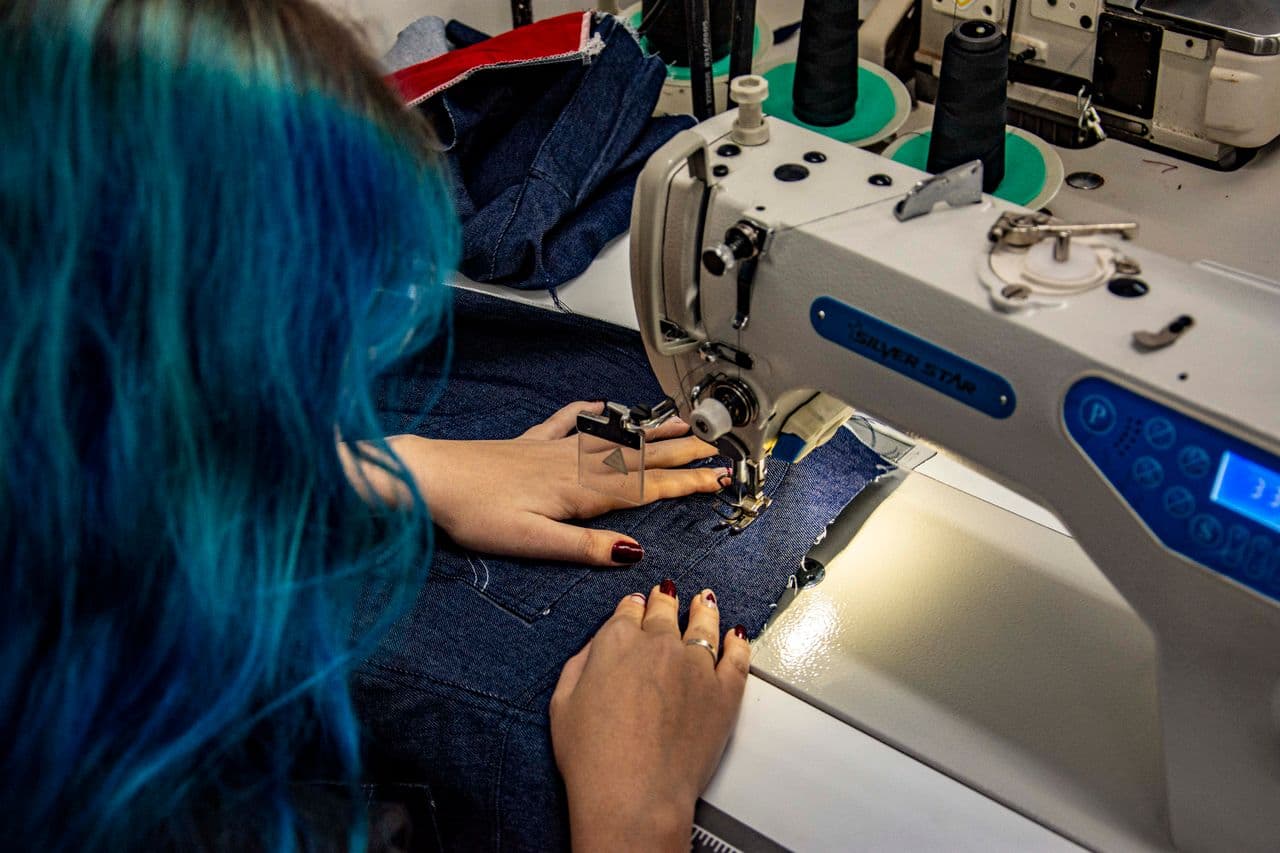
Turn waste denim into circular design skills for students
 SKD Türkiye
总结
A denim retailer opens its design and production floor to students, turning waste denim into real collections through training, mentoring and manufacturing.
Context
Submitted through the COP31 Sustainable Transformation Awards · SKD Türkiye (WBCSD Global Network Partner)
The company is an apparel retailer built around denim, with more than 2,000 employees and its own design and production capability in Türkiye.
Design faculties teach concept and technique, but a student can graduate without ever seeing how a denim collection is actually made. Fabric selection, washing technique, accessory choice and sewing constraints are settled in industry rather than in a studio, and a design that cannot be produced never becomes a product.
The second gap is material. Waste denim is handled as an end-of-line problem rather than as a design input, so reuse, resource efficiency and circular design are taught as principles instead of being applied as constraints on a live collection.
Denim Fikrim was launched in 2022 to close both gaps in the same process. It carries no legal obligation and meets no sector standard; it is a voluntary programme funded from the company's annual business plan.
The first edition ran in İstanbul alone, drew approximately 78 applications and selected 16 finalists. The programme was then opened to the whole of Türkiye. The 2026 edition drew approximately 200 applications from 24 provinces and 51 universities, and 10 finalists completed the full development cycle and produced 10 collections. Across the 2022, 2024, 2025 and 2026 editions the programme received approximately 830 applications in total and took 46 young designers through intensive training, mentoring and production.
No edition was held in 2023. After the Kahramanmaraş earthquakes of 6 February 2023 the project's resources were redirected to needs in the earthquake zone.
Location of the initiative: Türkiye; a nationwide programme run from the company's İstanbul headquarters; applications in 2026 came from 24 provinces and 51 universities
Solution
Denim Fikrim is a development programme rather than a design competition. Finalists are trained, mentored, supplied with materials and taken through manufacturing, and the outcome is assessed as a producible collection rather than as a drawing.
The call reaches students through two routes: the design departments of universities and the academics who teach in them. That is what gives the programme reach into cities where the company has no design presence, and it is the reason applications now arrive from 24 provinces.
Sustainability is set as an entry condition rather than as a judging criterion. Waste denim and sustainable materials are one of the starting requirements of the brief, so material choice and reuse shape the design from the first sketch instead of being reviewed at the end.
After pre-selection, finalists enter a development cycle spread over 54 days in total. Three strands run through it: classroom training on sustainable fashion, denim fabric, washing techniques, accessories, material selection and production processes; applied workshops; and a production phase in which each finalist builds a collection alongside the company's design and production teams.
Mentoring is deliberately mixed. Company denim design and production teams cover manufacturability, suppliers contribute technical knowledge on fabric, accessories and production, and Turkish and international fashion, denim and sustainability specialists assess the work for design quality, producibility and sustainability.
The effect is designed to extend past the shortlist. Every applicant has to develop a design against sustainability and reuse criteria in order to enter, so the teaching reaches the whole applicant pool rather than the finalists alone.
The cycle closes in the market. The winning collection is manufactured and sold in a limited number of the company's stores, and the revenue from those sales is donated to SUYADER, a sustainability association, which connects design, production and consumption to a social outcome.
Figure 1: The 2026 programme calendar, from the application period and pre-selection through the training week and competition process to the final jury presentation and results

Figure 2: Applications and finalists by edition: 78 applications and 16 finalists from İstanbul in 2022, then nationwide calls with 250, 300 and 200 applications from 24 to 25 provinces and 10 finalists in each of 2024, 2025 and 2026

Impact
Sustainability Impact
Climate
The programme does not target Scope 1 or Scope 2 emissions from the company's own operations. Its emissions relevance is upstream, in Scope 3, because the material a collection is built from determines whether fabric has to be produced new for it.
Waste denim fabric and sustainable materials are a required input for every collection developed in the programme, so each of the 10 collections produced in the 2026 edition displaces fabric that would otherwise have been bought new, and every applicant has to design against the same reuse requirement in order to enter.
The wider enabling effect is on the designers themselves. Fabric selection, washing technique and material choice are settled in production rather than in a studio, and the 46 young designers taken through training, mentoring and production between 2022 and 2026 carry the reuse constraint into those decisions in their working lives afterwards.
No emission figure is available, because the environmental side of the programme is measured through applications, collections and contact days rather than through material flow.
Nature
The environmental result is produced through design decisions rather than through a waste treatment process. Waste denim fabric and sustainable materials are the required input for every collection developed in the programme, which turns offcuts and surplus fabric from a disposal question into a design resource.
In the 2026 edition, 10 collections were developed on that basis, and reuse, resource efficiency and circular design sit inside the training content and the collection development stage rather than being covered as theory.
Because the entry brief applies the same requirement to every applicant, approximately 200 designs in the 2026 edition alone were worked up against reuse and sustainable material criteria, so the material effect reaches well beyond the collections that are actually manufactured.
Social
The programme is measured on reach, inclusion and the depth of the development experience rather than on the number of garments produced.
Reach widened from a single city to national coverage. The 2022 edition ran in İstanbul only; the 2026 edition drew applications from 24 provinces and 51 universities. Across the 2022, 2024, 2025 and 2026 editions approximately 830 applications were received and 46 young designers completed intensive training, mentoring and production.
Depth is measured in contact time. The 10 finalists of the 2026 edition completed 54 days of training, applied workshops and production, which is a working period rather than a competition weekend.
Equal access is treated as a design requirement of the programme rather than as a courtesy. Between 2024 and 2026 the fabric, accessory and sewing support needed to realise each collection was met in full, and each participant received up to TRY 10,000 of additional material support. Accommodation for finalists travelling from other cities, and transport and meals for all finalists during the programme, were covered by the company, so that the cost of taking part does not decide which students can accept a place.
Five indicators are tracked in each cycle: applications received annually and in total; the number of provinces and universities reached; the number of finalists entering the training and production programme; the length of the training, workshop and production period; and the number of collections developed from waste denim and sustainable materials. The data comes from digital application records, finalist lists, training programmes, workshop and production records, project catalogues and jury documents, and is consolidated into annual project results.
Business Impact
Benefits
The clearest business return is recruitment quality. The company observes candidates over 54 days of design, workshop and production work rather than through an interview, and it sees them solving manufacturing constraints on its own product.
Academic reach follows. A call carried by design departments and academics gives the company a standing relationship with 51 universities across 24 provinces, which is a talent channel that no recruitment campaign reproduces at the same cost.
The design and production teams gain from teaching. Explaining fabric behaviour, washing technique and accessory limits to designers who have never met them forces the teams to restate their own working rules, and the reverse flow of student proposals tests those rules against unfamiliar ideas.
Supplier relationships deepen, because fabric, accessory and production suppliers take part as trainers during the education week rather than only as vendors.
The winning collection is manufactured and sold in a limited number of stores, which tests a student-originated design against real customers in the company's own retail environment before any wider commitment is made.
Internally, the process and results are shared with employees, which is how the sustainability approach spreads from the project team into the wider business.
Costs
The whole cost base sits with the company; participants pay nothing. Between 2024 and 2026 the fabric, accessory and sewing support required for every finalist collection was met in full, with up to TRY 10,000 of additional material support per participant, and accommodation for finalists from other cities together with transport and meals for all finalists was covered. The programme budget itself is not disclosed.
The larger cost is not cash but time. A 54-day cycle absorbs mentoring hours from denim design and production teams, production slots for non-commercial runs, and marketing effort for the call, announcements and organisation of the programme.
Production capacity is the binding constraint on growth. The number of finalists is limited by how many collections the production teams can carry alongside commercial work, which is why applications can scale nationally while the finalist group stays small.
The revenue from the winning collection is donated rather than retained, so the programme is not designed to pay for itself.
Costs are contained where the model allows it: the university call network costs nothing to operate, suppliers contribute technical training in kind, and standard training modules can be reused between editions instead of being rebuilt each year.
Impact Beyond Sustainability And Business
Co-benefits
The programme creates a working relationship between academia, brand, manufacturer, supplier, sector specialist, consumer and civil society along a single value chain, which is harder to build through any of those relationships taken separately.
Students who do not reach the finalist group still develop a design against reuse and sustainable material criteria in order to apply, so the educational effect reaches the full applicant pool of approximately 830 applications across the four editions held so far.
Selling the winning collection and donating the revenue to a sustainability association turns a training output into funding for civil society, and gives customers a route into the programme through a product rather than a message.
For the suppliers involved, teaching students about fabric, accessories and production is also a way of setting expectations for the designers they will work with in a few years.
Potential side-effects
Rapid expansion is the main risk to quality. Training, mentoring and production are labour-intensive, and opening the programme to more universities without adding mentoring and production capacity would dilute exactly what distinguishes it from a design competition. Controlled growth and standardised training modules are the stated response.
Production capacity is a hard ceiling. A collection cannot be developed without machine time, so a widening applicant pool concentrates disappointment unless the finalist group grows with it.
Geographic inclusion has a cost that must be carried permanently. Travel, accommodation and meal support is what allows students from other cities to take part on equal terms, and withdrawing it would quietly return the programme to students living in İstanbul.
Measuring the environmental side through participation rather than through material flow leaves the reuse claim qualitative. Until the volume of waste denim entering the collections is recorded, the circular design result cannot be reported alongside the social result with the same confidence.
Implementation
Typical Business Profile
The model suits consumer-facing companies that both design and manufacture their own product and can therefore put a student design into real production: apparel, footwear, furniture, home textiles and packaging among them.
It presumes three internal capabilities: an in-house design function willing to teach, production capacity able to absorb small non-commercial runs alongside commercial work, and a marketing function able to run a national call through universities.
Maturity requirements are moderate. The programme does not need a carbon accounting system or an external standard; it needs a defined material constraint, a curriculum and a budget line inside the annual business plan.
Delivery engages senior management, the sustainability committee, marketing, denim design, production and procurement, together with university design departments and material suppliers.
Approach
Name the two gaps the programme is meant to close: Separate the skills gap, which is a student's lack of exposure to industrial production decisions, from the material gap, which is waste fabric being treated as disposal rather than as a design input, because each requires a different part of the programme design.
Route the call through universities rather than advertising: Reach students through design departments and academics, since that channel carries the call into provinces where the company has no presence and gives academic staff a role in preparing candidates.
Make sustainability an entry condition, not a judging criterion: Require every applicant to develop the design against waste denim reuse and sustainable material criteria, so that the teaching effect covers the whole applicant pool and the finalists arrive with the constraint already applied.
Pre-select a small group and commit to a fixed development period: Reduce the applicants to a finalist group sized to the available production capacity, and set a defined cycle length, in this case 54 days, so participants and mentors both plan against it.
Teach the industrial content that design education leaves out: Cover denim fabric, washing techniques, accessories, material selection and production processes in classroom sessions, and bring fabric, accessory and production suppliers in as trainers during the education week.
Remove participation costs before they filter the group: Meet fabric, accessory and sewing costs in full, add a defined material allowance per participant, and cover accommodation, transport and meals so that students from other cities take part on the same terms.
Pair every finalist with mentors from inside and outside the company: Assign design and production staff to manufacturability, and bring in Turkish and international fashion, denim and sustainability specialists and jury members to assess the work face to face during the workshop and production stages.
Take the winning collection into the market and give the revenue away: Manufacture it, sell it in a limited number of stores, and donate the proceeds to a sustainability association, which moves a student idea from the training environment into real retail and into a social outcome.
Measure with a fixed indicator set and feed it back into the curriculum: Track applications, provinces and universities reached, finalists, contact days and collections developed from waste denim, using application records, finalist lists, workshop and production records, catalogues and jury documents, and use mentor and jury feedback to rebuild the next edition's training content.
Stakeholders Involved
Project leads: The programme is part of the company's annual business plan and is owned at board level. It runs with the approval and support of the Chair of the Board and under the leadership of the Chair of the Sustainability Committee. The Sustainability Committee meets regularly, develops the company's sustainability approach and reviews the progress and results of the programme, which keeps decisions about scope, budget and continuity at committee level rather than inside a single department.
Company functions: Marketing runs project planning, stakeholder communication, announcements and the organisation of each edition. Denim design and production teams carry the technical load: training, mentoring, material selection, collection development and manufacturing. The two functions work to the same cycle, so the call, the training calendar and the production slots are planned together. Process and results are shared with employees across the company, which is how the approach is absorbed into day-to-day working practice rather than staying with the project team.
Main providers: Fabric, accessory and production suppliers take part directly in the education week, sharing technical knowledge and providing expertise and material support for material selection and production. Their role is instructional as well as commercial, and it is what allows finalists to make manufacturable material decisions rather than theoretical ones.
Other: University design departments and academics carry the call to students and support access for young people in different cities. Turkish and international fashion, denim and sustainability specialists, together with jury members, meet finalists directly and assess their designs for fashion quality, producibility and sustainability, transferring knowledge and experience in the process. SUYADER, a sustainability association, receives the revenue from sales of the winning collection, which brings civil society into the value chain rather than leaving it outside the programme. Feedback is collected through face-to-face assessment during the training and workshop stages, mentor discussions, technical team guidance and jury evaluation, and is used both to improve the designs in progress and to shape the training content of the following edition.
Key Parameters To Consider
The programme has run in four editions, in 2022, 2024, 2025 and 2026, with 2022 as the baseline year for impact measurement. The 2023 edition was not held because resources were directed to the earthquake zone, so the series is deliberately not continuous.
The development cycle is 54 days of training, applied workshops and production for the finalist group, which is the parameter that determines mentoring load and production scheduling.
The structure is modular: call, pre-selection, training, workshop, production, jury and market release can each be adapted, which is what makes the model transferable to other design disciplines and other geographies.
Financing comes from the company's own resources through the annual business plan; the university network, supplier contributions and specialist mentoring are contributed in kind.
Implementation And Operations Tips
Put the sustainability constraint in the entry brief. Applying it at judging produces designs that are decorated with sustainability; applying it at entry produces designs that were built around it, and it teaches the whole applicant pool rather than the shortlist.
Size the finalist group to production capacity, not to demand. The value of the programme is that every finalist collection is actually made, and that promise breaks first when the shortlist grows faster than machine time.
Pay for travel, accommodation and meals from the start. Without that, a national call produces a finalist group from one city, and the geographic reach reported in the application numbers never appears in the room.
Use the university channel rather than advertising. Design departments and academics filter and prepare candidates before the application is even submitted, which raises the quality of the applicant pool at no additional cost.
Give the output a real market destination. Manufacturing and selling the winning collection is what converts the programme from an educational exercise into evidence that a student design can hold its place on a shop floor.