Implement solar thermal to decarbonize industry
 WBCSD
WBCSD总结
Solar thermal for industry serves as replacement for fossil fuel boilers and delivers zero-emissions energy while lowering overall energy costs.
Context
Industry accounts for 25% of total CO2 emissions from energy systems, with process heat making up nearly two-thirds of industrial energy demand. Today, more than 80% of this heat still comes from fossil fuels, making its decarbonization essential for achieving net-zero emissions. Fortunately, various renewable heating solutions, such as heat pumps, solar thermal, and thermal energy storage, are already commercially available
Currently, there are just under 1 GW of solar thermal solutions for industrial processes installed globally. Currently, there are just under 1 GW of solar thermal solutions for industrial processes installed globally. (1) However, the potential of the technology is much greater. Estimates forecast it can supply up to 12% of the global final energy demand (2) and feature it as an important piece in the portfolio of renewable heating solutions needed to reach net-zero GHG emissions. According to the International Energy Agency (IEA), the deployment of solar thermal solutions in industry needs to accelerate rapidly and be up to 20 times faster during 2022-2028 than currently projected to have a chance at limiting global warming to 1.5°C. (3)
Solution
Solar thermal solutions use solar collectors to absorb sunlight and generate heat. They efficiently expose water or another fluid inside the collectors to the sun, heating it up to the desired temperature. The generated heat can then be used for residential and commercial heating, for district heating networks and industrial processes requiring hot water or steam at temperatures up to 400°C.
Figure 1: Types of solar thermal solutions and example industrial processes where they can supply heat

Solar thermal solutions encompass a variety of technologies that can be roughly split into two categories – non-concentrated and concentrated solar thermal solutions.
Non-concentrated solar thermal solutions are mostly suitable for lower temperature uses – such as preheating water – but are more cost and space efficient. They include flat plate collectors, evacuated tube collectors, and compound parabolic concentrator collectors.
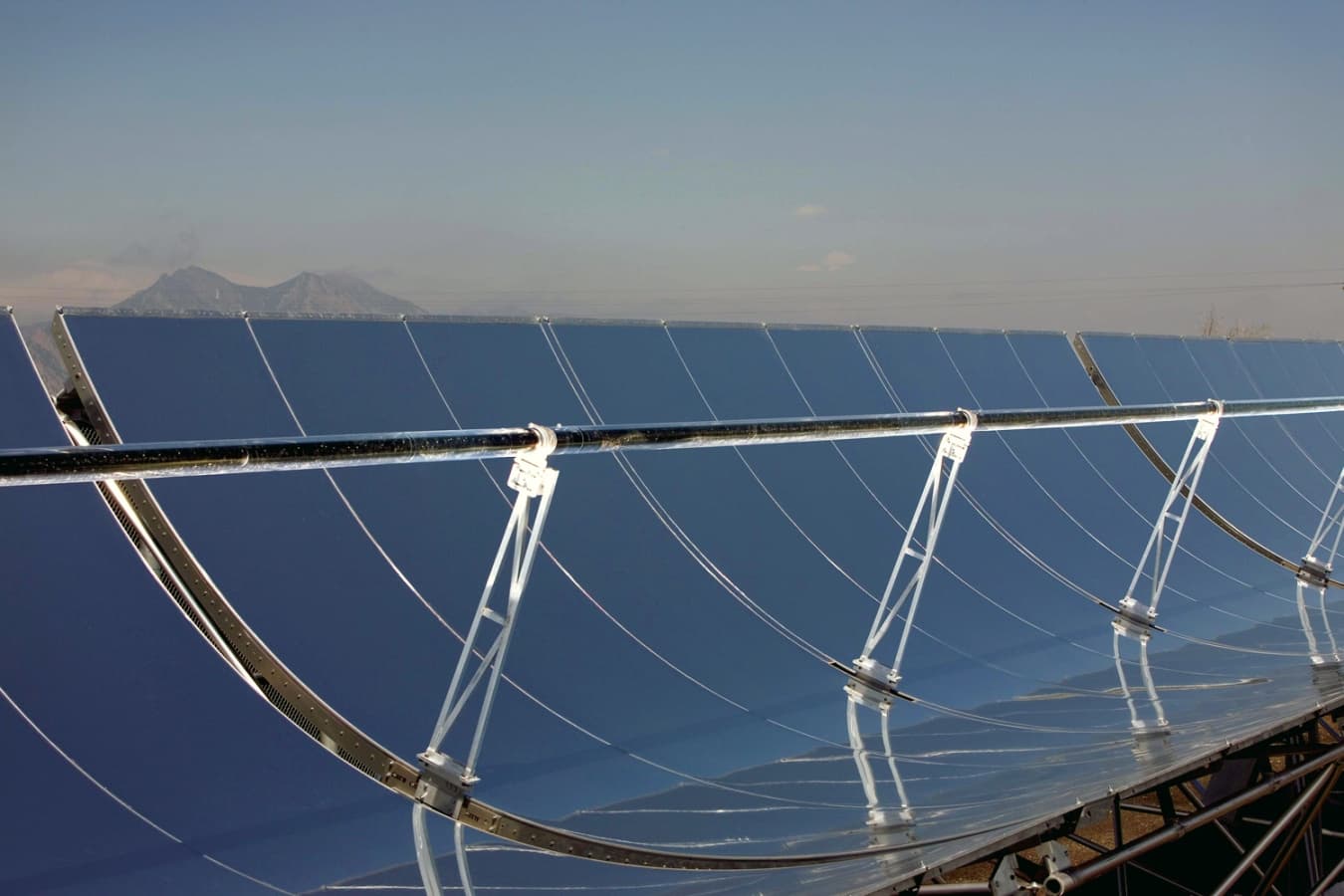
Concentrated solar thermal solutions concentrate direct sunlight into a specific point to generate heat at higher temperatures than their non-concentrated counterparts and can produce high pressure steam. They include parabolic trough and linear Fresnel solutions.
Additionally, solar thermal solutions can be paired with absorption chillers and other technologies to provide cooling to buildings and industrial processes. Finally, there are photovoltaic thermal (PVT) hybrid collectors producing both heat and electricity available on the market.

Usage
Project details | Decisive parameters | Barriers faced | Success factors | Ease of process integration |
Heineken – Engie – Solarlite-Azteq Seville, Spain Food & Beverage 30 MWth + 68 MWh hot water storage tank | - Amount of available space - Subsidy on the investment costs - Solar thermal did not require any changes to the production line and the brewery, unlike electrification. | - The high CAPEX investment cost was the major barrier in getting internal approval for the project. Engie secured a subsidy to make the project commercially attractive. | - Heineken’s strong corporate commitment to reduce GHG emissions and a clear roadmap to achieve net zero by 2025. - Heat-as-a-service agreement with Engie who financed the project and secured a subsidy. | - Integration with one connection point to the existing steam network. |
Verdun, France Food & beverage 12 MWth + 3000 m3 hot water storage tank | - Solar thermal provides long-term price stability and independence from the fluctuations in the energy market, providing clear economic benefits - Emissions savings compared to fossil fuels | - The permitting process including an archeological survey and a pipeline connection under a railway | - Lactalis’s commitment to carbon footprint reduction - The heat-as-a-service agreement enables Newheat to constantly optimize the management of the solution. - Financial assistance from the French government agencies | - The integration equipment needed to be installed already before the beginning of the project during the construction of the drying facilities |
California Dairies Industries – SOLID Turlock, California, US Food & beverage 2.8 MWth + 172.6 m3 hot water storage tank | - The required process temperature (40-80°C) was ideal for flat plate solar thermal. | - The permitting processes in California for the solar thermal and the pipeline connection to the facilities which runs under 6-lane railway | - Identification of the correct integration point for the solar thermal to maximize its efficiency - Close collaboration with California Dairies Industries to minimize interference with existing processes | - Thermal storage integration mitigates the temperature variability of the supplied hot water and enables integration into existing control systems. |
More use cases available in the WBCSD’s Renewable industrial heat navigator brief: Solar thermal solutions.
Impact
Sustainability impact
Climate
Solar thermal solutions generate fully renewable energy without any emissions. They therefore save 200-400kg of CO2-eq per MWh of heat supplied depending on the fossil fuel technology they are displacing.
The lifecycle emissions of solar thermal solutions are only about 9-35 kg CO2-eq per MWh (1) coming primarily from the manufacturing process and steel production.
Nature
Solar thermal solutions have large land footprint (1.6-4.2 m2/kW) which can cause negative side-effect on nature. However, larger ground installations can be combined with other land uses such as animal grazing.
Social
Solar thermal eliminates local air pollution (NOx and other harmful emissions) associated with conventional combustion of fossil fuels.
Business impact
Benefits
Solar thermal solutions come with several inherent advantages which make them attractive for some industrial applications. These are:
They provide fully decarbonized and renewable heat.
They do not use any fuel to generate heat, practically eliminating operational costs and avoiding fossil fuel, electricity, and biomass price fluctuations as well as supply shortages.
Under favorable conditions, they offer short payback periods of 3-5 years.
They do not require costly upgrades to local grid or other infrastructure and can be deployed in fully off-grid remote locations.
They can supply low, medium, or high-pressure steam at temperatures up to 400°C.
Costs
Key commercial parameters | Value Non-concentrated solar thermal | Value Concentrated Solar thermal | Context |
Capital expenditure | 400-1000 €/kW | 600-1200 €/kW | ↑ Inclusion of thermal storage ↑ Acquisition of land for the solar thermal solution ↑ Higher required temperatures ↑ Farther distance between solar thermal solution and heat sink ↑ Need for additional integration equipment ↓ Larger plants benefit from economies of scale as the additional equipment (other than the collectors) has a fixed price. ↓ Efficient project planning |
Operational cost | 0.5-1% of CAPEX annually | 0.5-3% of CAPEX annually | Solar thermal solutions produce energy without any fuel. The operational costs are relatively small and are driven by operation and maintenance including the cleaning needs. They vary based on the environment, e.g. they can be higher in deserts due to the need to clean dust. |
Levelized Cost of Heat | 20-50 €/MWh | 30-70 €/MWh | The exact LCOH depends on local irradiance, operating temperatures, heat requirements, lifetime of the plant, cost of financing, and other factors. You can find example scenarios of LCOH for several European locations in a factsheet prepared by Solar Heat Europe and CEPI. |
Implementation
Typical business profile
The solar thermal technology is best suited for industries using heat below 200°C, such as food and beverage, paper and pulp, fast-moving consumer goods, and pharmaceuticals. Moreover, it reaches highest efficiencies in low latitude regions with high solar radiation and small seasonal differences. Finally, solar thermal does not require almost any local infrastructure. Therefore, it is suitable for off-grid applications such as mining and material processing.
Solar thermal solutions have high upfront capital costs but minimal operational costs and long lifetime. They are therefore ideal for novel financing models such as Heat-as-a-Service which allow companies to avoid the capital expenditure and rather just pay for the supply of heat (such as in the case of the Heineken plant in Seville, Spain).
Approach
Assess Heat Demand and Temperature Requirements
Evaluate site Conditions
Select Suitable Technology
Explore financing Options
Engage stakeholders Early
Conduct Feasibility and Permitting Studies
Design and Engineer the System
Procure and Construct
Commission and Optimize
Monitor and Maintain
Stakeholders involved
Manufacturing plant director: Solar thermal supplies hot water or steam which are instrumental to the manufacturing processes. The implementation project therefore requires strong buy-in from the plant leadership.
Operations: In addition to the plant leadership, company-level operations professionals should bring in specialized expertise and experience from similar projects.
Finance: Solar thermal represents a large capital investment which in most companies requires approval of an investment committee including finance professionals.
Sustainability: Implementation of solar thermal significantly reduces Scope 1 emissions and should be included in long-term emissions reduction plans.
Key parameters to consider
Generally, three main parameters are seen as crucial for assessing the commercial viability of solar thermal solutions:
Required temperature: lower required temperature improves efficiency and lowers capital costs
Project size: larger systems benefit from economies of scale
Location: high solar irradiance increases amount of heat generated and easy availability of land close to the industrial facility reduces the required investment
Ideal locations with high solar irradiance include for example southwest of the United States, northern Africa, southern Europe and Australia. Other viable locations with medium and low irradiance are east coast of the United States, central and northern Europe, and northern China. However, operational projects are spread across the whole world. You can find their locations and specifications in this database published by AEE Intec.
You can find approximate irradiation levels for your location on this map provided by the World Bank Group, Esmap, and Solargis.

Implementation and operations tips
Common implementation success factors reported by companies are:
Availability of land close to the facility
Availability of capital subsidies and/or Heat-as-a-Service financing models
A clear commitment to decarbonization by the industrial company
Going further
External links
Source list
(1) IEA SHC (2024), Solar Heat Worldwide, https://doi.org/10.18777/ieashc-shww-2024-0001
(2) IEA SHC (2024), Technology Position Paper: Solar Heat for Industrial Processes (SHIP), https://www.iea-shc.org/Data/Sites/1/publications/IEA-SHC-Task64-Technology-Position-Paper-SHIP-2024-01.pdf
(3) IEA (2024), Renewables 2023, https://iea.blob.core.windows.net/assets/96d66a8b-d502-476b-ba94-54ffda84cf72/Renewables_2023.pdf
(4) Gabio-Thomas et al. (2023), Environmental impacts of solar thermal power plants used in industrial supply chains, https://doi.org/10.1016/j.tsep.2023.101670; Milousi et al. (2019), Evaluating the Environmental Performance of Solar Energy Systems Through a Combined Life Cycle Assessment and Cost Analysis, https://doi.org/10.3390/su11092539