Fund rooftop solar to decarbonise retail property
 Esas Properties
 SKD Türkiye
Summary
Idle rooftops are converted into solar plants under an energy performance contract, meeting all common area electricity demand from renewables and lowering power costs.
Context
Submitted through the COP31 Sustainable Transformation Awards · SKD Türkiye (WBCSD Global Network Partner)
The company owns and manages shopping centres in the retail property sector and operates the Burda portfolio in Türkiye.
For a shopping centre operator the carbon problem has a single dominant source: 87.6 per cent of the carbon emissions in the company's shopping centre operations comes from electricity consumption. Lighting, cooling, ventilation and vertical transport in common areas run continuously during trading hours, and the emissions follow the grid mix rather than any decision taken inside the building.
The obstacle was not the technology but the capital. On-site generation competes for the same investment budget as leasing, refurbishment and asset acquisition, and a portfolio-wide programme funded from equity would have been rationed to one or two assets.
The company started the initiative in 2021 as part of its transition to low-carbon operations, beyond any legal requirement, and 2021 is treated as the reference point for the transformation. The initiative has since moved past the pilot stage into a scaled and institutionalised clean energy programme across the portfolio.
The carbon reduction target sits on the company target card, which ties it to the corporate objectives of the chief executive and other senior executives. Results are published in the company's sustainability reporting (1) and the sustainability data is verified by an independent third-party assurance provider (2).
Location of the initiative: 01 Burda, 17 Burda, 39 Burda and 41 Burda shopping centres and the Plaza head office building, Türkiye
Solution
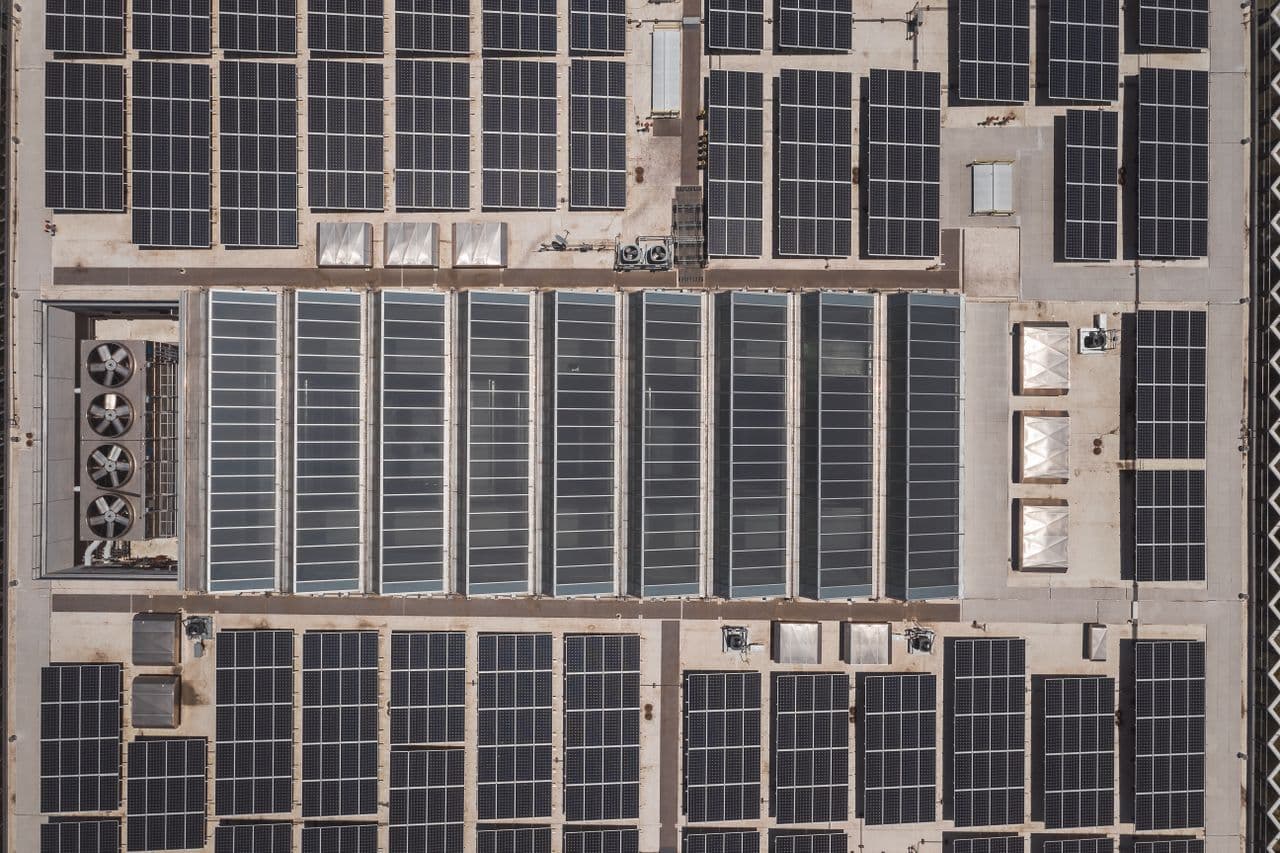
The company converted idle shopping centre rooftops into solar power plants and financed them through an energy services company model, developed with a specialist energy partner. Six solar plants have been delivered, representing a total investment of EUR 5.4 million.
The financing structure is the part that made the scale possible. Under the energy services company arrangement, the high initial investment barrier that normally limits clean energy projects is reduced, so delivery is not constrained by the property owner's own equity. The energy partner carries project design, technical feasibility, the structuring of the model itself, delivery of the solar investments, monitoring of generation performance and operational optimisation; the company defines portfolio energy needs, sets investment priorities, coordinates the sites, tracks consumption data and integrates the output into its emissions reduction targets.
Generation is managed at portfolio level rather than asset by asset. Consumption profiles are analysed across the portfolio, and generation is matched against common area electricity demand, which is the load the owner controls directly rather than tenant consumption.
The physical basis of the model is that the roofs were already there and unproductive, and the assets that carry most of the generation are the same assets that consume the electricity. Four of the six plants sit on shopping centre roofs; the other two are ground-mounted, added to lift installed capacity beyond what the available roof area allows.
Emissions accounting runs in line with the Greenhouse Gas Protocol approach. Net emissions are calculated by deducting the reductions arising from the solar investments and renewable energy use from gross emissions, so the generation and the reported carbon result are linked through one method rather than reported separately.
The programme is still growing: an additional 1.2 MW of capacity is targeted for 2026.
Figure 1: Solar performance across the portfolio, 2024 against 2025: generation, common area consumption, reported renewable coverage, installed capacity and avoided emissions, with cumulative generation above 43 GWh from four rooftop and two ground-mounted plants.

Impact
Sustainability Impact
Climate
The initiative targets Scope 2 emissions from purchased electricity, which are the dominant source in this business: 87.6 per cent of the carbon emissions of the shopping centre operations comes from electricity consumption. Emissions are calculated in line with the Greenhouse Gas Protocol approach, and net emissions are derived by deducting the reductions from the solar investments and renewable energy use from gross emissions. The reference point for the transformation is 2021, the year the initiative started.
Since 2021, six solar plants have been delivered and more than 43 GWh of green energy has been generated, corresponding to approximately 18,619 tCO2e of avoided emissions. The company describes that output as equivalent to one hour of the country's average annual energy consumption, and as comparable to taking 3,600 vehicles off the road for a year or to the annual carbon absorption of 760,000 trees (1).
In 2025, 17 million kWh of renewable generation delivered 7,399 tCO2e of avoided emissions, and net total emissions were 30,177 tCO2e. That performance represents a 3.86 per cent reduction in net emissions compared with 2024. Generation rose from 14,021 MWh in 2024 to 17,087 MWh in 2025 and installed capacity from 12.00 MWp to 13.05 MWp, while common area consumption fell slightly from 16,904 MWh to 16,815 MWh.
In 2025 renewable generation covered 100 per cent of shopping centre common area electricity consumption, and the electricity consumption of the Plaza head office building. The figure is an annual portfolio balance rather than a continuous on-site supply: generation reached 101.6 per cent of common area demand across the year and the coverage is reported capped at 100 per cent. The 100 per cent clean energy target set for common areas for 2030 was therefore reached in 2025, five years early.
Nature
The programme prioritises the use of idle shopping centre rooftops for solar generation, while also increasing total installed capacity through ground-mounted plants. Comprising four rooftop and two ground-mounted solar plants, the approach makes use of existing roof space and helps meet the portfolio's renewable electricity needs.
While rooftop solar brings generation close to the point of consumption, the ground-mounted plants provide capacity beyond the physical constraints of the available roof area. Renewable generation and common area electricity consumption are therefore considered together at portfolio level.
Social
Low-carbon energy use has been extended across shopping centre operations, which supports more sustainable commercial space in the cities where the assets operate.
The model creates a working relationship between the property owner, the energy company, facility management, tenants and users around low-carbon operation, so energy management, emissions reduction and financial efficiency become a shared subject rather than a matter for the owner alone.
Business Impact
Benefits
The initiative produces savings in electricity costs alongside the emissions reduction, which is the evidence that low-carbon transition can generate operational and financial value as well as environmental value.
The financing structure is itself a benefit. By reducing the high initial investment barrier, the energy services company model allowed the investments to proceed without being limited to the owner's own equity, which is what made a six-plant portfolio programme possible rather than a single demonstration asset.
Idle roof area was turned into a productive asset, so most of the capacity was added without reducing lettable space, and the two ground-mounted plants extend generation beyond the limit the roofs set.
The programme produces measurable data for reporting. Generation, consumption and emissions figures feed the annual sustainability report and independent assurance process, and the carbon reduction indicator on the company target card gives senior executives a defined performance measure rather than a general commitment.
For the energy partner, the arrangement produced a scalable delivery model for the commercial property sector, which is why the collaboration is structured as a long-term partnership rather than a series of contracts.
Costs
Total investment across the six solar plants is EUR 5.4 million, delivered under the energy services company model so that the capital requirement is not carried as an upfront call on the property owner's equity.
The principal cost drivers and dependencies are regulatory processes, grid connection permits, the availability of suitable roof or land area, the balance between generation and consumption, financing conditions and the continuity of technical maintenance. These are managed through the specialist energy partner, regular performance monitoring and portfolio-level energy management.
Ongoing operating cost shifts rather than disappearing: purchased electricity falls, while plant maintenance, performance monitoring and the management of the partnership become permanent line items.
The generation and consumption balance sets the limit of the model. Sizing generation against common area load, which the owner controls, rather than against total site consumption is what keeps the output usable.
An additional 1.2 MW of capacity is targeted for 2026, which is a planned rather than a committed cost at the time of reporting.
Impact Beyond Sustainability And Business
Co-benefits
The model reduces exposure to electricity price movements as well as to carbon, because a share of consumption is met from generation the company owns the output of rather than from purchased power.
The model has considerable potential for wider adoption across the sector. AYD's Sectoral Sustainability Roadmap study, completed in 2024, found that approximately 10 per cent of the 88 shopping centres taking part in its second-phase survey had solar installations, while 34 per cent planned to introduce them (3). Calculations based on a limited sample of shopping centres separately indicated that solar generation could cover approximately 46 per cent of common area electricity consumption. These findings show the room available for expansion; they are not a sector-wide renewable coverage rate achieved in 2025.
The arrangement produced a transferable outcome for both sides: emissions reduction and electricity cost savings for the property owner, and a scalable delivery model in the commercial property sector for the energy partner.
Potential side-effects
The model creates a long-term dependency on a single energy partner for design, delivery, performance monitoring and optimisation. That concentration is what makes the arrangement efficient, and it is also the main structural exposure.
Rooftop generation is constrained by the roof. Structural capacity, orientation, shading and the area actually available limit how much can be installed at each asset, so the approach scales with the portfolio rather than with demand.
Permitting and grid connection sit outside the company's control and are the main sources of schedule risk.
Generation that exceeds the load the owner controls delivers less value than generation matched to it, so oversizing a plant relative to common area consumption is a real trade-off rather than a theoretical one.
Meeting 100 per cent of common area consumption from renewables does not address tenant electricity use inside the units, which remains the larger part of site consumption and is not covered by this initiative.
Implementation
Typical Business Profile
The model suits owners and operators of energy-intensive commercial buildings with large roof or land area: shopping centres, offices, mixed-use developments, logistics centres and similar assets where common area electricity is a controllable load carried by the owner.
It is most relevant where electricity dominates the carbon inventory, as it does in shopping centre operations, and where the portfolio is large enough that a repeatable delivery structure is worth building.
It is accessible to owners without spare investment capacity, because the energy services company structure is designed to remove the upfront capital barrier rather than to reduce the cost of equipment.
Delivery engages senior management and the sustainability committee, energy and facility management, finance, site operations teams and the sustainability reporting function, working with a specialist energy partner.
Approach
Locate the emissions before committing capital: Break the carbon inventory down by source to establish how much comes from electricity — 87.6 per cent of shopping centre emissions in this portfolio — so that investment is directed at the dominant source rather than at the most visible one.
Survey idle roof and land area across the portfolio: Assess each asset for structural capacity, available area, orientation, shading and grid connection, and rank the sites by generation potential relative to their own consumption.
Analyse consumption profiles asset by asset: Match expected generation to common area load rather than to total site consumption, because common area electricity is the demand the owner controls and can therefore offset directly.
Remove the capital barrier with an energy services company structure: Set the investment up with a specialist energy partner that carries project design, technical feasibility, the structuring of the financing model and delivery, so that the programme is not limited by the owner's own equity.
Clear the regulatory path early: Plan for licensing, grid connection permits, site suitability and compliance requirements at the outset, since permitting and connection are the main causes of delay and cannot be compressed later.
Build in sequence and manage generation at portfolio level: Deliver plants asset by asset — six between 2021 and 2025 — while managing generation, consumption and the balance between them centrally across the portfolio instead of site by site.
Put the carbon indicator on the company target card: Place the emissions reduction objective on the corporate scorecard so that it is carried by the chief executive and other senior executives, and have a sustainability committee acting under a board resolution track the indicators, coordinate the units involved and manage the data flow into reporting.
Monitor, verify and report on one method: Track generation and consumption data continuously, review plant performance reports, collect operational feedback from site teams, calculate net emissions by deducting the reductions from gross emissions in line with the Greenhouse Gas Protocol approach, and take the result through annual sustainability reporting and independent third-party assurance (2).
Stakeholders Involved
Project leads: The initiative was launched with senior management ownership as part of the company's low-carbon transition strategy, and the carbon reduction target was placed on the company target card so that it is connected to the corporate objectives of the chief executive and other senior executives. Governance runs through a Sustainability Committee established by board resolution and operating under chief executive sponsorship, which tracks targets, monitors performance indicators, coordinates the units involved and manages the data flow into sustainability reporting.
Company functions: Energy and facility management define portfolio energy needs and coordinate the sites; finance handles the investment structure; site operations teams provide the operational feedback that informs performance management; and the sustainability reporting function consolidates generation, consumption and emissions data into the annual report and the assurance process.
Main providers: A specialist energy services company acted as the main solution partner, taking direct responsibility for project design, technical feasibility, structuring the energy services company model, delivering the solar investments, monitoring generation performance and operational optimisation. The relationship is structured as a long-term strategic collaboration built on technical expertise and shared objectives rather than as a procurement arrangement, and the stakeholder view expressed by the partner is that its strongest feature was turning sustainability objectives into concrete and measurable impact rather than leaving them on paper.
Other: Public authorities and local government are involved through licensing and grid connection processes. Tenants and site users are affected through the shift to low-carbon operation of common areas, and suppliers and local communities form the wider stakeholder group around the assets. Independent third-party assurance providers verify the sustainability data before publication.
Key Parameters To Consider
The reference year is 2021 and the reported data runs to 2025, covering six solar plants and a total investment of EUR 5.4 million.
Cumulative generation exceeds 43 GWh, corresponding to approximately 18,619 tCO2e of avoided emissions; the 2025 figures are 17 million kWh generated, 7,399 tCO2e avoided and 30,177 tCO2e of net total emissions.
An additional 1.2 MW of capacity is targeted for 2026, which is a stated objective rather than a delivered result.
Replication depends on technical feasibility, a long-term energy partnership, performance tracking, regulatory compliance and financing being designed together rather than sequentially.
Sector uptake is still low, which is what leaves room for replication: the AYD study found solar installations at about 10 per cent of the shopping centres it surveyed in 2024, with a further 34 per cent planning them (3).
Implementation And Operations Tips
Start from the carbon inventory, not from the roof. Electricity accounted for 87.6 per cent of emissions in this case, which is what justified concentrating the whole programme on one intervention rather than spreading effort across many smaller measures.
Size generation against the load you control. Common area consumption is the owner's own demand; tenant consumption is not, and matching generation to it is what allowed a 100 per cent result to be claimed honestly for that scope.
Treat the financing structure as the design problem. The technology was available throughout; the barrier was upfront capital, and the energy services company model is what removed it.
Put the target on the scorecard early. Carrying the carbon indicator at chief executive and senior executive level is what kept the investment sequence moving over four years rather than stalling after the first plant.
Expect permits, not panels, to set the schedule. Regulatory processes, connection permits and site availability are the risks that repeat at every asset and are best handled by a partner that runs them routinely.