Plant windbreaks to protect soil moisture in dry basins
 Unilever
 SKD Türkiye
Summary
Windbreak lines and a drip-irrigated community garden hold soil moisture in a water-stressed farming basin, cutting wind erosion, evaporation and irrigation demand.
Context
Submitted through the COP31 Sustainable Transformation Awards · SKD Türkiye (WBCSD Global Network Partner)
The company is the Türkiye business of a global consumer goods manufacturer, employing more than 1,000 people across production, supply chain and commercial functions.
The Konya Closed Basin in central Anatolia is one of the most water-stressed farming areas in the country. Annual rainfall of 300 to 350 mm, high drought risk and intensive agricultural water abstraction combine to leave both crop yields and groundwater under continuous pressure.
A field assessment carried out in Burunoba village and its surroundings in 2025, taken as the base year for the initiative, recorded low soil moisture, high wind erosion risk, rising evaporation and heavy dependence on irrigation. Fields were open and unprotected, with no physical barrier between the crops and the prevailing wind.
Water stewardship and climate adaptation sit under nature, which is one of the four priority areas of the company's Growth Action Plan 2030 (1). The group has committed to running water stewardship programmes in 100 water-stressed locations by 2030; by the end of 2025 it had 29 active programmes in 14 countries, and the Türkiye initiative is one of them (2).
No regulation required the work. It was carried out voluntarily and outside the company's own operational boundary, in a shared basin where the direct beneficiaries are farmers and villagers rather than company sites. That choice is deliberate: in a closed basin, the water risk that matters to a manufacturer sourcing agricultural raw materials sits in the fields around it, not behind its own fence line.
Location of the initiative: Burunoba village, Karaman province, Konya Closed Basin, Türkiye
Solution
The intervention applies nature-based solutions inside a working agricultural landscape rather than restoring land taken out of production. It was designed and delivered with the Nature Conservation Centre (Doğa Koruma Merkezi), a Turkish conservation organisation responsible for technical design, field implementation and impact management, while the company provided funding and strategic direction.
The design has two components.
The first is a windbreak system. Lines of trees, predominantly oleaster and acacia, were planted along field boundaries: 20,030 seedlings along 59.18 km of windbreak line, protecting an area of influence of 45 ha. The mechanism is physical rather than administrative. Lower wind speed at crop level means less soil lifted by wind erosion, less evaporation from soil and canopy, and therefore a lower volume of irrigation water needed to grow the same crop on the same field.
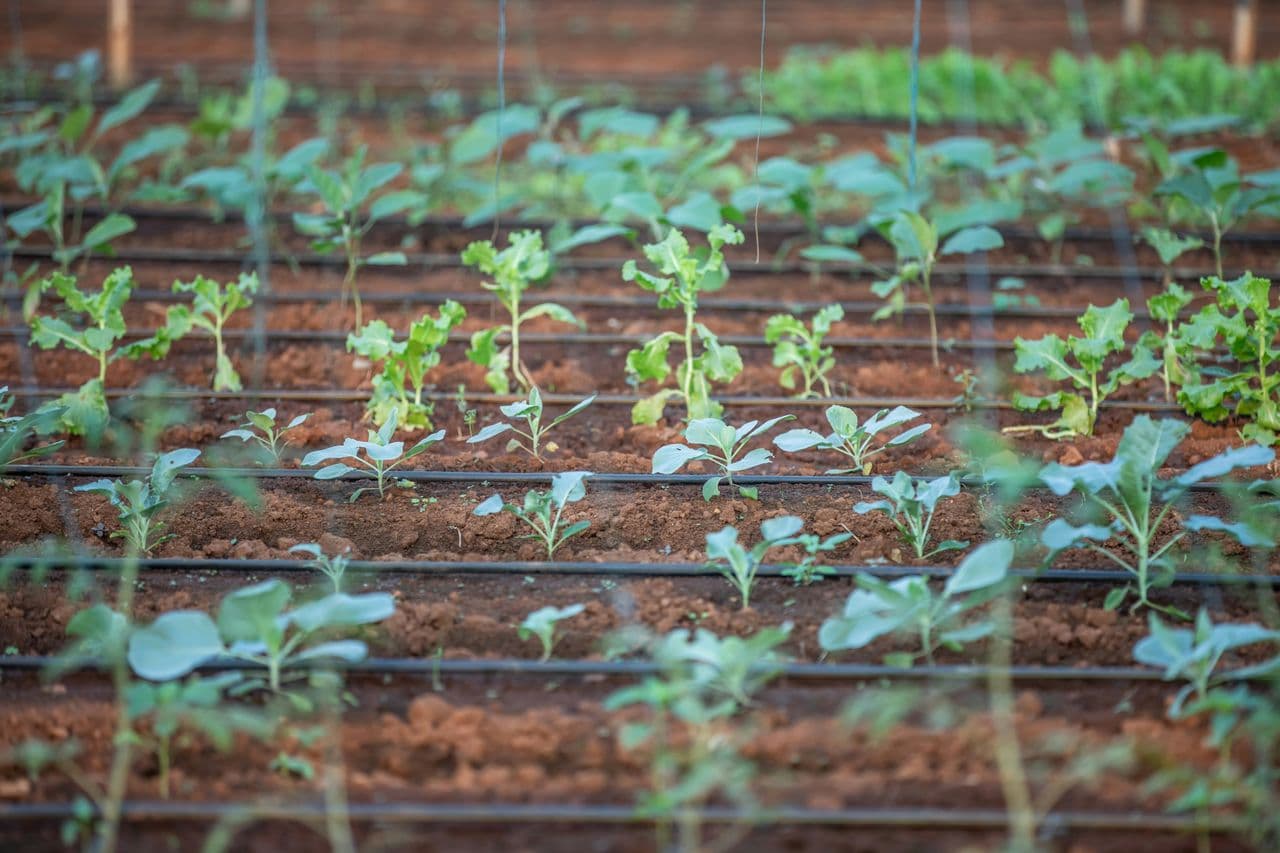
The second is a community garden, planned through interviews with the women of the village and planted with 436 plants of around 32 species under a drip irrigation system. It serves as a working demonstration of water-efficient production at village scale and adds a managed pocket of plant diversity to a landscape otherwise dominated by a small number of field crops.
Species selection carries much of the design logic. Oleaster and acacia tolerate drought and establish with limited maintenance water, which matters in a basin where every additional cubic metre of irrigation competes with existing agricultural demand.
Training and joint field work form part of the intervention rather than an addition to it. Fruit tree pruning training and shared planting work transfer the practical knowledge needed to keep the plantings alive once the delivery partner steps back.
The programme is run in line with the Alliance for Water Stewardship (AWS) Standard, as with the other projects in the group's global water programme, so that outputs are recorded in a comparable, transparent and verifiable structure and feed into corporate sustainability reporting. By 2026 both components were operating, giving the village permanent physical infrastructure to reduce wind speed, hold soil moisture and lower irrigation need.
Figure 1: Burunoba village, Karaman: windbreak lines planted along field boundaries (left) and the location of the drip-irrigated community garden (right)

Figure 2: The community garden site before planting (left) and after establishment, with drip irrigation, young trees and a shaded meeting point (right)

Impact
Sustainability Impact
Climate
The initiative is a climate adaptation measure rather than an emissions abatement measure, and no emissions reduction is claimed for it. It does not target Scope 1 or Scope 2 emissions from the company's own sites, and it is not accounted as a Scope 3 reduction. Depending on survival, the estimated net aboveground carbon sequestration by 2030 is approximately 746-1,066 tonnes of CO2, corresponding to a survival range of 70-100%.
The climate value sits in resilience. In a basin receiving only 300 to 350 mm of rainfall a year, with rising evaporation and high drought risk, windbreaks reduce wind speed over the protected fields, conserve soil moisture and reduce the irrigation volume needed per hectare. That lowers the exposure of local agricultural production, and of the supply chains that depend on it, to the drought conditions the region is projected to face more often.
Monitoring is designed around that logic: change in soil moisture across the area of influence and the reduction in irrigation requirement are tracked as primary indicators rather than tonnes of carbon.
Nature
The windbreak network protects 45 ha of farmland from wind erosion, which is the mechanism by which topsoil and its organic content are lost in open, dry landscapes. Retaining that soil retains the water-holding capacity that goes with it.
The community garden contributes 436 plants of around 32 species, adding structural and species diversity in an area dominated by monoculture field crops. Together with the tree lines, this creates ecological corridors that link otherwise isolated patches of vegetation.
Drip irrigation in the garden demonstrates water-efficient production directly to the farmers who will decide whether to adopt it, which extends the nature benefit beyond the planted area itself.
Social
Local ownership was built into the design rather than sought afterwards. The community garden was planned through interviews with the women of the village, and the planting was carried out on 11 November, National Afforestation Day, by company employees and villagers working together.
Training sessions, including fruit tree pruning, transfer technical skills that farmers can apply to their own holdings, and a continuous feedback mechanism of site interviews, training events and village meetings shapes the work according to local needs rather than an external plan.
Requests from neighbouring villages to receive the same intervention are the clearest available evidence of social acceptance, and they also give the delivery partner a pipeline of sites where the model can be repeated with community consent already in place.
Business Impact
Benefits
The business case is a supply chain resilience case rather than a cost saving case. Agricultural raw materials come from basins under water stress, so reducing evaporation losses and irrigation dependence in a shared basin protects the productive capacity the company sources from.
The work delivers the Türkiye component of a global commitment to run water stewardship programmes in 100 water-stressed locations by 2030, which converts a corporate target into a verifiable field result rather than a statement of intent.
Collaboration with a conservation organisation gives the company technical capability it does not hold internally, and gives the partner a scalable, measurable model that can be offered elsewhere.
Social licence in the sourcing region improves. Requests from neighbouring villages indicate acceptance of the approach, which lowers the negotiation cost of any future intervention in the same basin.
Costs
Costs comprise financial and technical investment in field implementation, seedling supply, irrigation infrastructure and training, funded by the company while the conservation partner carries technical delivery.
The initial investment is identified as one of the main barriers to wider adoption, alongside the continuing need for seedling maintenance, reliable access to water for establishment and long-term local ownership after the delivery phase ends. Those risks are managed actively through local stakeholder participation, training and maintenance and monitoring plans rather than treated as accepted losses.
Continuity is secured by tying the work to the company's 2030 targets and to a multi-year partnership, so the maintenance obligation is funded beyond the planting year.
The capital cost of the windbreak and the annual maintenance budget are not disclosed.
Impact Beyond Sustainability And Business
Co-benefits
Knowledge transfer is the most transferable co-benefit. Training and joint field work leave behind practical skills in pruning, maintenance and water-efficient irrigation that farmers apply on their own land, independently of the planted area.
The participation of village women in planning the community garden creates a route into the initiative for a group often outside agricultural decision-making, and gives the garden a maintenance constituency.
The tree lines and the mixed-species garden function as ecological corridors, supporting species that a purely afforestation-style planting of a single species would not.
Demand from neighbouring villages turns one site into a potential cluster, which is what allows a village-scale intervention to build towards basin-scale effect.
Potential side-effects
Establishment irrigation is a genuine trade-off. Newly planted seedlings need water in a basin where water is the constraint, so the net water benefit only becomes positive once the trees are established and evaporation savings exceed establishment demand. Species selection towards drought-tolerant oleaster and acacia limits, but does not remove, that effect.
Survival is not guaranteed by planting. The number of seedlings planted is a weaker indicator than the survival rate, which is why both are tracked; a windbreak with poor survival delivers a fraction of the intended wind speed reduction.
Benefits build over time rather than appearing at handover, and the maintenance obligation runs for years after the planting event. Without a funded maintenance and monitoring plan and genuine local ownership, the physical infrastructure degrades and the measured benefit falls away.
Implementation
Typical Business Profile
The model suits manufacturers that source agricultural raw materials from water-stressed basins and need to act on water risk that sits outside their own operational boundary, where site-level efficiency measures cannot reach it.
It is most relevant for companies with a corporate water stewardship target, a sustainability function able to work with an external conservation partner, and a supply chain function that can identify which basins matter commercially.
Delivery engages sustainability, supply chain and corporate affairs functions on the company side and requires a technical conservation partner able to carry species selection, field implementation and impact monitoring. Geographically it applies to semi-arid regions with wind erosion and evaporation pressure on irrigated agriculture.
Approach
Select the site on water-stress evidence: Screen candidate basins for rainfall deficit, drought risk and irrigation dependence, and choose a location in a shared basin rather than inside the company's own boundary, so that the intervention reaches the water users who account for most of the demand.
Record a field baseline before any planting: Assess soil moisture, wind erosion risk, evaporation and irrigation dependence in the target village and fix that assessment as the base year against which later change is measured.
Appoint a technical conservation partner and split the roles clearly: Contract a conservation organisation to take responsibility for technical design, species selection, field delivery and impact management, and keep the company's role to funding, strategic direction and integration with corporate targets.
Clear land access and permits with public bodies first: Work with public institutions and local administrations to define the application areas and complete permit processes before seedling procurement starts, and involve academic partners for technical validation and knowledge sharing.
Design the windbreak to the existing field pattern: Lay the lines along field boundaries so that farming operations are not disrupted, size the network to the area to be protected, and select drought-tolerant species such as oleaster and acacia that establish with limited maintenance water.
Co-design the community component with the people who will maintain it: Hold interviews with the women of the village to establish what would actually be used and maintained, then build a drip-irrigated garden with a mixed species list rather than a single-species planting.
Anchor the planting in a public community event: Carry out the planting on National Afforestation Day with employees and villagers working together, so that ownership is established at the moment of delivery rather than negotiated afterwards.
Monitor survival and behaviour, not planted numbers alone: Track seedling survival rate, soil moisture change, irrigation reduction and species count through site observation, scheduled maintenance, farmer feedback and periodic impact assessment, run the work against the AWS Standard, and report the results inside corporate sustainability reporting.
Stakeholders Involved
Project leads: The initiative is sponsored at corporate level as the Türkiye component of the group's global water stewardship commitment, with nature positioned as one of the four priority areas of the Growth Action Plan 2030. Strategic direction and funding sit with the company; technical implementation and site management sit with the conservation partner, and the two work to a shared multi-year plan rather than a single project cycle.
Company functions: Sustainability, supply chain and corporate affairs teams take an active role. Sustainability owns the water stewardship target and the AWS Standard framework, supply chain connects the intervention to the sourcing basins that carry commercial water risk, and corporate affairs manages the relationship with public institutions and local administrations. Employees also participate directly in the planting day, which links the corporate target to the field.
Main providers: Seedling suppliers and drip irrigation equipment suppliers provide the physical inputs. Their role is procurement-led and specified by the conservation partner's technical design rather than by the supplier, so species selection and layout remain with the technical partner.
Other: The Nature Conservation Centre (Doğa Koruma Merkezi) is the technical partner and carries field delivery and impact management. Public institutions and local administrations define the application areas and run permit processes. Academic stakeholders contribute knowledge sharing and technical validation. Farmers and villagers, including the women who planned the community garden, participate directly in implementation, maintenance and monitoring, and provide the feedback that shapes subsequent work. The programme is run within the Alliance for Water Stewardship (AWS) Standard framework.
Key Parameters To Consider
Five indicators carry the programme: windbreak length in km and area of influence in ha; number of seedlings planted and their survival rate; change in soil moisture across the area of influence; reduction in irrigation requirement in cubic metres or per cent; and a biodiversity indicator based on species count.
The model is designed for semi-arid climates and is scale-flexible. A field-level windbreak can be implemented by a single smallholder, while the same approach can be planned at basin scale and integrated across large farming areas, which is what allows a village pilot to become a regional programme.
The principal constraints are seedling maintenance, access to water for establishment, long-term local ownership and the initial investment cost. Permit processes with public institutions and local administrations sit on the critical path and should be started early.
Results are tracked within the AWS Standard framework and integrated into corporate sustainability reporting, which keeps the outputs transparent and verifiable rather than dependent on project-level self-assessment.
Implementation And Operations Tips
Design with the community before designing the planting. The garden layout followed interviews with the women of the village, and that sequence is what produced a component the village maintains rather than one it tolerates.
Measure survival rate alongside the number of seedlings planted. Planted numbers are easy to report and tell little about whether the windbreak will function.
Use a community event as the delivery mechanism. Planting on National Afforestation Day with employees and villagers turned a contractor task into a shared one at no additional capital cost.
Treat requests from neighbouring villages as the adoption signal. They indicate the model has been accepted in the field and identify where replication can start with consent already in place.
Integrate the intervention with agricultural training rather than presenting it as conservation. Farmers adopt windbreaks and drip irrigation because they protect yield and reduce pumping, and the environmental result follows from that.