Turn heritage sponsorship into measurable social value
 Saya Holding
 SKD Türkiye
Summary
Multi-year support for an archaeological excavation combines physical conservation, academic research, visitor access and a measured carbon baseline for the site.
Context
Submitted through the COP31 Sustainable Transformation Awards · SKD Türkiye (WBCSD Global Network Partner)
The company is a diversified holding group employing between 51 and 250 people.
Klaros, in the Menderes district of İzmir, functioned as an oracle site from the late 13th century BCE to the 4th century CE and is considered one of the oldest prophecy sites of the ancient world. Excavations were begun there by the Ministry of Culture and Tourism in 2001.
Corporate involvement in archaeology is usually episodic. A season is sponsored, a communication opportunity is taken, and the support ends before the results appear — which does not match the timescale on which excavation, conservation and scientific publication actually work.
The company joined as main supporter in 2025 and structured its involvement to run past a single season. Support in 2025 was TRY 2,500,000; for 2026 it was increased by 60 per cent to TRY 4,000,000, taking total corporate support to TRY 6,500,000. The commitment is managed as a long-term social investment integrated with the company's corporate responsibility and sustainability approach rather than as a seasonal sponsorship (1).
The excavation obtained presidential-decree excavation status at the beginning of 2026, which strengthened both the scientific standing of the work and the basis on which it can be sustained.
Location of the initiative: Klaros ancient site, Ahmetbeyli, Menderes district, İzmir, Türkiye
Solution
The approach treats an archaeological site as an asset with cultural, scientific, social and environmental performance that can each be funded and measured, rather than as a recipient of donations.
Multi-year financing is the first component. A committed and rising annual budget allows the excavation team to plan across seasons, and the increase from 2025 to 2026 was made explicit so that continuity is visible to the academic and public partners who depend on it.
Physical conservation is the second. A protective canopy was built over the Apollo, Artemis and Leto cult statues. The canopy shields the large marble statues from rain, sunlight, temperature variation, wind and other environmental agents that cause physical and chemical deterioration, and it does so in a way that allows the works to remain displayed where they were found, so visitors experience the heritage in its own setting rather than in a museum elsewhere.
Environmental performance is the third, and is unusual for a heritage site. Energy consumption at the excavation house was converted into a measured carbon figure for the 2025 base year, and a solar system is planned for the excavation house to displace grid electricity, with the reduction to be measured against that baseline using the same method.
Scientific production is the fourth. Support covers the continuity of excavation work and the academic output around it, including doctoral research within a university institute of social sciences and a survey carried out in the 2025 excavation season among residents of Ahmetbeyli and domestic visitors to the site, aimed at measuring perceptions, attitudes and behaviour towards the archaeological area and building a scientific basis for sustainable site management.
Education is the fifth. A scholarship fund mechanism is designed to route income into support for higher education students, while academic teams, university students and recent graduates are brought into the excavation work itself, so the site operates as an applied learning environment.
The components are held together by a measurement framework designed to cover visitors, budget, academic output, scholarship income and energy and carbon, which is what converts sponsorship into a reportable social investment.
Figure 1: The protective canopy over the Apollo, Artemis and Leto cult statues at Klaros, which keeps the marble works on display where they were found while shielding them from rain, sunlight, temperature variation and wind

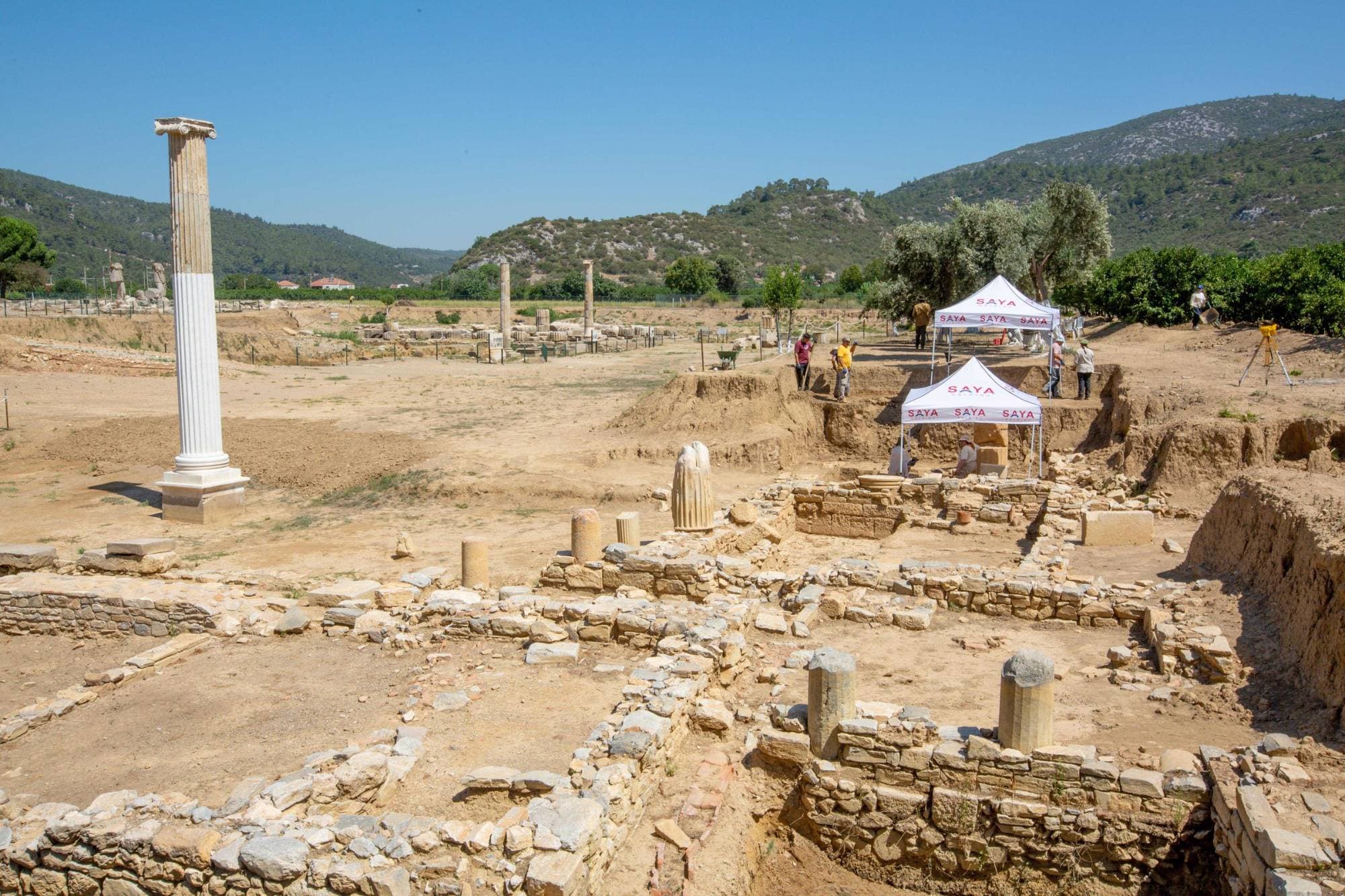
Figure 2: The Klaros excavation site, with the excavation team's field tents among the exposed structures and a re-erected column

Impact
Sustainability Impact
Climate
The initiative targets Scope 2 emissions — the purchased electricity consumed at the excavation house, which is the energy-using facility associated with the site.
For the 2025 base year, carbon emissions from the excavation house's energy consumption were calculated at 9.385 tCO2e. The calculation was made from electricity consumption data using carbon accounting principles consistent with the GHG Protocol approach.
This figure is a reference value rather than a result. It exists so that the reduction delivered by the solar system planned for commissioning in 2026 can be measured rather than estimated. After commissioning, renewable generation, the reduction in grid electricity consumption and the avoided carbon emissions are to be monitored annually using the same methodology, and reported on a comparative basis from 2026 onwards.
The wider value is that a measured energy and carbon baseline is uncommon at heritage sites. Establishing one at an excavation house makes low-carbon site management a tracked objective rather than an aspiration, and the same method transfers to excavation sites, museums and cultural sites more generally.
Social
The site received 19,392 visitors in 2025, the base year against which access, visibility and sustainable tourism effects will be tracked. As comparative background, qualified visitor numbers — the medium-interest visitor group — were 11,126 in 2021, 14,926 in 2022, 16,462 in 2023 and 19,649 in 2024.
Conservation of the Apollo, Artemis and Leto cult statues under the protective canopy keeps the works accessible in place, so cultural heritage is experienced where it was created rather than being removed from its context to be protected.
The academic contribution is direct. Doctoral research is being carried out within a university institute of social sciences by a specialist archaeologist and museologist under the supervision of a professor of archaeology. In the 2025 excavation season a survey was conducted among residents of Ahmetbeyli and domestic visitors, to measure perception, attitude and behaviour towards the archaeological area and to create a scientific basis for sustainable site management.
Access to higher education is addressed through a scholarship fund mechanism intended to convert site-related income into student support, and through the involvement of academic teams, university students and recent graduates in excavation work, which gives the site a role as an applied learning environment for archaeology and museology.
Local ownership is the other social outcome. The community of Ahmetbeyli plays a central part in the protection of the site and in strengthening cultural memory around it, and civil society organisations contribute to awareness and dissemination work.
Performance is currently tracked across three areas: annual changes in visitor numbers against the 2025 baseline; the annual budget and cumulative corporate support; and academic studies, field reports, survey work and scientific outputs.
Looking ahead, plans include establishing and growing a scholarship fund to support students, as well as installing a solar energy system at the excavation house. Following its commissioning, energy consumption, carbon emissions and avoided emissions will also be monitored.
Business Impact
Benefits
The commitment builds durable relationships across an unusually wide stakeholder set — a national ministry, a university and its excavation team, local authorities, a rural community and civil society organisations — around a subject with genuine public interest rather than a promotional platform.
Because support runs across seasons rather than events, the company is associated with results that can be pointed to: a completed conservation structure, a measured carbon baseline, published academic work and a rising visitor series.
Internally, the initiative gave the sustainability committee and the corporate social responsibility working group a live case in which social and environmental performance are measured together, and the measurement framework built for it — visitors, budget, academic output, scholarship income, energy and carbon — is reusable for other cultural assets the company supports.
The presidential-decree excavation status obtained at the beginning of 2026 raises the institutional standing of the work the company supports, which strengthens the credibility of the association and the basis for engaging further partners.
Costs
The direct cost is the sponsorship budget: TRY 2,500,000 in 2025 and TRY 4,000,000 in 2026, TRY 6,500,000 in total, with the annual commitment expected to continue.
Beyond the budget line, the company funded the protective canopy project for the cult statues and supports events, communication activity, visibility work and stakeholder relations, and the planned solar system at the excavation house is a further capital item.
These are recurring rather than one-off costs. An excavation is a multi-decade scientific undertaking, so a supporter that commits to continuity is committing to an annual budget line rather than to a project with a completion date.
Delivery is also constrained by factors outside the company's control: excavation seasons depend on weather and on permits issued under national heritage legislation, and academic outputs appear on research timescales rather than reporting timescales.
Costs are contained by concentrating on a single site rather than dispersing support, by integrating oversight into existing governance — the board, the sustainability committee and the corporate social responsibility working group — instead of creating a separate structure, and by designing the scholarship fund so that site-related income contributes to the education component.
Impact Beyond Sustainability And Business
Co-benefits
Sustainable tourism effects reach the surrounding area. Rising visitor numbers support local economic activity in Ahmetbeyli and its district, and improved visibility and accessibility work by local authorities compounds this.
The academic community gains research capacity: the excavation supports applied learning and scientific production for academics, students and researchers, and the perception survey creates a body of social science evidence about how an archaeological area is understood by the people who live beside it.
The energy and carbon work has a demonstration value beyond the site. Cultural heritage locations rarely measure their own emissions, and a worked example at an excavation house lowers the barrier for museums and other cultural sites to do the same.
Potential side-effects
Visitor growth is the tension in the model. The same access that funds and justifies conservation increases physical pressure on the site and on the surrounding settlement, so visitor management has to develop at the same rate as visitor numbers, and the perception survey is one of the instruments through which that pressure is being tracked.
The protective canopy is itself an intervention in the setting. Keeping the statues in place is preferable to removing them, but a permanent structure changes the visual context of the site, which is a conservation trade-off rather than a costless gain.
Dependence on a single corporate supporter is a continuity risk. The multi-year commitment reduces it, but excavation planning that assumes a rising budget is exposed if that budget is withdrawn, which is an argument for widening the supporter base as the model matures.
The carbon figure also has to be read for what it is: it covers energy consumption at the excavation house, not visitor travel to the site, which is likely to be the larger emissions source associated with rising visitor numbers and is not currently within the measured boundary.
Implementation
Typical Business Profile
The model suits companies that already make cultural or community investments and want them measured rather than merely reported — holdings, construction and real estate groups, consumer businesses and financial institutions with a regional presence near a heritage asset.
It is most relevant where the company can commit funding across several years, because excavation, conservation and academic publication all run on multi-year cycles, and where there is an existing sustainability governance structure capable of tracking social and environmental indicators for an asset the company does not own.
Delivery engages the board and senior management as sponsors, a sustainability committee and corporate responsibility working group as the governance layer, and the sustainability and corporate communications functions for operational coordination with the academic and public partners.
Approach
Choose an asset with an established scientific structure: Support a site that already has an authorised excavation team and a public heritage authority behind it, so that funding reinforces an existing scientific process instead of having to create one.
Commit across seasons and make the increase explicit: Move from event sponsorship to a multi-year budget line — TRY 2,500,000 in 2025 raised by 60 per cent to TRY 4,000,000 in 2026, TRY 6,500,000 in total — so the excavation team can plan beyond the current season.
Fix the physical conservation priority first: Identify the assets most exposed to deterioration and protect them; here a canopy over the Apollo, Artemis and Leto cult statues shields the marble from rain, sunlight, temperature variation and wind while allowing the works to stay on display where they were found.
Establish an energy and carbon baseline for the site: Calculate emissions from the excavation house's electricity consumption using carbon accounting principles consistent with the GHG Protocol approach, and publish the base year figure — 9.385 tCO2e for 2025 — before any reduction is claimed.
Plan the renewable replacement against the baseline: A solar energy system is planned for the excavation house. Once operational, annual monitoring will track energy generation, reductions in grid electricity consumption and avoided emissions using a consistent methodology.
Fund scientific production alongside conservation: Support doctoral research, field reports and survey work, including the 2025 season survey of Ahmetbeyli residents and domestic visitors on perception, attitude and behaviour towards the archaeological area.
Build a route from the site into education: A scholarship fund mechanism is planned to channel site-related income into student support. Academic teams, university students and recent graduates will also be encouraged to participate in excavation activities, strengthening the site’s role as an applied learning environment.
Track a fixed indicator set and report annually: Monitor visitor statistics against the 2025 base year, project budget records, excavation and field reports, academic outputs and survey data, scholarship fund income, communications coverage, and energy consumption and carbon results, and report them on a comparative basis from 2026.
Stakeholders Involved
Project leads: The board and senior management sponsor the initiative directly and treat it as a strategic social investment rather than a communications budget item. Governance is integrated with the company's existing structures: the board, the sustainability committee and the corporate social responsibility working group set direction and review performance, which keeps the commitment inside corporate decision-making rather than in a separate philanthropic track. Medium and long-term continuity rests on the annual sponsorship budget, the institutional and scientific footing provided by presidential-decree excavation status, and the human resource capacity created by involving academic teams, university students and recent graduates in the excavation.
Company functions: Operational follow-up is coordinated by the sustainability and corporate communications teams, which maintain the regular flow of information with the academic excavation team, university partners, public institutions and local stakeholders, and which collect the visitor, budget, academic, scholarship and energy data that the indicator set requires.
Main providers: Contractors and suppliers delivered the technical infrastructure, including the protective canopy structure over the cult statues, and support communications activity and visitor experience applications at the site.
Other: The Ministry of Culture and Tourism began the excavation in 2001 and provides the legal permits and heritage policy framework within which the work is carried out. Ege University, through its institute of social sciences, the excavation team, academics, researchers and students, is the main scientific implementer, responsible for excavation, field application and academic output; the doctoral research is supervised by a professor of archaeology and carried out by a specialist archaeologist and museologist. Local authorities contribute to visibility, accessibility, visitor experience and sustainable tourism. The community of Ahmetbeyli is central to local ownership and to strengthening cultural memory around the site, and was one of the populations surveyed in the 2025 season. Civil society organisations contribute to awareness and dissemination. Stakeholder feedback is assessed through reports, academic outputs, visitor data, surveys and sustainability tracking.
Key Parameters To Consider
The model rests on three components: long-term corporate financing, university-public-private collaboration, and a measurable impact approach. All three are needed; funding without the collaboration produces a donation, and collaboration without measurement produces a report that cannot be compared year on year.
2025 is the base year for every indicator, including the carbon figure, and comparative reporting runs annually from 2026. Setting a base year before the interventions land is what makes subsequent claims verifiable.
The visitor series has to be read carefully, because two different counts exist: total visitors to the site in 2025 and the qualified, medium-interest visitor series for 2021 to 2024. They answer different questions and should not be merged into a single trend line.
Presidential-decree excavation status, obtained at the beginning of 2026, is a structural parameter rather than a milestone: it changes the institutional basis on which the excavation is planned and financed.
The framework is transferable to other archaeological sites, museums, cultural assets and conservation projects, and the energy and carbon component in particular can be integrated into energy management and renewable energy work at any cultural site.
Implementation And Operations Tips
Set the carbon baseline before the renewable installation, not after. A site that installs a solar system first has no defensible way to state what it avoided.
Separate the visitor counts you report. Total visitors and qualified visitors measure different things, and combining them produces a growth claim the underlying data does not support.
Protect in situ where conservation allows it. Keeping the cult statues on site under a canopy preserves the relationship between the works and their setting, which is the reason people visit, and avoids the more familiar outcome in which the site is emptied of what made it significant.
Fund the social science alongside the archaeology. The survey of residents and visitors produces the evidence needed for visitor management decisions later; without it, site management responds to pressure rather than anticipating it.
Use existing governance. Routing oversight through the board, the sustainability committee and the corporate responsibility working group meant the initiative inherited established review and reporting routines instead of needing new ones.
Agree the indicator set with the academic partner at the outset. Excavation teams report on scientific cycles, and aligning what is collected — and when — avoids a mismatch between research timescales and corporate reporting timescales.